GRAND ILLUSION? “Briefcase” Firm Base 7 Behind Sh5.5Trn Nyakisharara Airport Exposed as Project Raises Red Flags
A storm is brewing over the ambitious Nyakisharara International Airport project—and at the center of it is a haunting question that refuses to go away: can a “briefcase company” really build a $1.5 billion airport?
What was recently announced as a game-changing infrastructure project to transform Uganda into a global aviation hub is now facing intense scrutiny, political resistance, and a trail of troubling revelations that read more like an investigative thriller than a development success story.
Leading the charge is western Uganda Mps led by Kashari South MP Nathan Itungo Twesigye, whose constituency hosts the proposed site. And he is not mincing his words.
“When you check, this company that you’re giving contract to work on Nyakisharara airport… the information we have and is available is… the company is just related to Base 7 International. The operations of the company are said to be in Nyakishara but when you go there, nothing on the ground,” he warned.
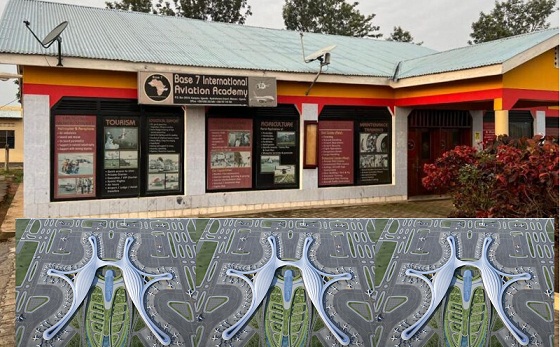
The company in question—Base Seven Company, also known as Base 7 Aviation International Academy—is at the heart of a mega project valued at $1.5 billion, set to rise on a 21 square kilometre site in Nyakisharara, Mbarara.
On paper, it sounds like a dream.
Two massive runways, each stretching 5.5 kilometres, a 3.7-kilometre VIP runway, hotels, logistics zones, and a grand vision to connect Latin America and China through Uganda—cutting travel time from 42 hours to just 20.
President Yoweri Kaguta Museveni has already thrown his weight behind the project, directing Prime Minister Robinah Nabbanja to coordinate land acquisition, relocation, and compensation for affected communities.
But behind the glossy vision, cracks are beginning to show.
And MP Itungo says the country could be walking into a trap.
“They [Base 7] say [their offices] are in Nyakisharara near Mbarara City, yet Nyakisharara is in Mbarara City. They even don’t know the exact area. They say one of the directors / company secretary is a lay canon. How many lay canons are here? Just a lay canon but no name,” he questioned.
He went further, raising alarm over the company’s registration timeline.
“If you check, the registration is 2024…and they want to build an airport here? It’s a briefcase company and I will not allow this company.”
This is not the first time Base 7 has appeared on Uganda’s aviation radar.
Reports indicate the company surfaced six years ago, promising to establish an aviation school at the same site—working with questionable partners from Kampala and South Africa.
That project never took off.
A directive from State House reportedly even pushed the Uganda Civil Aviation Authority to certify them as an Approved Training Organisation (ATO). They got the certification—but still reportedly demanded $10 million from government to start operations.
The question then, as now, was simple: if government could not adequately support the state-owned Soroti Flying School, why bankroll a private entity?
The deal collapsed.
Now, the same players are back—with a far bigger proposal.
And that has many asking—what changed?
The scale of the Nyakisharara project is staggering, even by global standards, aviation experts say.
Runways longer than any currently in existence. A “global hub” in a relatively remote area. A plan to divert half of the world’s air traffic through Uganda.
To some, it sounds visionary.
To others, it sounds wildly unrealistic.
Aviation experts are already raising serious doubts.
Airport success is not determined by location alone. It depends on passenger demand, cargo volumes, airline economics, connectivity, and supporting infrastructure.
“An airport alone rarely creates an inflow of passengers,” analysts warn.
Yet Nyakisharara is being pitched as a global transit hub—without clear evidence of the demand needed to sustain it.
Even more concerning is the financial structure behind the project.
The airport is expected to be developed under a Build-Operate-Transfer (BOT) model, where private investors finance, build, and operate the facility before handing it over to government.
On the surface, it sounds like a win-win.
But experts caution that BOT deals can become dangerous liabilities.
If projected revenues fail to materialise, governments often end up providing guarantees, subsidies, or bailouts—leaving taxpayers to shoulder the burden.
And then comes the money trail.
At a meeting in September 2025, Base 7 introduced its partners, including China’s Hunan Construction Investment Engineering Company and the China Southwest Architectural Design and Research Institute.
These are established firms.
But the financier—Blackrock Uwekeza Ltd—reportedly raises eyebrows.
Records show the company has filed dormant accounts since its incorporation in May 2022, with no evidence of active business operations.
Yet its representative, Bethuel Macharia, boldly pledged to finance the entire airport.
That alone has triggered alarm bells.
Even more explosive are findings from Uganda’s Financial Intelligence Authority.
Sources indicate that in February 2025, a €40 million deposit from Union Bank of Switzerland was flagged as suspicious. The sender—Black Rock Uwakeza Limited—was reportedly unverifiable.
When pressed to explain the source and purpose of the funds, the recipients allegedly failed to provide satisfactory answers.
The money trail reportedly led to a web of renamed entities, including “Base Seven” and “Black Rock,” raising fears of possible financial manipulation.
Though these claims remain under scrutiny, they have added fuel to an already raging fire.
Meanwhile, on the ground in Nyakisharara, uncertainty reigns.
The project will require relocation of the Mbarara–Ibanda road and displacement of communities across a vast area—possibly up to 30 square kilometres under a broader master plan.
Land acquisition disputes, experts warn, could delay the project and drive up costs if not handled transparently.
These same observers warn that the country risks repeating past mistakes if caution is not exercised. There are growing fears that the firm could push government to compensate affected landowners, take over the land, and then—through well-connected networks—subdivide and sell it off to private individuals, a scheme critics say has happened before. Some even allege that current investors linked to UTL are plotting a similar move.
This has happened before. Talk of the infamous Naguru–Nakawa land saga, where 53 acres were handed to OpecPrime Properties to develop a satellite city, only for the land to be parceled out to private developers and individuals instead—sparking parliamentary investigations and protracted legal battles. OpecPrime, which had initially acquired the land at a nominal cost, later demanded over Shs170 billion in compensation after government repossessed parts of it.
Environmental concerns are also looming large.
The site includes settlements, agricultural land, and sensitive ecosystems—making a comprehensive Environmental Impact Assessment not just necessary, but critical.
And yet, as of March 2026, there is still no officially announced cost estimate from government.
All this comes at a time when Uganda is already investing heavily in other aviation projects.
The expansion of Entebbe International Airport is ongoing.
Kabalega International Airport in Hoima is nearing completion.
Against this backdrop, critics are asking: can the country afford another mega airport?
Or worse—can it afford to gamble on the wrong partner?
Even the project’s core idea is being challenged.
According to watchers, building a refuelling hub for flights between China and Latin America may not deliver meaningful economic benefits, especially if passengers never leave the plane.
They also say the proposed high-altitude site—at 1,517 metres above sea level—could actually increase operational costs, requiring longer runways and more fuel for aircraft.
Aviation observers argue that if Nyakisharara is to have an airport, it should ideally be limited to handling domestic flights as a hub rather than an oversized international facility.
Still, the project has powerful backing.
President Museveni has expressed confidence in its potential, seeing it as a bold step toward positioning Uganda on the global aviation map.
Even him has reportedly called for due diligence.
And that is where the pressure is now building.
MP Itungo’s warning is gaining traction.
“This is near my home… we need to carry out due diligence before it’s too late,” he insists.
Because if his fears are true—if Base 7 is indeed a “briefcase company”—then Uganda could be staring at one of the biggest infrastructure gambles in its history.
A $1.5 billion dream.
Built on uncertain ground.
And as investigations deepen, one question continues to echo louder than ever:
Is Nyakisharara Airport Uganda’s next big breakthrough—or its next big scandal?
GOT A HOT STORY? EMAIL: redpeppertips@gmail.
SOURCE PROTECTION/CONFIDENTIALITY IS OUR NO.1 PRIORITY.
About Post Author