A PEASANT’S OPINION: Underground Train Tunnel Cycling Kampala Metropolitan
I was horrified to the core watching government destroy people’s homes and livelihoods in the name of protecting wetlands. Things that people had painstakingly worked for all their lives were destroyed in minutes without being given alternative accommodation. I thought government had to first create an alternative before demolishing people’s homes. I was personally affected because some of my friends, relatives and one of my maama w’abaana owned homes in those so-called wetlands. Meaning I’ll never be able to visit them in that neck of the woods ever again. How sad! Worryingly, many of those people had sold their land in the villages; now they are going to come back and inconvenience us.
Necessity is the mother of all inventions: Our capital city is overpopulated, one of the reasons many people encroached on wetlands where NEMA is now hell-bent on evicting them. Though the banene are exempt.
Understandably, more and more people are still flocking to the main city for greener pastures. Sadly, most of those people are moving there because of poor government planning. For example, MPs or civil servants from Mbarara or Arua municipalities have to move their families of five or ten people to the capital for better services like education, when those family members can remain in their respective villages and contribute to the local economy. We’ve got to stop that.
Traffic jams
Time is the most precious resource of all. A minute wasted can never be recovered ever again. Meaning we have to use it wisely, accountably and productively. Since we are in the money economy, every second counts; therefore, it is important and wise to calculate how much money you earn per second, minute, hour, day, week, month and year. That can be done by breaking your salary into those windows. Until you do that, you cannot value your time and yourself.
On the side of government, it should tell us how much tax it loses to this problem in that time too. Otherwise, every day, a lot of productive time is wasted loitering around and in phantom traffic nightmares. From our President to our kings, we have all fallen victim to that bottleneck. That has got to stop!
Besides time, a lot of useful fuel is burned and wasted in traffic jams. Many accidents also happen. With our oil about to start flowing, lives are going to transform, automatically amplifying the aforementioned challenges. Because as more and more citizens prosper financially, they will need to travel in all directions for all kinds of reasons, meaning our current roads will be overwhelmed. So we need to plan wisely for generations ahead.
Late last year, on my way from Kigambanankwale to Masaka via Kampala, I lost over an hour between Wakiso and the New Taxi Park, then lost another 16 hours and even spent the night in a traffic jam along the Kampala–Masaka Road. The vehicles were so stuck that even ambulances had no alternatives.
In my village, an hour equals UGX 1,000 doing kagoma work for someone. I wonder how much an hour in a city like Mbale, Arua, Mbarara or Kampala costs. Needless to say, every passenger in the taxis I used cursed our shortsighted government officials.
Throughout the long, cold night, strangers suggested solutions to the traffic-jam problem. Over the years, I have heard a million suggestions and several solutions have been thrown at it, but the problem does not seem to go away. Government, on our behalf, even took a big loan from Japan and built a road in the air, but still the problem is growing.
Alarmingly, various studies show that more than half of the world’s population lives in cities. Kampala, the smallest district in Uganda, alone has more residents than several districts put together. Yet more and more people are still flocking there. Keep in mind that when it was first designed, the planners of the day did not anticipate all the population growth and development we have undergone. That means it is the most challenged district in the country.
Cities and urban areas are the engines of global economies. Look after them well and they give you the best returns; neglect them and they create all kinds of troubles. Right now, lots of businesses and people in the Kampala Metropolitan jurisdiction are losing money to traffic jams. Sadly, traffic jams in that jurisdiction affect the whole country in one way or another.
Can you imagine it takes two hours for a taxi to travel the 70 kilometres from Mityana to Kampala, yet the same taxi takes three hours to cover a longer journey of 200 kilometres from Hoima to Kampala because the first 70 kilometres from Kampala have less traffic than the road to Mityana? I will not even talk about the katogo between Bwaise and Luwero, as well as Jinja Road.
That, to me, clearly shows that it does not matter which district you live in; events in Kampala concern you, and for that reason alone, you have to be part of the solution. The rapid population growth expected in the next 20 years and beyond challenges patriotic citizens to plan for the future today.
With all due respect, as a nation, we have done little to prepare our transportation industry for the future, yet the future is now. It is our opportunity, responsibility and duty to leave a positive mark on our economy and national infrastructure blueprint.
We all agree that creating sustainable and manageable human spaces is a big challenge for every government. Right now, the cost of living is rising faster than income, meaning very soon millions of Kampala Metropolitan dwellers will not be able to afford food and accommodation unless alternatives are created quickly.
If government does not act, desperate citizens will continue destroying vital wetlands as well as engaging in crimes like the kind we are seeing today.
As citizens, it is your social responsibility to help government create those alternatives because it is our collective responsibility to enable fellow countrymen to live well. In my peasant opinion, we urgently need an affordable and environmentally friendly transport system that carries more people at once for less money; and from my vantage point here in the village of Kigambanankwale, that will be TRAINS.
I heard government is going to renovate the old rail tracks from Busia to Kampala, plus the Tororo–Pakwach line. In my opinion, if our government visionaries looked into the future, the Pakwach line would end at the Sudan border.
This is the era of mobile economies. Like all other animals, we move to where the food is and, to quickly and easily do that, we need a good transport system. Someone hunts for food in Nimule and sleeps in Arua or Koboko.
At this point in time, and for the next 100 years, we need to and can remove the majority of travellers and vehicles from the roads, especially in Kampala and its suburbs. But to achieve that, we urgently have to construct an alternative, and to me that is a ring underground tunnel cycling the Kampala Metropolitan Area.
YES WE CAN & SHOULD!
PHASE ONE
Back in the 1980s, when our current government was still in the bush, there was a programme on UTV called Do It Yourself. In the programme, people were encouraged to physically make things for themselves—things like carpentry, artwork and building. Following that line of thinking, we must do things for ourselves too.
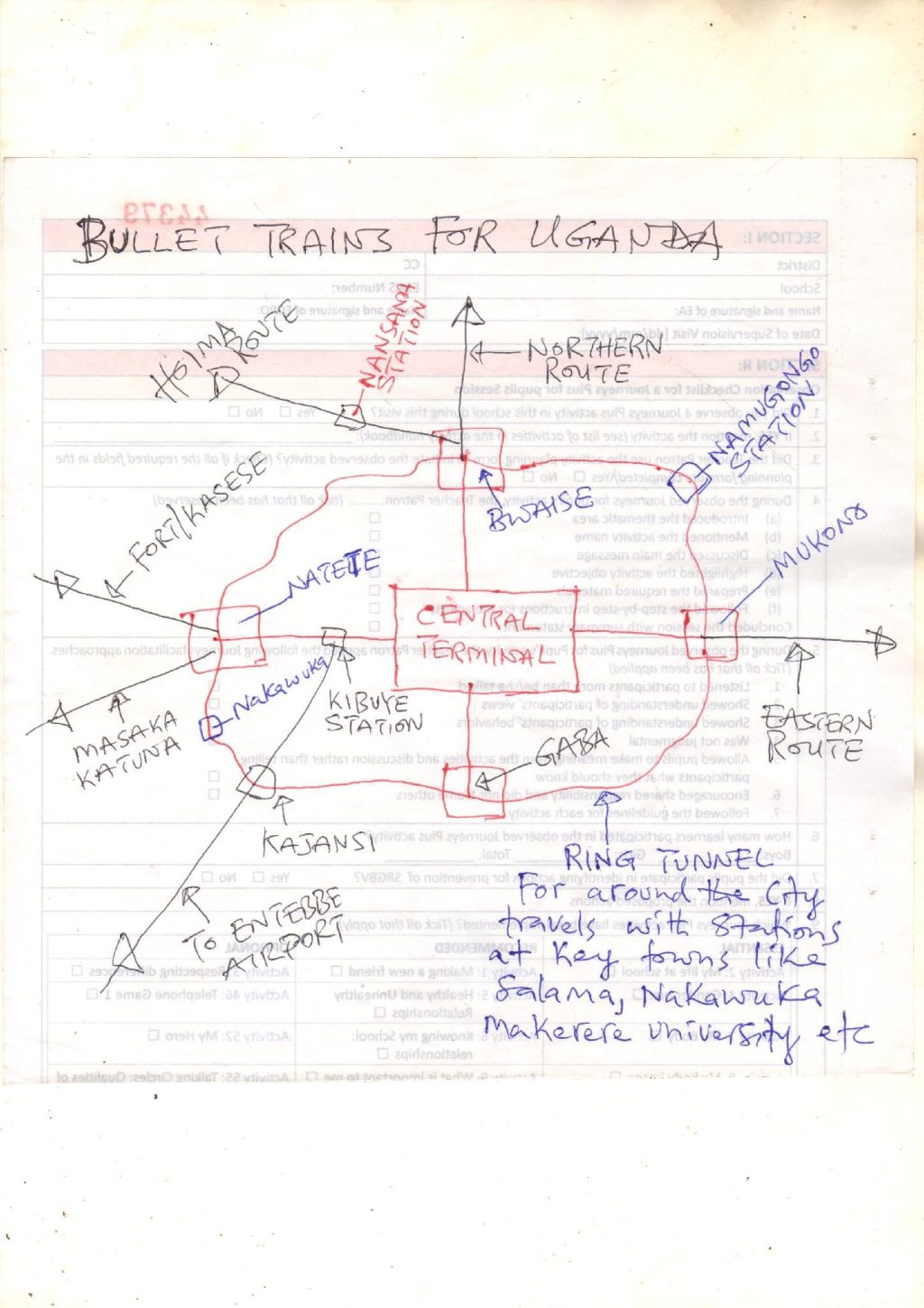
The Chinese say: If you want to get rich, build roads. But since we are playing catch-up, we have to build super roads. By that, Uganda Railways Corporation, with the blessing of Parliament, will draw a master plan for a well-planned, international-standard underground train network circling the whole Kampala Metropolitan Area, with tentacles stretching to Jinja, Masaka, Busunju and Luwero, as illustrated on the map above. Because the main objective is to decongest our roads and relieve the metropolitan area of people.
The consortium can model the project on what Hong Kong did through MTR Corporation. By that, URC will tell the public how much money is necessary for the construction, then give the public websites and bank accounts through which to deposit money that shall automatically transform into shares. More like we do when applying for passports. With the money directly deposited into bank accounts, no single penny will be lost at that stage.
Once URC gets the ball rolling, government and patriotic influencers like Full Figure, Frank Gashumba, Pr. Bugingo, Bobi Wine, MPs, Norbert Mao, religious leaders, TikTokers and many others will call, using native languages, on the public to invest and share in the profits. They will educate citizens on the long-term benefits.
Village people like me should be able to deposit through mobile money. NINs of investors will be required, and they will be given investor numbers, more like NSSF and other unit trust funds. That way, investors and shareholders will be able and free to deposit many more times.
Upon every deposit, you will get a text like:
“You’ve deposited X amount, which is Y shares; your total shares are 10,000.”
Suppose a share is UGX 10,000. If 20 million ordinary Ugandans deposit UGX 50,000 each, how much would that be? Mind you, we have oligarchs who can invest upwards of a million shillings. Let us not forget the big companies and corporations in the land, as well as our brothers and sisters in the diaspora and international investors.
It’s possible!
A while back, The New Vision published a story that Ugandans spend UGX 20 billion in betting houses every day, the majority of which is lost to the houses. Other Ugandans have lost billions to cryptocurrency scams. Some are now buying shares in goat schemes that they will later learn are scams.
In my view, that money can be invested for good. After all, the objective of those gamblers is making profits without sweating.
In this case, it will be like keeping a dairy cow or layers. Feed them well and they give you profits. Mind you, when people invest in something, they do not want to see it spoiled. They will keep an eye on their investment, thereby protecting it against corruption, neglect and vandalism so that it makes them more profits.
That means investors will grill management for every penny not accounted for or poorly utilised. They will want every accident fully investigated, and they will want to know why certain wagons are not in use.
What say you?
As for the people whose properties will be demolished to pave the way for the project, they will be compensated with cash, or their properties will be valued and converted into shares.
BENEFITS
First and foremost, it will clean up our environment and the air we breathe, while at the same time raising our patriotism.
Then it will save our nation from the chronic debt trap we are in at the moment. For the first time, a major project will be directly funded by citizens who are the primary beneficiaries.
But above all, it will decongest our roads and capital city.
Yes, we can!
I will let you imagine the jobs this will create.
At the current URC headquarters, we build a central underground terminal that will be designed like an airport, complete with a VIP lounge and other amenities, but with five or more underground platforms. Above it, there would be a mall, hotel and other commercial facilities. That should become the norm at every major station and terminal. Our good and bad history, as well as our culture, should be plastered on the walls of the stations for all to see and learn from. The stations should also be built in a way that recognises and celebrates our various cultures.
The ring tunnel for travel around the Kampala Metropolitan Area will have stations at key locations such as Salama, Namugongo, Makerere University, Kajjansi, Nakawuka and Entebbe Airport.
URC can subcontract four companies to build the northern, Masaka–Katuna, eastern, and Hoima–Kasese routes, which of course will not be underground like the ring tunnel. However, URC would retain full control of the ring tunnel and the central terminal. All the excavated soil from the ring tunnel will be taken to Ggaba and deposited in Lake Victoria, creating land for condominiums, a university and a huge, well-planned public botanical park, more like New York’s Central Park, where citizens would go to relax and work out.
We need to plan our cities in advance to maximise space and resources. By going underground, we give back the streets to the people who need them most. If this is done, we shall create more pedestrian spaces on our streets and, in the process, improve public health and business sales in one go, as well as catapult the nation into a new age of prosperity.
The best part is that once the trains start making profits, you, the shareholders, will receive dividends depending on your investment. Furthermore, you will have the liberty to sell or liquidate your shares at short notice, just like in all unit trust funds. You will also provide a next of kin who benefits in case your Maker decides to take you unexpectedly.
I estimate that in Phase One, approximately two million people will have the liberty to work or travel through Kampala daily, spending money as they go. Hawkers overflowing Kampala will no longer have excuses to cling to the city. People will synchronise their travel plans around trains.
Spouses and other dependants of key breadwinners will be able to farm and carry out other activities back home while the main breadwinners hustle in Kampala and elsewhere, then return safely in the evening without being stuck in traffic jams.
My friend, if we had a train system along Masaka Road, yours truly and thousands of other travellers would not have spent that cold, rainy night stranded on the road.
Organisations like the Police Force can buy cheaper land and build estates in Busunju, Jinja, Buikwe, Kayabwe, Mityana and Luwero to accommodate the families of their staff within walking distance of the train tracks for easy access and deployment.
Property developers will construct condominiums, stadiums, markets, public parks and hospitals at strategic, walkable locations close to these lines to enable accessibility and convenience.
That way, someone from Jinja will easily travel to Gulu or Mbarara, watch their team in action and return conveniently. Space currently occupied by Owino Market, the New Taxi Park and the Old Taxi Park will also be freed up for the construction of malls and skyscrapers.
For convenience and accessibility, at the New Taxi Park we build a station that links to Natete, Nakawa, Wandegeya and Bwaise.
To avoid cash getting lost, passengers will pay electronically through mobile money and other electronic means. That way, no single penny will be lost at that point either.
Functionality, efficiency and punctuality should be key, but above all, the system should be affordable for everyone. In each direction, we shall have three or more lines: freight, bullet and normal trains.
To reduce and avoid accidents, every day, 50 minutes before going on a driving shift, each driver will undergo a quick medical test and shall not drive for more than six hours.
To deter criminals, surveillance cameras will be installed.
All that said, the project will be very expensive, probably costing billions of US dollars, but in the long run it will be economical and a generational investment for whoever helps fund it.
Otherwise, if we do not take drastic measures to relieve the capital, it may choke to death.
PHASE 2 – Building for the Future
Imagine if AFCON came when we had a rail system stretching to all our borders. Our visitors would have the best experience around.
With plans to build super airports in Mbarara and Northern Uganda, the need for fast transportation to and from those airports is a must. Today, we have an airport in Hoima, but it takes a lot of time to reach it. The rail line to Hoima will simplify that.
It is often said that the current train system was built by colonialists to transport raw materials, and that is partly why it failed after they left. Meaning we have to build a system that serves our current and future needs.
After people start seeing the fruits of the first phase, they will pour in more money and we soldier on.
In this phase, we turn the guns on the Masaka–Katuna route via Mbarara, as well as the eastern, northern, Fort Portal–Mpondwe border and Karamoja routes.
That way, someone who lives in Kabale or at the Sudan border will travel 600 kilometres in three to four hours. Also, someone in Nimule will be able to travel to Busia or Katuna using one ticket.
With the Entebbe route ending at the airport, it will be easy for someone travelling from any part of the country to arrive at or depart from the airport.
For someone travelling from Northern Uganda and South Sudan, using the old route through Tororo is time-consuming. Therefore, we must create a shortcut across Karuma that links up with the Luwero station.
CARGO
If you have been observing our public transport industry, you must have noticed how people send cargo in all directions. You may also have observed how much of that cargo never reaches its destination.
That can drastically reduce.
With trains crisscrossing the nation, they will take over cargo transportation.
Each piece of luggage will be labelled with barcodes for digital tracking. That way, someone in Busia, Arua or Kabale will be able to send goods to any part of the country connected by rail and have them received by a business partner.
I know you are worried about the electricity necessary for the trains to run. Me too!
Electricity for that will be included in the package as well.
Yes, it is hard, but possible. All our leaders have to do is sell us the vision.
As citizens, we have got to stop complaining and do the things our leaders seem to fail at. After all, we are the very people using those things.
Together, we can build a Uganda that only mothers wish for their children.
Conclusively, our colonial masters, the English, built the London Underground Metro in 1863, 163 years ago, when the population of that city was about three million people. Their national GDP was $831 million and that of London was $2.881 billion. What is our GDP?
Borrowing Victor Hugo’s comment:
“There is nothing as powerful as an idea whose time has come.”
Many of you have been thinking about the train solution for many, many years but have been too shy to table your thoughts. Now is the time to turn your dream into reality.
We also have a word of courage to nibble on. Alexander the Great used to say:
“When lions are led by sheep, the lions become cowards. But when sheep are led by lions, they fight viciously.”
Make no bones about it—Ugandans are lions.
Now my question is: Are our leaders, at all levels and from all political camps, sheep or lions?
Many readers, as usual, will brush off my submission and, disappointingly, will not propose any solutions.
My prayer is for all visionary and patriotic citizens to amplify my submission so that together we can produce a final solution to the traffic-jam problem. This should be done within this political term.
I also pray that you forward this to all your friends, local politicians, your area MP, the National Planning Authority, Uganda Railways Corporation and State House so that they can build upon it as well.
Fellow Ugandan, I had better sign off or else I shall ramble until the cows come home.
Stay curious and take care.
I remain your patriotic, curious and inquisitive peasant,
Rukidi Rwakasimbi
Kigambanankwale Village
WhatsApp: 0752653030
Email: Atwookirrr@gmail.com
About Post Author