ENERGY WARS! Ministry of Energy–Busitema University Clash Over Multi-Billion 4 Megawatt Solar Plant as Campus Earns ZERO from Power Sales
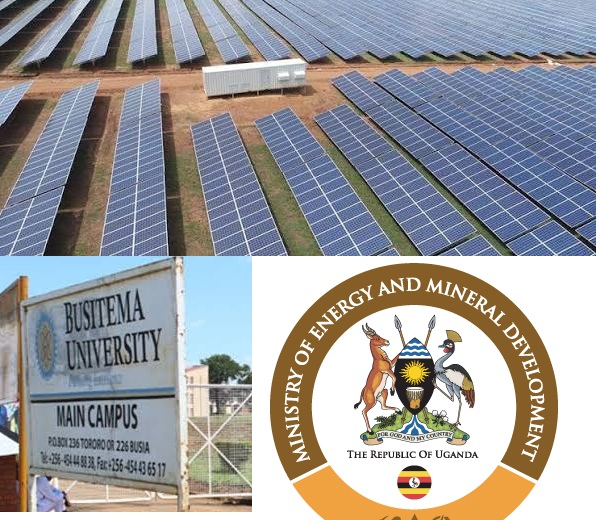
A multi-billion-shilling solar power project hailed as a landmark renewable energy investment has become the centre of an embarrassing accountability row after the Auditor General revealed that Busitema University has not earned a single shilling from electricity sales because of the absence of a clear revenue-sharing agreement and operational framework with the Ministry of Energy and Mineral Development.
The findings, contained in the Auditor General’s report for the financial year ending December 2025, expose governance and planning weaknesses that have denied the university revenue from its flagship 4 Megawatt solar power plant, even though the facility has been feeding electricity into the national grid.
The Auditor General found that owing to the lack of a clear revenue-sharing agreement and operational framework governing the solar project with the Ministry of Energy and Mineral Development, Busitema University has not earned any revenue from electricity sales.
The revelation has thrown the spotlight on one of Uganda’s most celebrated renewable energy projects, commissioned in 2022 under a bilateral agreement between the governments of Uganda and Egypt.
Constructed at a cost of USD 6.5 million through a grant from the Government of Egypt, the 4MW photovoltaic power station was established at Busitema University’s main campus in Busia District to strengthen renewable energy education while contributing electricity to the national grid.
The project was developed under an agreement between Uganda’s Ministry of Energy and Mineral Development and Egypt’s Ministry of Electricity and Renewable Energy. Busitema University was selected as the host institution before an agreement was signed between the university and the Ministry of Energy, with Busitema University Fund (SMC) Limited operating the project on behalf of the university.
Although the project obtained a grid connection licence from the Electricity Regulatory Authority and a Power Purchase Agreement with the Uganda Electricity Transmission Company Limited (UETCL), the Auditor General says the university has not realised revenue because there is no clear framework defining how proceeds from electricity sales should be shared.
The findings raise fresh questions about why a project designed to strengthen renewable energy education and contribute electricity to the national grid has failed to generate financial returns for the university several years after commissioning.
The audit also exposes wider management challenges at the institution.
According to the Auditor General, Busitema University accumulated domestic arrears amounting to UGX2.024 billion. Out of this amount, UGX1.582 billion related to employees and tax arrears, while graduate fellows’ allowances totalled UGX170.7 million.
The report warns that the outstanding obligations expose the university to the risk of litigation by employees.
Procurement management also came under scrutiny.
Auditors established that the university failed to prepare multi-year procurement plans for two procurements worth UGX2.579 billion, contrary to proper planning requirements.
The report further reveals that 40 obsolete assets had already been recommended for disposal but were never included in the procurement and disposal plan for the 2024/2025 financial year, leaving outdated government property sitting idle instead of being formally disposed of.
Planning failures also emerged as a major concern.
The Auditor General found that the university had not finalised the strategic plan aligned to the National Development Plan IV by 1 July 2025, raising concerns over the institution’s long-term planning and alignment with national development priorities.
Despite these governance shortcomings, auditors noted that funds allocated for non-payroll outputs amounting to UGX18.856 billion were fully warranted and utilised. However, implementation remained mixed, with 18 outputs fully implemented while 15 outputs were only partially implemented, suggesting that significant planned activities were not fully achieved.
Ironically, the findings come at a time when Busitema University continues to receive recognition for innovation and research.
The university has distinguished itself nationally through research in sustainable agriculture, HIV self-testing interventions and food security, while the 4MW solar plant has been promoted as a Renewable Energy Centre of Excellence supporting engineering education and contributing power to surrounding communities and the national grid.
However, the Auditor General’s findings suggest that despite the project’s technical success and academic value, unresolved governance arrangements between the Ministry of Energy and Mineral Development and Busitema University have prevented the institution from benefiting financially from electricity sales.
The audit also highlights broader concerns affecting Uganda’s public universities, noting that many institutions lack standardised procedures for disseminating research findings to policymakers, local communities, industry partners and other stakeholders. As a result, many innovations remain underutilised, limiting their visibility, practical application and contribution to national development.
The latest report now piles pressure on the leadership of Busitema University and officials at the Ministry of Energy and Mineral Development to explain why a multi-million-dollar solar investment that has become a symbol of Uganda’s renewable energy ambitions continues to generate electricity for the national grid without generating revenue for the university that hosts it.
GOT A HOT STORY? LET US KNOW!
Got breaking news, explosive secrets, or hard evidence?
Email us: redpeppertips@gmail.com
We accept tips, documents, videos, photos, and recordings—the more evidence you have, the better.
CONFIDENTIALITY IS OUR TOP PRIORITY. SOURCES ARE ALWAYS PROTECTED!
About Post Author