DEVELOPING HUGE SCANDAL! OPM Bosses On Spot for Changing Sh1trn NUSAF 4 Project Design, Setting Aside Sh59bn For Themselves To “Eat”
A storm has erupted around the proposed NUSAF 4 project, with senior officials at the Office of the Prime Minister facing sharp scrutiny over a project design that allocates a staggering Sh59.3 billion to project management with questions arising why too much of the borrowed money is being swallowed by administration instead of reaching poor Ugandans.
The controversy exploded last Friday when a meeting convened to brief Members of Parliament from beneficiary 104 districts on the design and implementation of NUSAF 4 ended prematurely after Prime Minister Robinah Nabbanja rejected key aspects of the proposed design.
The proposed programme, worth about Sh1.02 trillion, is expected to run for five years across 104 districts covering roughly 60 percent of Uganda.
But instead of giving the project a green light, Nabbanja stormed into the meeting after being alerted to concerns raised by MPs and challenged the NUSAF team over what she described as excessive administrative expenditure and a design change that could fail to put enough money directly into productive activities.
At the centre of the controversy is the Sh59.3 billion set aside for project management.
The allocation is part of the proposed project’s four major components and has triggered questions about whether taxpayers are getting value for money from a programme being financed through borrowed funds.
The NUSAF team presented a design in which Sh504.2 billion would go towards sustainability enhancement, Sh89 billion towards transformational delivery systems, Sh370.7 billion towards strengthening safety nets for enhanced resilience and human development, while Sh59.3 billion would be consumed by project management.
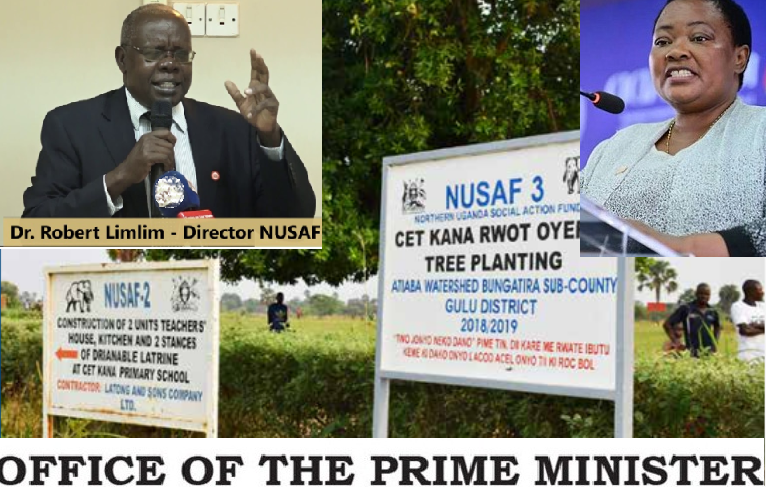
Dr Robert Limlim is the NUSAF project team leader.
The figures have raised eyebrows among MPs who want to know why such a huge amount is required to administer a project whose primary objective is supposed to be lifting vulnerable households out of poverty.
Nabbanja was particularly unhappy with the proposal to target approximately 400,000 households through Labour Intensive Public Works, arguing that NUSAF 4 should put greater emphasis on productive activities capable of generating sustainable household incomes.
The Prime Minister warned officials against designing a programme in which a substantial chunk of the borrowed money could disappear into administration, coordination and other overheads.
She reminded MPs that the money is borrowed and will eventually have to be repaid by Ugandans.
“This money is going to be paid by you, your grandparents, our fathers, our children,” Nabbanja told the meeting, insisting that the funds must be put to their best possible use.
Her intervention effectively halted the meeting and sent the NUSAF team back to the drawing board.
The Prime Minister had initially been represented by Minister in Charge of General Duties Hilary Onek, but made an unexpected appearance after concerns raised by MPs reached her.
She disagreed with the presentation led by Dr Robert Limlim, the NUSAF project team leader, and questioned whether the proposed interventions adequately addressed the needs of beneficiaries.
Several MPs had already expressed dissatisfaction with the presentation, accusing the project team of giving them an inadequate summary without supplying sufficient documentation to allow proper scrutiny.
Dodoth West County MP Baatom Ben Koryang of Karenga District called for the steering team to return to the drawing board, incorporate the Prime Minister’s recommendations and reconvene Parliament with a revised proposal.
He also questioned why MPs had not been given copies of the detailed project design.
Kilak North MP Antony Akol of Amuru District said MPs could not meaningfully recommend reallocations or changes without knowing how the proposed money would be distributed among districts and activities.
He said the presentation had exposed disagreements within the Office of the Prime Minister that needed to be resolved before implementation.
The MPs’ concerns strike at the heart of the Sh1.02 trillion NUSAF 4 plan.
The project is expected to support 200,000 smallholder farmers and micro-enterprises, assist 36,000 youth and women-led enterprises and create an estimated 1.4 million jobs during implementation.
It is also expected to support 400,000 households through climate-smart and disaster-risk-financing Labour Intensive Public Works and improve nutrition among children during the first 1,000 days of life by supporting 20,000 pregnant and lactating mothers.
But lawmakers are demanding to know whether the proposed design will actually deliver these benefits or whether too much money will be consumed before it reaches communities.
Minister Onek proposed a different approach, suggesting that 70 percent of the funds should go directly towards productive activities, 25 percent towards marketing and only five percent towards software and related systems.
That proposal effectively puts the spotlight on the current structure, particularly the amount being allocated to management and systems.
The NUSAF 4 programme is being financed by the World Bank and is expected to operate across nine sub-regions, stretching from Busoga through Bunyoro and the Albertine region to West Nile, Acholi, Karamoja and Teso.
The programme officially commenced on April 20, 2026, but its implementation now faces fresh uncertainty following the Prime Minister’s rejection of the proposed design.
Some MPs warned that delaying approval could have financial consequences because the loan supporting the programme has already been approved and interest could be accruing.
But Nabbanja insisted that urgency could not be used as an excuse to approve a flawed project.
She directed that the government engage the World Bank to ensure the final design reflects Uganda’s priorities.
The controversy also comes against a background of growing scepticism over the impact of previous NUSAF phases.
Uganda launched NUSAF 1 in 2003 with about Sh370.7 billion, equivalent to $100 million at the stated historical project value, in response to the effects of the LRA insurgency in northern Uganda.
NUSAF 2, introduced in 2009, was worth about Sh500.5 billion, based on its $135 million project value, and focused on recovery, rehabilitation, basic-service infrastructure and livelihood support.
In 2016, government launched NUSAF 3, valued at approximately Sh481.9 billion, equivalent to $130 million, with a stronger focus on resilience, disaster-risk financing, productive inclusion, savings groups and livelihood support.
Now, nearly two decades after the first phase, MPs are demanding evidence that the latest trillion-shilling intervention will deliver substantially better results.
The meeting’s dramatic collapse has therefore opened a new battle over the design, priorities and management of NUSAF 4.
At the centre of the storm is the question of the Sh59.3 billion project-management allocation.
While the project team has presented it as part of the overall cost of implementing the programme, MPs want detailed justification for the amount and a clear breakdown of where every shilling will go.
They are also demanding transparency on how the remaining funds will be distributed across the 104 districts and the various interventions.
The accusations over the project design have now put OPM officials under intense scrutiny, although the available details establish a Sh59.3 billion project-management allocation, not that individual officials personally received the money.
The NUSAF team has been ordered back to the drawing board, with MPs making it clear that they will not simply rubber-stamp a Sh1.02 trillion programme without seeing precisely how much will reach ordinary Ugandans.
For Nabbanja, the message was blunt: NUSAF 4 must be designed around production, livelihoods and household incomes — not bureaucracy.
And for Parliament, the bigger question is whether Uganda is about to borrow another trillion shillings to fight poverty, only for billions to disappear into the machinery created to administer the fight.
More details to follow…
GOT A HOT STORY? LET US KNOW!
Got breaking news, explosive secrets, or hard evidence?
Email us: redpeppertips@gmail.com
We accept tips, documents, videos, photos, and recordings—the more evidence you have, the better.
CONFIDENTIALITY IS OUR TOP PRIORITY. SOURCES ARE ALWAYS PROTECTED!
About Post Author