MINERAL LICENCE FRAUD MESS! Energy Ministry Finally Wakes Up, Slams Brakes on New Licences To Clean Up Sector
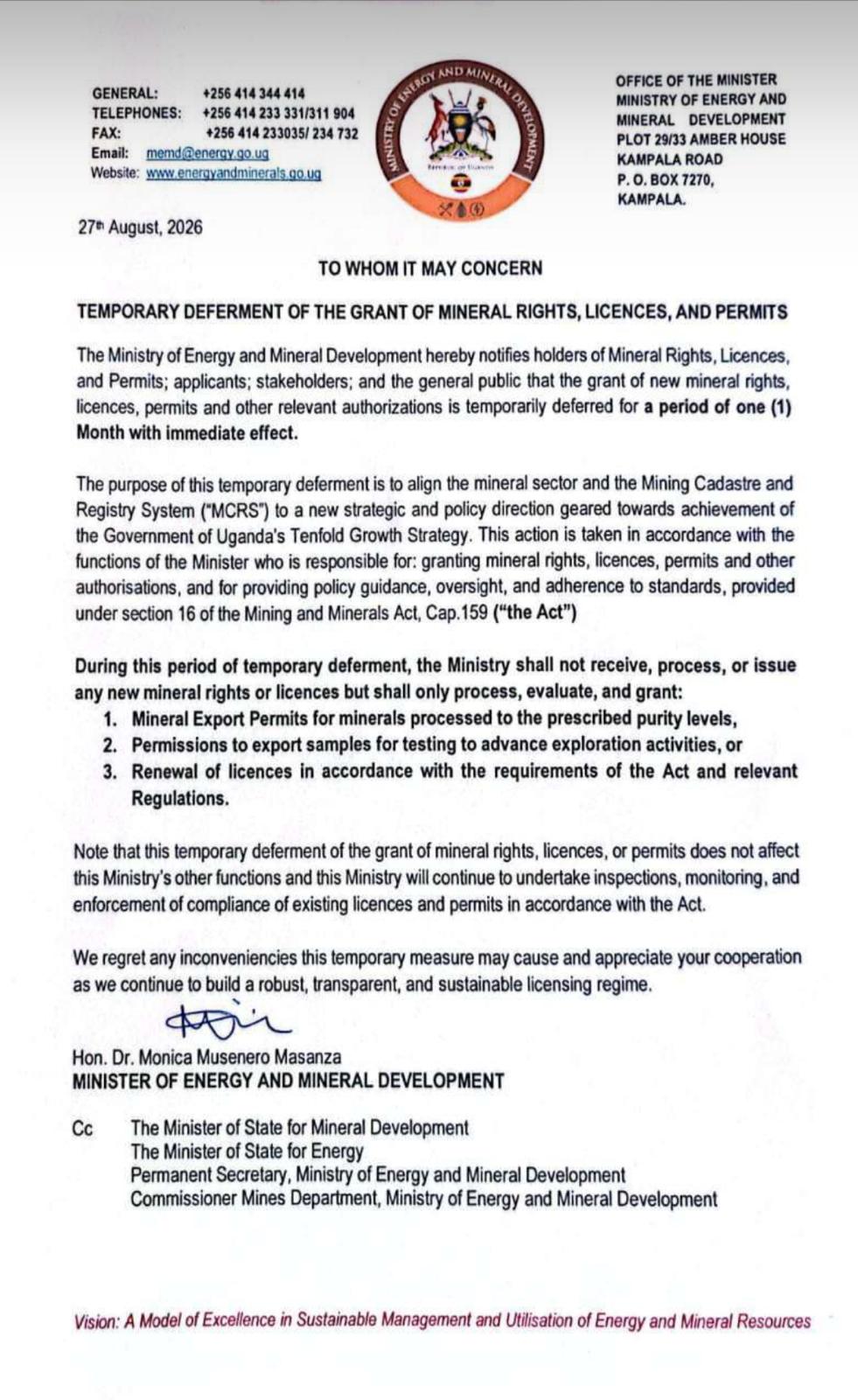
KAMPALA — Government has slammed the brakes on the issuance of new mineral licences and exploration rights for 30 days, in a major regulatory reset aimed at cleaning up Uganda’s mining sector, eliminating speculative claims and stopping abuse of mineral rights.
The immediate moratorium was announced by Energy and Mineral Development Minister Dr Monica Musenero Masanza at the Uganda Media Centre on Friday, August 28, 2026, as Government moves to tighten control over the rapidly expanding minerals industry.
Musenero said the one-month freeze should not be interpreted as Government turning its back on investors but rather as an attempt to ensure that Uganda’s mineral wealth is controlled by credible investors capable of developing resources responsibly and creating value for the country.
“The grant of a mineral right is the first step in participating in the minerals industry,” Musenero said.
“It is therefore important that the licensing framework not only facilitates investment, but also ensures that credible and capable investors are attracted, mineral resources are developed responsibly, and value addition is promoted.”
The suspension comes amid concerns over the rapid expansion of mineral licensing in Uganda and the need to clean up the sector as the country positions minerals as a major driver of economic transformation.
Government wants the review to ensure that mineral rights are not being acquired merely for speculation, while investors who receive licences actually fulfil the work and development obligations attached to them.
The mining sector has been placed at the centre of Uganda’s wider Tenfold Growth Strategy, which seeks to grow the economy to about US$500 billion by 2040.
Minerals, together with agro-industrialisation, tourism and science, technology and innovation, have been identified as priority sectors expected to drive the transformation.
The Fourth National Development Plan (NDP IV) for 2025/26–2029/30 similarly places emphasis on value addition, industrialisation, employment creation and private-sector growth.
The latest licensing freeze follows a dramatic expansion in mineral rights, particularly after the introduction of the digital Mining Cadastre and Registry System, which was intended to improve transparency and administration in the allocation and management of mineral rights.
According to Commissioner of Mines Agnes Alaba, by June 30, 2026, Government had granted a staggering 212 prospecting licences, 497 exploration licences, five large-scale mining licences, 38 medium-scale mining licences and 18 small-scale mining licences, among others.
The portfolio also included three artisanal mining licences, three mineral smelting licences, six mineral refining licences, five mineral processing licences and 205 mineral dealer licences, alongside other permits and authorisations.
The scale of the licensing activity has now prompted Government to pause the issuance of fresh rights and scrutinise what has already been granted.
The Government’s Mining Cadastre Portal allows existing and prospective rights holders to submit applications, renewals, reports and other transactions electronically.
However, the Directorate of Geological Survey and Mines has acknowledged that data cleaning and system migration remain part of the transition to the digital system.
During the 30-day moratorium, the Ministry will review existing mineral rights, investigate contested and overlapping boundaries and establish whether licence holders are complying with their statutory work commitments.
The review will also seek to identify inactive or non-compliant operators and establish whether mineral rights are being used for the purposes for which they were granted.
Permanent Secretary Irene Bateebe raised concerns over possible misuse of exploration rights, warning that some operators could be using exploration licences to undertake activities outside the scope of their authorisations.
“An exploration licence is intended to establish the nature, extent and economic potential of a mineral deposit, not to become a substitute for a production licence,” Bateebe said.
Government’s licensing framework distinguishes between prospecting, exploration, retention and mining rights, with different obligations and requirements attached to each stage.
Companies found inactive or non-compliant could face enforcement action under the law, including possible loss of their mineral rights where statutory conditions have not been fulfilled.
Despite the freeze, Government stressed that legitimate mining operations will continue.
Existing licence holders will still be able to pursue renewals, while geological samples may continue to be exported for laboratory analysis and testing.
Routine inspections, monitoring and compliance operations will also continue throughout the suspension.
Mineral exports will similarly continue under existing regulatory requirements, particularly where products meet the prescribed processing, documentation and export conditions.
Bateebe insisted that the review is not aimed at scaring away investors but at making Uganda’s mining sector more beneficial to the country.
“Uganda is not closing its door to mining investment,” she said.
“It is raising the question of who gets through that door, and what they are prepared to leave behind for the country.”
The clean-up is being undertaken under the Mining and Minerals Act, 2022, which replaced the previous mining law and introduced a broader framework for regulating mineral rights, strengthening the mining cadastre and increasing State participation in strategic mineral development.
The law established the Mining Cadastre Department and provides for a computerised Mining Cadastre and Registry System to process and maintain information on mineral rights and applications.
It also provides for the Uganda National Mining Company to manage the State’s commercial and participating interests in mineral agreements.
Government is increasingly seeking to move Uganda away from simply extracting and exporting raw minerals towards beneficiation, value addition, industrialisation, technology transfer and job creation.
The 30-day freeze therefore gives the Ministry an opportunity to clean up the licensing register, resolve disputed claims and tighten compliance before opening the door for new mineral rights.
For investors and operators, the message from Government is now clear: mineral licences will no longer simply be about securing access to Uganda’s resources, but demonstrating the capacity and commitment to turn those resources into jobs, industries, revenues and wider economic benefits for the country.
GOT A HOT STORY? LET US KNOW!
Got breaking news, explosive secrets, or hard evidence?
Email us: redpeppertips@gmail.com
We accept tips, documents, videos, photos, and recordings—the more evidence you have, the better.
CONFIDENTIALITY IS OUR TOP PRIORITY. SOURCES ARE ALWAYS PROTECTED!
About Post Author