SEX FOR MARKS SCANDAL! TOP KYAMBOGO DON BLOWS LID ON FELLOW LECTURERS…Reveals Visiting Professor Left Shocking ‘You Forgot Your Nicker In My Room’ Message On Female Student’s Exam Script; Another Don Defended Sex With Students, Asking ‘What Is Wrong With Bonking Students Above 18?’; Plus PhD Head Of Department Who he Caught With Student On His Lap In Office
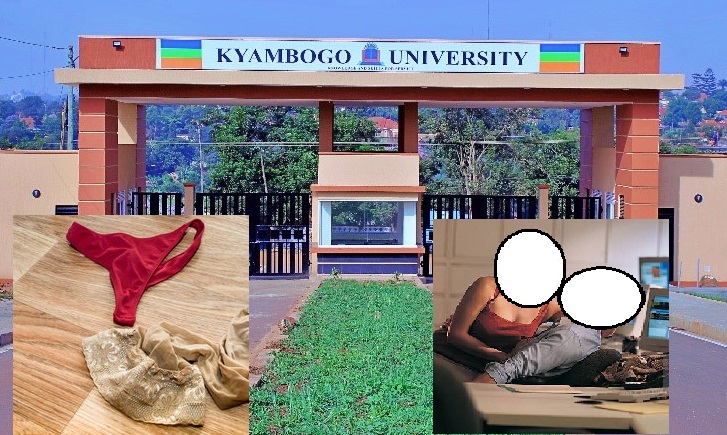
KAMPALA — A former senior academic at Kyambogo University has lifted the lid on what he describes as a disturbing culture of sexual impropriety involving lecturers and female students, recounting shocking encounters in examination rooms, staff offices and university corridors.
Dr Peter Musibala, a pioneer founder and former Head of the Bachelor of Adult and Community Education (BACE) programme at Kyambogo University, has come forward with a series of revelations about alleged sexual relationships between academics and students during his years of service at the institution.
From a visiting professor allegedly leaving an embarrassing bedroom confession on a female student’s examination script to a lecturer openly questioning what was wrong with having romantic relationships with students above 18, Musibala’s account raises fresh questions about professional ethics in Uganda’s institutions of higher learning.
Even more shocking, the former don recalls encountering a PhD-holding Head of Department allegedly holding a female student on his lap inside his office.
Musibala’s revelations come at a time when sexual harassment, abuse of authority and alleged sex-for-marks arrangements are attracting renewed scrutiny in Uganda’s universities, following discussions on sexual abuse during a recent Parliamentary Public Accounts Committee (PAC) engagement with Makerere University officials.
Speaking to Red Pepper, Musibala said the incidents were among several experiences that troubled him while serving at Kyambogo, prompting him to question whether academic qualifications alone should be sufficient to make someone fit to teach at a university.
THE ‘NICKER’ EXAM SCRIPT BOMBSHELL
One of the most extraordinary incidents, according to Musibala, happened while he was marking semester examination scripts.
The former academic says he stumbled upon a sticker attached to the answer script of a female student, carrying a message that appeared to expose an intimate encounter between the student and a visiting professor.
The message allegedly read: “You forgot your nicker in my room.”
The wording, Musibala suggests, left him shocked because it had found its way into an examination script, a document that should ordinarily contain a student’s academic responses and the examiner’s professional assessment.
The former don attributes the message to a visiting professor, although he has not publicly identified the academic or the student involved.
‘WHAT IS WRONG WITH BONKING A STUDENT ABOVE 18?’
In another incident, Musibala recalls confronting a staff member whom he suspected of having an inappropriate romantic relationship with a student in his department.
According to the former Head of Department, the lecturer had already marked examination scripts and submitted them to his office.
The staff member later reportedly returned seeking access to the scripts, claiming that he wanted to make adjustments.
Musibala says he refused to release the scripts and subsequently cautioned the lecturer about his alleged relationship with students.
But instead of accepting the warning, the academic reportedly challenged him with a question that Musibala says exposed a troubling attitude towards lecturer-student relationships.
“What is wrong with loving a student above eighteen years?” the lecturer allegedly asked Musibala.
The question, according to Musibala, reflected an attitude among some academics who may believe that a student’s age automatically makes a romantic relationship professionally acceptable.
However, even where a student is an adult, lecturers occupy positions of authority over examinations, research supervision, recommendations and academic progression.
This power imbalance can make it difficult for students to freely reject sexual advances or report misconduct without fearing possible academic consequences.
PHD HOD CAUGHT WITH STUDENT ON HIS LAP
In yet another incident, Musibala recounts walking into the office of a senior academic who held a PhD and served as a Head of Department.
To his alleged shock, he found the senior lecturer with a female student seated on his lap.
The former don says the encounter reinforced his concerns about the conduct of some members of academic staff and the need for stronger professional standards.
He has not identified the Head of Department or the student, nor established whether the incident resulted in a formal complaint or disciplinary action.
But the account adds another troubling dimension to the allegations, with the university office, which should be a place of academic consultation and mentorship, allegedly becoming a setting for inappropriate intimacy.
QUESTIONS PHD HOLDERS’ ETHICS
Beyond recounting the incidents, Musibala questions whether universities sufficiently scrutinise the professional conduct of people recruited to teach and supervise students.
He argues that possessing a PhD or other impressive academic qualifications should not automatically qualify someone to serve as a university lecturer without demonstrating appropriate professional and ethical standards.
He wants Government and university managers to strengthen measures against sexual harassment, establish effective reporting mechanisms and ensure that complaints are investigated without fear or favour.
ERON LAWRENCE CASE: KYAMBOGO’S 2023 SEXUAL ABUSE STORM
Musibala’s revelations bring back memories of another major sexual misconduct scandal that rocked Kyambogo University in 2023, involving Dr Eron Lawrence, a former Deputy Vice Chancellor in charge of Finance and Administration and senior lecturer at the institution.
Lawrence was accused of sexually assaulting a 16-year-old visually impaired girl who was participating in a university-supported programme known as All We See Is Possibilities.
The allegations triggered outrage among parents, civil society organisations and international donors supporting the programme.
The university subsequently announced that it had instituted an internal investigation committee and encouraged victims and anyone with information to report confidentially to the University Secretary.
In a public statement at the time, management said it had zero tolerance for sexual harassment and violence, adding that any staff member found culpable would face disciplinary action under the university’s Human Resource Regulations.
The case became particularly contentious because of concerns that the university was taking too long to conclude its internal processes.
There were also allegations that some university staff had attempted to silence the victim’s family through negotiations, claims that heightened pressure on management to demonstrate accountability.
Vice Chancellor Professor Eli Katunguka-Rwakishaya maintained that the institution had to follow due process before taking disciplinary action.
INVESTIGATION FOUND LAWRENCE CULPABLE
In January 2024, the university’s six-member investigation committee reportedly concluded its work and submitted its findings to the University Secretary, Arthur Katongole.
According to the University Secretary, the committee found Lawrence culpable of gross misconduct, sexual harassment, conduct damaging to the image and status of the university, and unprofessional or unethical behaviour.
Katongole also disclosed that Lawrence had not appeared before the committee during the investigation and had effectively absconded from duty.
The matter was subsequently referred to the University Appointments Board for consideration and disciplinary action.
Management stopped his salary pending the conclusion of the disciplinary process, while indicating that the university could proceed ex parte if he failed to respond to the required notices.
FROM CAMPUS TO LUZIRA
The Lawrence scandal also moved beyond the university’s internal disciplinary machinery into the criminal justice system.
Police investigated the allegations, and the Directorate of Public Prosecutions preferred charges of aggravated defilement.
Lawrence was subsequently arrested after a period during which he had reportedly been on the run, with police having announced a Shs10m reward for information leading to his arrest.
He appeared before Nakawa Magistrates Court and was remanded to Luzira Prison as proceedings over the criminal allegations commenced.
The prosecution alleged that he had abused his position of authority over the vulnerable student.
The university later announced that its Appointments and Disciplinary Committee had resolved to dismiss him after considering submissions from the institution’s legal team.
The case exposed the difficult questions universities face when allegations of sexual abuse involve senior officials who occupy powerful positions within their institutions.
It also put pressure on Kyambogo to strengthen its sexual harassment policies and establish clear procedures for preventing and handling complaints.
2019 WARNING BY SUPREME COURT JUDGE
Interestingly, concerns about sexual harassment at Kyambogo did not begin with the Lawrence scandal.
In 2019, Supreme Court Justice Professor Lillian Tibatemwa-Ekirikubinza challenged the university management to address concerns about sexual harassment when she presided over the institution’s belated International Women’s Day celebrations.
She emphasised the importance of investing in women and respecting their human rights, arguing that these were essential to uplifting communities, companies and countries.
Her intervention highlighted the importance of creating academic environments in which female students could pursue their education without facing harassment or exploitation.
The subsequent Lawrence scandal demonstrated how serious such concerns could become when allegations involve senior university officials.
KYAMBOGO INVITES VICTIMS TO SPEAK OUT
At the height of the Lawrence controversy, Kyambogo management publicly appealed to victims and people with information about sexual harassment to come forward.
The university said it would treat information confidentially and protect whistleblowers under its internal protection rules.
Management also urged affected persons to contact the Acting University Secretary, Arthur Katongole, through the official channels provided in its statement.
The institution insisted that allegations would be handled under its disciplinary framework and that any staff member found culpable would be held accountable.
However, Musibala’s latest revelations raise fresh questions about how widespread the problem may have been and whether existing safeguards are sufficiently effective.
MOUNTAINS OF THE MOON UNIVERSITY NOT SPARED
The Kyambogo revelations are emerging against another disturbing backdrop involving Mountains of the Moon University (MMU), where student feedback has raised allegations of sexual misconduct, financial exploitation and examination malpractice.
In August 2026, the university interdicted its Faculty of Business and Management Sciences Dean, Dr John Rwakihembo, following complaints contained in its 2026 End of Programme Survey Report and Student Evaluation of Course and Teaching (SECAT) Report.
In a letter dated August 10, 2026, Vice Chancellor Professor Pius Coxwell Achanga directed Rwakihembo to step aside for two months as the institution investigated allegations of soliciting or extorting money from students in connection with research supervision.
The survey also contained allegations of sexual misconduct involving lecturers in the faculty.
One respondent, identified as R341, alleged that female students had faced sexual advances and assault by lecturers.
The report did not name the lecturers allegedly involved or provide details of the incidents, and it was not clear whether the complaints had previously been formally reported to university authorities.
SHS6M RESEARCH SUPERVISION CLAIMS
The student survey also raised serious allegations about the cost of research supervision.
Respondent R413 described the dean as another person allegedly involved in taking money for research, claiming that students under his supervision had each paid at least Shs5m.
Another respondent, R250, alleged that after being transferred to Rwakihembo, the dean changed the student’s research topic and demanded Shs6m, which the student claimed to have paid because they felt they had no choice.
Other respondents complained that research supervision had become so expensive that some students struggled to graduate.
The survey also raised allegations of lecturers receiving money from students to help them pass examinations.
Respondent R272 alleged that some academics were collecting money from students under the guise of helping them pass.
These were student allegations contained in an anonymised survey, not established findings of guilt.
455 STUDENTS PARTICIPATED
The university’s Quality Assurance Department conducted the End of Programme Evaluation, targeting 520 students based on the graduation list.
A total of 455 participated, representing an 87.5 per cent response rate.
Although the survey recorded high overall satisfaction, with 438 respondents, representing 96 per cent, saying they would recommend the university to prospective students, the negative feedback highlighted areas requiring management attention.
The university interdicted Rwakihembo for two months on half pay while investigations were conducted.
He was barred from accessing his office, university premises, records and systems without authorisation and directed to hand over the dean’s office pending the investigations.
The university emphasised that interdiction was not a finding of guilt and that Rwakihembo would be given an opportunity to respond to the allegations.
THE BIG QUESTION: WHO PROTECTS THE STUDENTS?
From Musibala’s recollections at Kyambogo to the Lawrence case and the student complaints at Mountains of the Moon University, the allegations raise questions about the effectiveness of institutional safeguards in Uganda’s higher education sector.
The central concern is not simply whether a student is above or below 18, but whether academic authority is being abused to obtain sexual favours, exert pressure or compromise the integrity of examinations and research supervision.
Musibala wants Government and university managers to take a closer look at the conduct of academic staff and ensure that professional ethics are treated as seriously as academic qualifications.
For Kyambogo, which has previously faced a major sexual abuse controversy involving a senior academic, his account reopens an uncomfortable conversation about what happens behind university office doors and whether students can safely report misconduct.
The latest allegations also put other universities on notice that academic excellence must go hand in hand with integrity, accountability and respect for students’ rights.
Kyambogo University has been contacted for a comment.
GOT A HOT STORY? BLOW THE WHISTLE!
Have breaking news, explosive revelations, juicy leads or evidence of wrongdoing?
WE WANT TO HEAR FROM YOU!
Send your tips, documents, videos, photos and audio recordings to:
redpeppertips@gmail.com
Whether it’s corruption, scandals, abuse of office, injustice or stories others are afraid to tell, help us bring the truth to light.
SOURCES ARE PROTECTED.
CONFIDENTIALITY IS OUR NO.1 PRIORITY!
About Post Author