79-YEAR REVIVAL! CER Installs New Archbishop Tubamoi as Northern Uganda Church Marks Historic Milestone
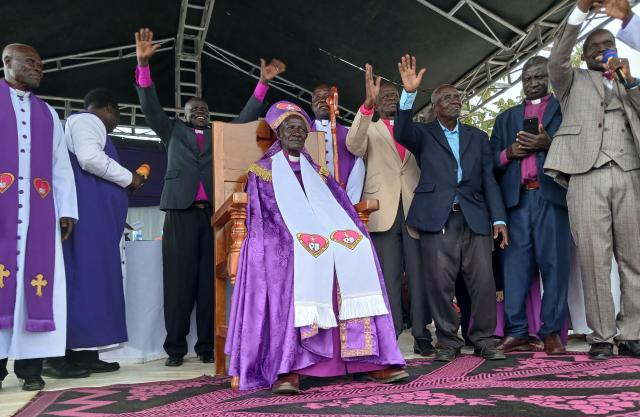
The newly consecrated archbishop of CER
The Chosen Evangelical Revival Church (CER) has marked 79 years since the spiritual revival that gave birth to the church, when Archbishop Robert Ocan Tubamoi was installed as its new overseer in Kitgum.
The church celebrated its 79th Salvation Day on Tuesday, September 29, bringing together members to commemorate the conversion of its founder, Yusto Otunnu, and the spread of the East African Revival in northern Uganda.
CER traces its origins to September 29, 1947, when Otunnu, then 25, underwent a spiritual conversion after listening to a sermon by Dr Elia Lubulwa, a Ugandan medical doctor and evangelist associated with the East African Revival.
Otunnu, who was born in Namokora, Kitgum, in 1922, had been baptised and confirmed in the Church of Uganda before joining the balokole, or “saved ones”, movement.
Rev Ken Odongkara, the CER disciplinary chairperson, said the revival introduced a new Christian message to communities where different Acholi clans traditionally worshipped spirits.
“When the issue of being born again came to Acholi, and for it to be known that there was a being greater than the one we worshipped, and that is Jesus Christ,” Odongkara said.
He said the revival also helped reduce divisions between communities by encouraging converts to regard one another as brothers and sisters.
Odongkara said early converts eventually agreed to make September 29 a day of commemoration because it marked the day Otunnu was converted.
“They decided that the 29th, when Yusto Otunnu was born again, should be for all,” he said.
The revival subsequently spread through Otunnu’s preaching. On January 6, 1948, Otunnu preached a sermon that influenced Janani Luwum, then a trained primary school teacher, to join the balokole movement.
Luwum later became Archbishop of the Church of Uganda before his death in 1977. By the 1950s, the movement had expanded significantly, and on August 28, 1958, it was formally organised at Anaka, in present-day Nwoya District. Otunnu became its chairperson, working alongside Obuku Yowaci, Owino Lajaro and Dronyi Sosthenes.
The movement later experienced internal divisions. According to the church’s historical account, disagreements that began in the 1960s culminated in a split in the 1970s, with rival factions emerging around Otunnu and Lajaro Owino.
The factions initially remained within the Church of Uganda, but the relationship between Otunnu’s faction and the Anglican Church later deteriorated.
Following the killing of Archbishop Janani Luwum in 1977, Otunnu fled to Kenya, where he continued his evangelistic work and criticised the government of Idi Amin.
He later returned to northern Uganda and established the Holy Spirit Bus Company, which, according to the church’s historical account, strengthened the economic position of his faction and contributed to its gradual separation from the Church of Uganda.
An attempt by Bishop Benoni Ogwal-Abwang of Northern Uganda Diocese to reconcile the group with the Anglican Church in 1984 failed. Otunnu subsequently registered the movement as an independent church in September 1985 under the government of Gen Tito Okello.
Following the overthrow of Okello’s government in 1986, Otunnu fled to Oxford in the United Kingdom, where he later received an honorary doctorate in theology. He died in Oxford on April 12, 1998, aged 76, and was buried there according to Acholi traditional burial rites.
Church shaped by conflict CER’s history has also been marked by Uganda’s armed conflicts, particularly in northern Uganda. Odongkara said church members suffered during the insurgency associated with Alice Lakwena’s Holy Spirit Movement because CER members did not worship Lakwena’s spirit.
“During the time of Lakwena, it was only this church that didn’t worship that spirit, and many of us were killed,” he said.
The prolonged conflict also disrupted the church’s development programmes. Tubamoi, the newly consecrated second archbishop, said the church’s independence came with a commitment to contribute to national development through education, health and agriculture. He said the wars limited what CER could do, but did not stop the church from investing in education.
“With the war, we couldn’t do much, but one thing CER has done is found schools,” Tubamoi said. The church says it has established seven schools in Kitgum and Pader, most of them government-aided. CER currently has two dioceses, Eastern and Western, and 218 churches holding Sunday services.
The Eastern Diocese covers Kitgum, Pader, Agago, Lamwo, Karenga, Kaabong and parts of the Teso and Lango sub-regions. The Western Diocese covers Gulu, Gulu City, Amuru, Omoro, Nwoya, Masindi, Kiryandongo, Kampala and areas outside Uganda.
The church estimates that it has about 15,000 followers in Uganda, with congregations also established in South Sudan, Kenya and the United States.
Pastor Alfred Komagum, a leader of Acholi East under the National Fellowship of Born-again Pentecostal Churches, called for closer cooperation between CER and other Christian denominations.
Komagum said CER’s commitment to Christian worship deserved support. “I was told that CER is a group of Christians who worship God with all their heart and must be supported,” he said.
Tubamoi, born in 1956 in Pajule Subcounty, Pader District, becomes the second archbishop of CER.
He succeeds the foundational legacy associated with Otunnu, whose ministry played a significant role in the spread of the Christian revival in northern Uganda.
Tubamoi, who married Mama Kamila Ochan in 1991, brings decades of experience in pastoral leadership, church administration, evangelism and clergy mentorship to the position.
In his vision for the church, Tubamoi says he wants to build a “Christian-centered church rooted in revival holiness, integrity, discipleship, and community transformation while advancing the gospel of Jesus Christ to all nations.”
His priorities include evangelism and church planting, youth and women’s empowerment, education and health, infrastructure and church ministry, and community development.
The priorities mark the next phase for a church whose origins date back to one conversion in Kitgum 79 years ago and whose growth has been closely intertwined with the religious and political history of northern Uganda.
GOT A HOT STORY? LET US KNOW!
Got breaking news, explosive secrets, or hard evidence?
Email us: redpeppertips@gmail.com
We accept tips, documents, videos, photos, and recordings—the more evidence you have, the better.
CONFIDENTIALITY IS OUR TOP PRIORITY. SOURCES ARE ALWAYS PROTECTED!
About Post Author