TALKING TOUGH! Office uniforms in offing as Minister Babalanda issues more rules of engagement to RDCs
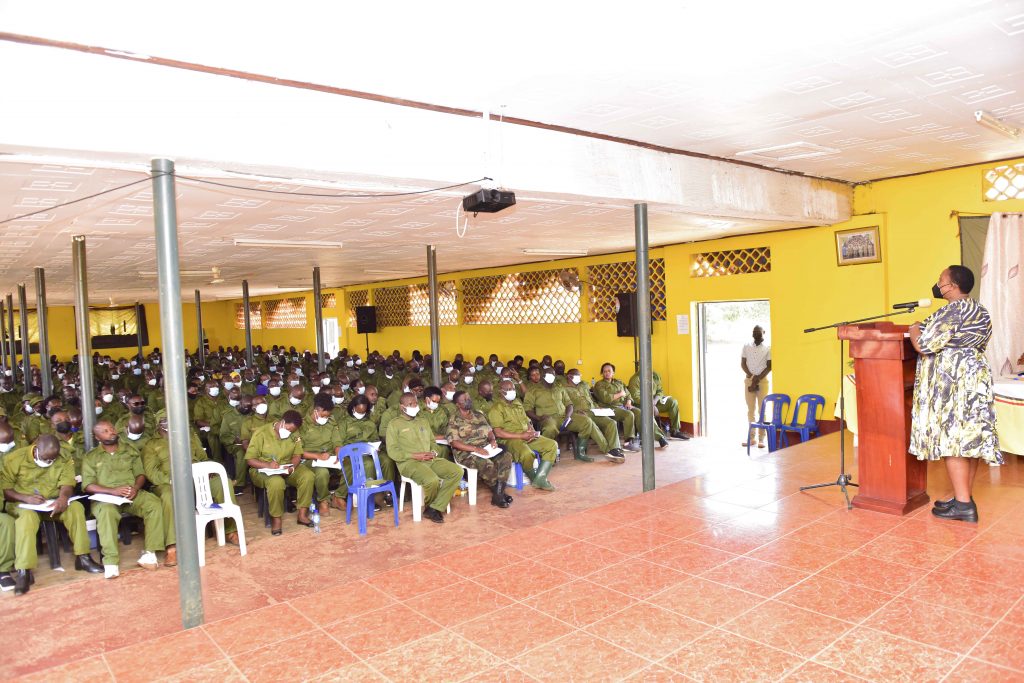
Minister for the Presidency Milly Babalanda delivering Operational guidelines for Resident District Commissioners, Resident City Commissioners, Deputy Resident Commissioners and Deputy City Commissioners during the Orientation retreat at the National Leadership Institute (NALI) Kyankwanzi on 26th July 2022. Photo by PPU/Tony Rujuta.
BY VENENSCIAS KIIZA
Like we recently reported on these very same pages, the Presidency Minister Babirye Babalanda used the recently concluded one week long Kyankwanzi retreat to issue the rules of engagement to RDCs/RCCs and their deputies as they execute their duties.
The minister made it clear to those who have been rattled by her work methods that in this new crusade of service delivery, the status quo must change. And to that effect, anybody who doesn’t approve of her work methods and the rules of engagement she read to them must shape up or ship out.
In part one we started with what she told them as far as service delivery, security and land matters are concerned. In our today’s second part, we reveal what she expects of them in areas of information management, office operations and as well roles of senior staff at the RDC secretariat. Read one:
ACCESS TO GOVERNMENT INFORMATION
On this, she told them to always liaise with the Chief Administrative Officers (CAOs) to access information on government-funded programs in their Cities/Districts. That they should have copies of the Bills of Quantities (BOQs) for construction projects for easy monitoring and evaluation.
They have also been tasked to also physically visit these projects and brief the Commissioner in charge of their region who will later brief the Senior Presidential Advisor RDC Secretariat and copy in to the Senior Presidential Advisor in Charge of Research and both of whom will brief the Minister and the Secretary, Office of the President.
“Accordingly, you should have access to all the information you need to undertake this role. You do not require permission from the Center to obtain information from any stakeholder in your city/district. In case of need for assistance to obtain information at the national level; you should liaise with the Commissioners in charge of your region. Overall, you have full mandate to access information on government-funded programs in your respective cities/districts. Therefore, you should carry on with your work through the RDC/RCC Secretariat without any distraction or excuse,” she said and added: “You should start communicating your issues of public concern through your immediate supervisors (the Commissioners in charge of your region) who will summarize your issues for forwarding to the Senior Presidential Advisor-RDC Secretariat and a copy to the Senior Presidential Advisor- Research. This direct interface is intended to enable immediate access to matters of urgent public concern rather than wait for quarterly reporting which usually render this information obsolete. This is also aimed at improving service delivery and to build confidence in the public to see relevancy of the Office of the RDC/RCC.”
CHIEF GOVERNMENT COMMUNICATORS
As Chief Government Communicators and monitors of public investments at the city/district level, according to the minister, they are supposed to utilize the free government radio programs every Friday of the week to brief the public on implementation of government programs, counter lies of detractors and also respond to public concerns on governance issues.
“Those in remote districts should liaise with the Commissioners responsible for your regions for guidance on how to manage the programs. Every Monday of the week, all of you will be required to make briefings to your respective commissioners on matters raised by the public during radio discussions which require interventions at the national level,” she advised.
The Minister apportioned every Wednesday of the week as time for the RCCs/RDCs and their deputies to meet with her to share any pertinent information or concerns.
CONFIDENTIAL INFORMATION
The minister also sternly warned RDCs about the culture of circulating confidential information on social media and to use it to blackmail others. She said this is illegal and unacceptable for public officers attached to the presidency to share classified information with members of the public and it is against the Public Service Standing Orders.
“All RCCs/RDCs are encouraged to use office emails for official business. The Office of the President will issue you with official emails. This will help us to manage our internal communication,” she stressed before subjecting all RDCs/RCCs and Deputies to take oath of secrecy as the retreat ended on Saturday May 21, 2022 at NALI Kyankwanzi. They also appended their signatures to these guidelines.
CAMPS
The minister was also rattled by the fact that some RDCs are branded and attached to camps of their godfathers. She reminded them that their only boss is the appointing authority- President Museveni who also does so after consultations. “There is therefore no justification for creating camps within the RDC/RCC network and it’s unacceptable. The NRM leadership does not believe in divisive politics of camps.”
MANAGEMENT OF MEMORANDA TO THE PRESIDENT
Babalanda further guided that the District Security Committee in consultation with area members of Parliament should guide the authors of presidential memoranda on key issues to raise for the President’s attention. In doing so, she hopes this will discourage demands that can be managed by the other government entities such as Ministries, Departments and Agencies and Local governments from getting to the President.
“You are also required to manage the programs jointly with the State House Protocol in order for the President not to spend more than two hours at a function to allow him attend to other official duties,” she stressed. The minister also directed all RCCs/RDCs and their Deputies to display her Office toll-free line (0800 320-320) at the entrances of their Offices for public use. The Message should be written out in local languages. As Chairpersons of the District/City Security Committees, they have also been advised to have a 24/7 telephone access and their office secretaries should attend to all calls from the public without discrimination.
RESIDENCY
All RCCs/RDCs and deputies have been advised to not operate from outside their duty stations. “You should reside in your districts of deployment to avoid operating on remote. You are Resident District Commissioners.”
CORRUPTION, OFFICE ABUSE
When Babalanda assumed her new office, friends, well-wishers and other advisors including the appointing authority told her to mentally and physically prepare for the task ahead. She was told that some of the people she was going to supervise are corrupt, others are past sale date (read expired), and others are 5th columnists who largely serve for themselves. She was further told that others are very disrespectful and indisciplined; others were used ‘wetting beaks’, and some were good but disoriented, always absent and lazy. She was then told to engage gears accordingly.
In her address she reminded them to tread carefully because the President and Minister continue to get detailed reports on corrupt RCCs/RDCs which she said it can’t be tolerated any longer. She cited some RCCs/RDCs in districts that implement Rehabilitation and Reconstruction Programs such as in Northern Uganda who allegedly connive with Chief Administrative Officers and Town Clerks to misappropriate public funds. We have intelligence to the point that some of you receive monthly bribes from CAOs to cover up shoddy works. She said all these are known and soon the law will take its course once nabbed with the help of the Minister of State for Economic Monitoring and the Anti-Corruption Unit of State House and other investigative agencies. She also had no kind words for some RCCs/RDCs who delegate their functions to non-staff whom they use as agents to extort money from the public.
Other acts of abuse include: misuse of government vehicles, absenteeism from duty, applying excessive force during operations, soliciting for bribes in exchange of provision of free government services and denying deputies assignments.
She guided thus: “Your offices should be open to the public; Monday to Friday from 8.00 am to 5.00 pm without fail. You should also be accessible on telephone throughout the day for service delivery. All RCC/RDC offices will be provided with landlines and official office lines. A tollfree line at the Minister’s Office has been installed. The tollfree line 0800-320-320 is in place and is used to receive feedback from the public on service delivery and abuse of office by our staffs. The line is attended to from 8.00 am to 5.00 pm; Monday to Friday. In cases of Emergency, the Minister’s office secretary- and the Personal Assistant will reach you on the Minister’s official line: 020-041-0700. This line is only for receiving calls in the Minister’s office.”
To deal with imposters who con both unsuspecting members of the public and as well RDCs using their office premises, the minister suggested uniforms to office staff in the RCC/RDC offices. “The Senior Human Resource Officer, Office of the President will also provide a list of permanent staffs in the RCC/RDC offices to be captured in our online bio data system that will be virtually hosted on a sub-domain for public use and reference.”
RDCs have also been instructed to share responsibilities with deputies in order to cut red tape and to improve services. “Sharing responsibility will eliminate performance gaps. The culture of RCCs/RDCs undermining their deputies and delegating non-staffs to do official work and prohibiting them from attending official workshops should stop with immediate effect. Attendance of workshops should be on a rotational basis for RDCs/RCC and Deputies,” she warned, and further guided that: “All the officers designated in the position of RDC, RCC and Deputy can handle clients at any one point. The culture of people sitting from morning to evening waiting for RDCs when the deputy is available should stop. Any senior officer at the station can bridge the gap of meeting with clients inclusive of the Administrative Assistants. RCCs/RDCs are not permitted to delegate their official work to non-staffs.”
WORKING HOURS
According to Babalanda, all RCC/RDC offices should be opened to the public every working day at 8.00 am and closed by 5.00 pm; and at no any point should the office be without a senior staff or secretary responding to the public at any one-time during business hours. “If the RCC/RDC is out, the deputy or secretary must be available to meet with clients. In cities where there are no deputy RCCs, the minister will consult with the President to have these positions filled. The culture of having empty and/or closed offices of RCC/RDCs has ended. RCC/RDCs should strictly notify their immediate supervisors if they intend to stay out of their stations for some time to ease monitoring of the office by the Center.”
UNITY, RELATIONS
RCCs/RDCs have also been warned against engaging in unproductive local politicking which involves taking sides. These have since been barred from campaigning for a political office as per the presidential directive of December 2021. “Anyone with such interests should gracefully resign at this point. If caught red handed campaigning you will be adequately sanctioned,” she stressed.
She also reminded them about public outcry of poor public relations exhibited by some RCCs/RDCs. “RCCs/RDCs should not exhibit arrogant attitude towards the public. They should be good listeners and accommodative while dealing with the public. No engaging in decisive politics. Also, the issue of poor working relations and hostility between RCCs/RDCs and the Local Government Officials, DISOs and the DPCs is well known. It is shameful for public officers who are working for the same government to engage in unproductive fights and disagreements which are usually caused by greed, selfish interests and failure to appreciate each one’s roles. This must end immediately.”
RDC SECRETARIAT
The Minister also reminded and went on to read to the RDCs the roles of the senior staff of the RDC Secretariat. These include senior Presidential Advisor -RDC Desk – Lt. Col. Kibrai Ambako who is the head and in charge of operations of the RDC Secretariat. He reports to the Secretary Office of the President. There is also senior Presidential Advisor – Research – Dr. Daniel Ssekiboobo Isabirye. He is in charge of research, quality assurance, documentation and strategic planning of the secretariat. He reports to the Secretary, Office of the President.
Commissioners include: Maj. Martha Asimwe (Western Region), Sr. Grace Akiror (Northern Region), Tweheyo James (Karamoja Region), Fredrick Mbagadhi Nkayi (Central Buganda Region), Bamwine Fred (Kampala Region) and Obedi Collins Gertrude (Eastern Region). These report to the senior presidential advisor – RDC desk.
They are tasked with among others; supervision; receiving reports from for onward submissions; reinforcing the President’s and Minister’s directives; harmonizing the interests of politicians and those of RDCs/RCCs; managing complaints against RDCs/RCCs and deputies in their respective regions; following up with Ministries Departments and Agencies on issues of importance raised by RDCs/RCCs that require immediate interventions at national level; and as well briefing the Head of the RDC Secretariat on matters of national importance for onward briefing to the secretary, office of the president who in turn briefs the minister for the presidency.
<<<<<<<<<<<<<<<<<<<<<<<<<<<<<<<<<
GOT A HOT STORY? CALL/TEXT/WHATSAPP 0777959024 OR EMAIL redpeppertips@gmail.com
About Post Author