Uganda’s Washington Embassy On Spot Over Cash Diversions, Unaccounted Dollars & Procurement Disarray

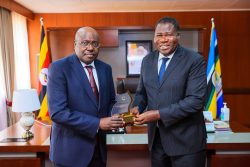
Amb Kakonge
A fresh Auditor General’s 2025 report has lifted the lid on troubling financial and administrative lapses at the Uganda Embassy in the United States, exposing irregular spending, unaccounted funds, procurement gaps and delayed planning under the leadership of Head of Mission Robie Kakonge.
Despite receiving an unqualified audit opinion, the findings paint a deeply unsettling picture of an embassy struggling with compliance, accountability and planning discipline at a time when Uganda’s diplomatic presence in Washington is expected to operate at the highest standards.
The report reveals that while the Mission’s Strategic Plan appeared well-funded on paper, the numbers tell a different story. A comparative analysis showed “overfunding with a UGX3.47Bn representing a 7.1% variance in the funding above the planned requirements,” raising questions about budgeting accuracy and whether resources are being efficiently allocated.
Even more concerning is the failure to align with national development priorities in time. The Auditor General notes that “by the time of reporting the entity had not finalised a new draft strategic plan aligned to the NDP IV by its commencement date of 1st July, 2025,” effectively leaving the Mission out of sync with Uganda’s broader policy direction.
Compliance itself remains shaky. A review by the National Planning Authority found that the Mission was only “moderately compliant at 65.6 per cent,” a rating that signals gaps in adherence to national planning and budgeting frameworks.
Financial management at the embassy is also under scrutiny. Out of an approved budget of UGX.15.852Bn, a total of UGX.14.859Bn was spent, showing a high absorption rate. However, beneath these figures lies a pattern of irregularities that has alarmed auditors.
In one of the most glaring findings, “funds to the tune of USD.87,794 were irregularly diverted from the activities on which they were budgeted and spent on other activities without seeking and obtaining the necessary approvals.” This diversion raises serious concerns about internal controls and adherence to financial procedures.
Adding to the alarm is the revelation that “an amount of USD.68,735.75 had not been accounted for by staff by the time of reporting,” leaving a significant sum of money hanging without proper explanation or documentation.
Procurement practices at the Mission also appear to be riddled with inconsistencies. The Auditor General found that although a procurement plan existed, “procurements amounting to USD.108,500 were not planned,” indicating a breakdown in planning and execution.
The situation is further complicated by discrepancies in expenditure. While rent had been budgeted at UGX.1.127Bn, the actual expense shot up to UGX.1.688Bn, meaning “procurements worth UGX.0.561Bn above the planned” were incurred. Such overruns point to weak budgetary controls and oversight.
In another breach of regulations, the report highlights that “there were no procurement reports being prepared and submitted to PPDA as required,” effectively cutting off a key layer of accountability in public procurement processes.
Human resource practices have also been called into question, with the Auditor General noting that the Mission recruited three local staff “under unclear circumstances,” raising concerns about transparency and adherence to established procedures.
On the infrastructure front, while the official residence was successfully renovated and completed in September 2025, the chancery—the core operational hub of the Mission—still requires further renovations, suggesting incomplete prioritisation of critical facilities.
The Embassy also suffered a financial setback following storm damage to the chancery roof. In a disappointing turn, the insurance company declined full compensation of USD 190,000, recommending an award of only USD.14,841, leaving the Mission to potentially absorb a significant loss.
Historical accountability issues continue to linger as well. A review of Treasury Memoranda reports spanning multiple financial years revealed that out of 26 recommendations made by the Public Accounts Committee, only eight were fully implemented, while fifteen were partially implemented and three were not implemented at all.
This pattern suggests a longstanding challenge in closing audit gaps and enforcing corrective action.
While the unqualified opinion suggests that the financial statements present a fair view, the underlying issues flagged by the Auditor General tell a far more complex story of operational weaknesses and lapses in accountability.
For a mission tasked with representing Uganda on the global stage, the findings serve as a stark reminder that credibility abroad begins with discipline at home. Whether these issues will be swiftly addressed or continue to linger remains a question that now hangs heavily over Uganda’s diplomatic footprint in Washington under Kakonge.
GOT A HOT STORY? EMAIL: redpeppertips@gmail.
SOURCE PROTECTION/CONFIDENTIALITY IS OUR NO.1 PRIORITY.
About Post Author