ROTARY WAR EXPLODES! Expelled Members Drag Ssese Islands Club Bosses To Court As Old Controversies Return To Haunt Disciplinary Team
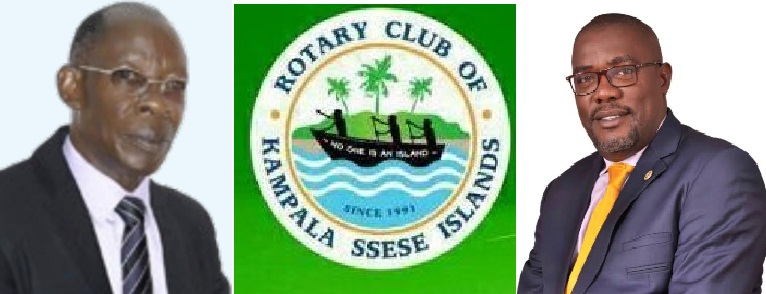
A photo montage of Disciplinary Committee Chairperson Medard Muganzi and Committee member Nelson Kabwama
A bitter internal war that has been simmering inside the Rotary Club of Kampala Ssese Islands has now burst into the open after five former members dragged the club and several of its top leaders to the High Court, setting the stage for a dramatic legal showdown that threatens to expose deep divisions, bitter power struggles and long-standing questions about governance within one of the country’s prominent Rotary clubs.
The case, which is scheduled to come up before the High Court tomorrow Monday June 22, 2026, has attracted attention not only because of the senior personalities involved but also because of the serious allegations being raised by the applicants regarding how disciplinary powers were exercised and whether the process that led to their expulsion complied with the Constitution, principles of natural justice and the club’s own bylaws.
The applicants, lawyers Ronald Samuel Wanda and Robert Byamukama, together with Nelson Turyatemba, John Martin Sekwe and Gladys Edwards Namala, have mounted a direct challenge against the Rotary Club of Kampala Ssese Islands Uganda Limited and a number of its leaders including club president Deborah Itwau Ongwech, Acting Secretary of the Board Bernard Ochan, Board Chairperson Dr. Canon Charles Kahigiriza, Disciplinary Committee Chairperson Medard Muganzi, committee members Julianne Mweheire, Nelson Kabwama and Laura Orobia, committee secretary Leonard Babwetera Kashagama and Ivan Kasambeko.
At the centre of the dispute is the applicants’ claim that their membership was terminated through a disciplinary process that they describe as irregular, procedurally defective and fundamentally unfair.
According to court documents, the applicants insist that they were denied their constitutional rights and subjected to a disciplinary process that was allegedly influenced by internal political battles over the future leadership of the club.
The applicants claim that tensions began escalating during discussions surrounding future club elections and leadership succession plans. Ronald Samuel Wanda states that he nominated fellow Rotarian Ivan Kasambeko for a future presidential position within the club, a move that allegedly generated disagreement among some members.
Court filings indicate that subsequent exchanges on the club’s communication platforms eventually became part of the wider conflict that later developed into disciplinary proceedings.
The applicants argue that what followed was not a legitimate disciplinary exercise but rather an effort to silence dissenting voices and remove members who were perceived as challenging the prevailing leadership structure within the club.
In their pleadings, the former members contend that freedom of expression became one of the central casualties of the conflict.
They argue that disagreements and differing opinions that should ordinarily have been resolved through debate, consultation and democratic engagement instead became grounds for disciplinary action.
The applicants further allege that they were suspended before being properly informed of the complaints against them and that they were excluded from official club platforms and activities before being afforded an opportunity to fully defend themselves.
One of the most serious claims before court concerns the composition and conduct of the disciplinary process itself.
The applicants maintain that the disciplinary committee exceeded its mandate and effectively assumed powers that should have remained with other organs of the club.
They further allege that the same individuals who initiated complaints became involved in determining the outcome of those complaints, creating what they describe as a conflict with the basic principles of impartiality and natural justice.
Particular attention is being directed at the role of Disciplinary Committee Chairperson Medard Muganzi.
The applicants contend that Muganzi played a central role in events leading to the disciplinary proceedings and later participated in processes whose outcomes directly affected those involved in the dispute.
Those allegations form part of the issues now awaiting judicial scrutiny.
The controversy surrounding Muganzi has attracted additional public interest because there was a previous alleged corruption matter in which his name had appeared.
Among the issues being referenced is a 2019 Inspectorate of Government report relating to investigations at the Rural Electrification Agency.
The Inspectorate of Government letter dated 26 June 2019, addressed to the Chairperson of the Rural Electrification Agency Board under the subject “Alleged Massive Corruption in the Rural Electrification Agency,” contains specific findings and recommendations arising from an investigation conducted by the Inspectorate of Government.
The Inspectorate further stated that:
“In view of the above findings, as detailed in the attached report, it is recommended that Mr. Medard Muganzi and Ms. Patricia Nakku Kawagga should refund UGX 10,722,900/= and UGX 13,566,900/= respectively to the Inspectorate of Government Asset Recovery Account number 003030088000007 within ninety (90) days of issue of this report. Failure to refund the said money will result in their prosecution.”
The same letter also contained findings relating to other REA officials, procurement practices, recruitment procedures, and the use of agency vehicles.

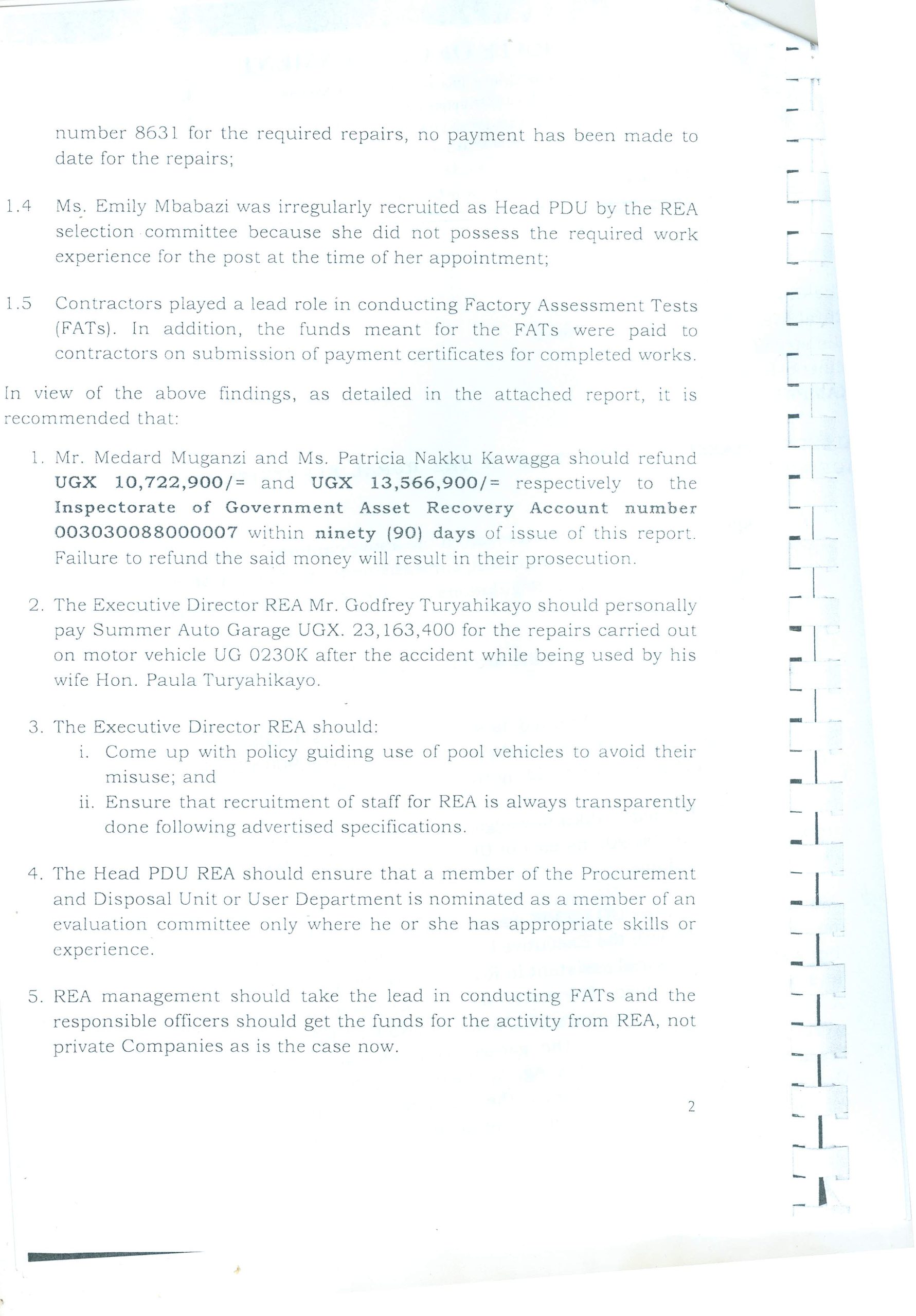
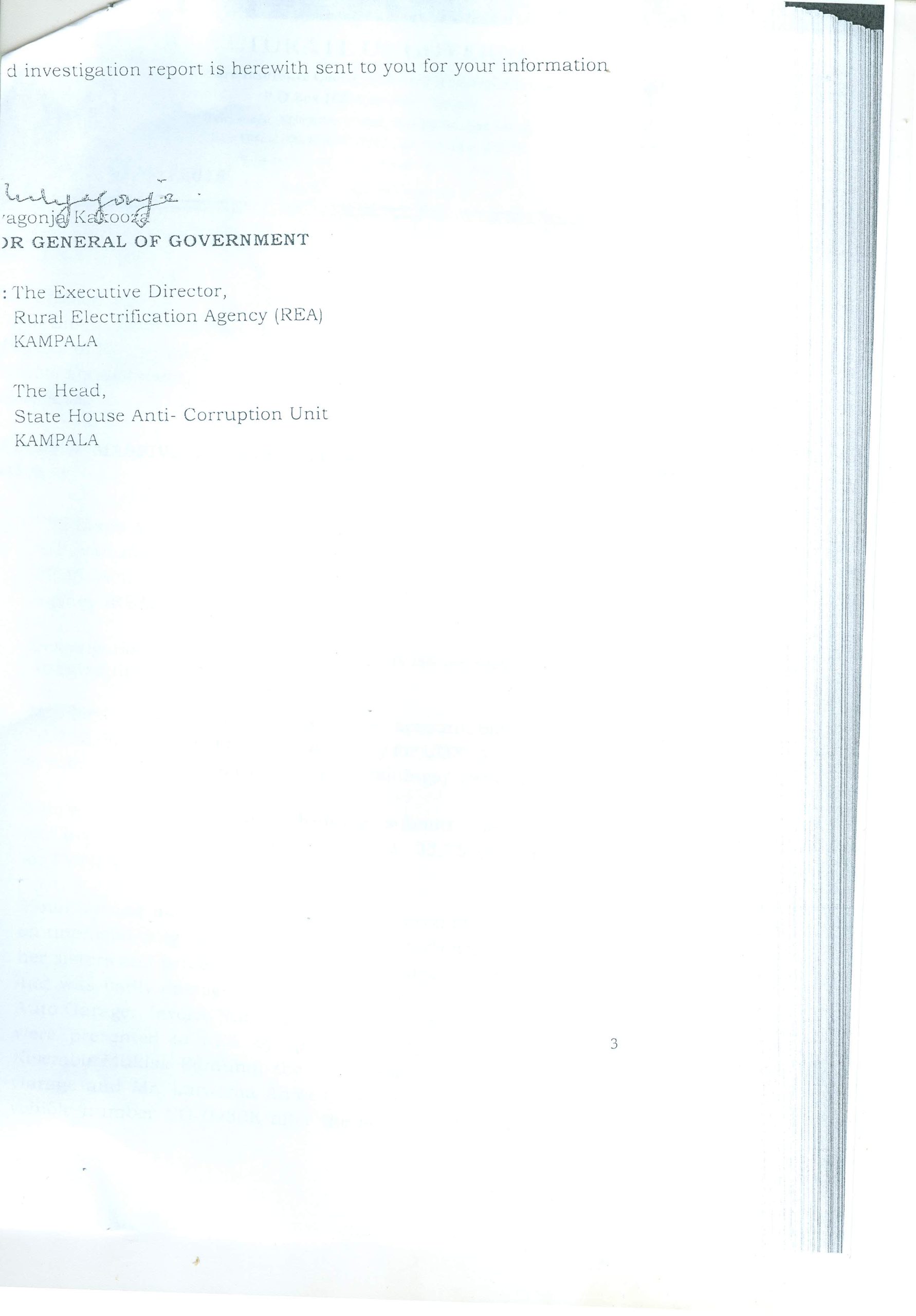
The IGG also ordered then REA executive director, Godfrey Turyahikayo, to pay for the repairs of a government vehicle that he was involved in an accident but outside official schedule. According to the IGG, Turyahikayo was travelling with his wife and others when the accident happened in Rukungiri District.
The vehicle was repaired by Summer Auto Garage and an invoice of Shs23.2m was presented to REA for clearance.
The IGG also indicated that Emily Mbabazi was irregularly recruited as head procurement and Disposal Unit by the REA Selection Committee because she did not possess the required work experience for the post at the time of appointment.
It is also alleged that contractors played a lead role in conducting Factory Assessment Tests where they had an interest.
After thorough investigations, the IGG ordered those implicated in embezzlement of the funds including Muganzi to refund the money with immediate effect.
However, it is important to note that the existence of allegations, investigations or recommendations in previous matters does not amount to proof of wrongdoing in the current dispute before court.
But watchers nevertheless argue that such history raises questions about whether an individual facing scrutiny elsewhere should have been entrusted with presiding over a highly sensitive disciplinary process involving fellow members.
Supporters of the applicants insist that public confidence in any disciplinary process depends not only on actual fairness but also on the appearance of fairness.
They argue that where questions are raised about neutrality, decision-makers should exercise extreme caution to avoid creating perceptions of bias.
Attention is also being directed at disciplinary committee secretary Leonard Babwetera Kashagama.
The applicants and their supporters have referenced historical disputes and correspondence in which allegations were made regarding his conduct in unrelated matters years ago.
Among the documents being cited is correspondence concerning accommodation arrangements linked to a Rotary International Convention in New Orleans.
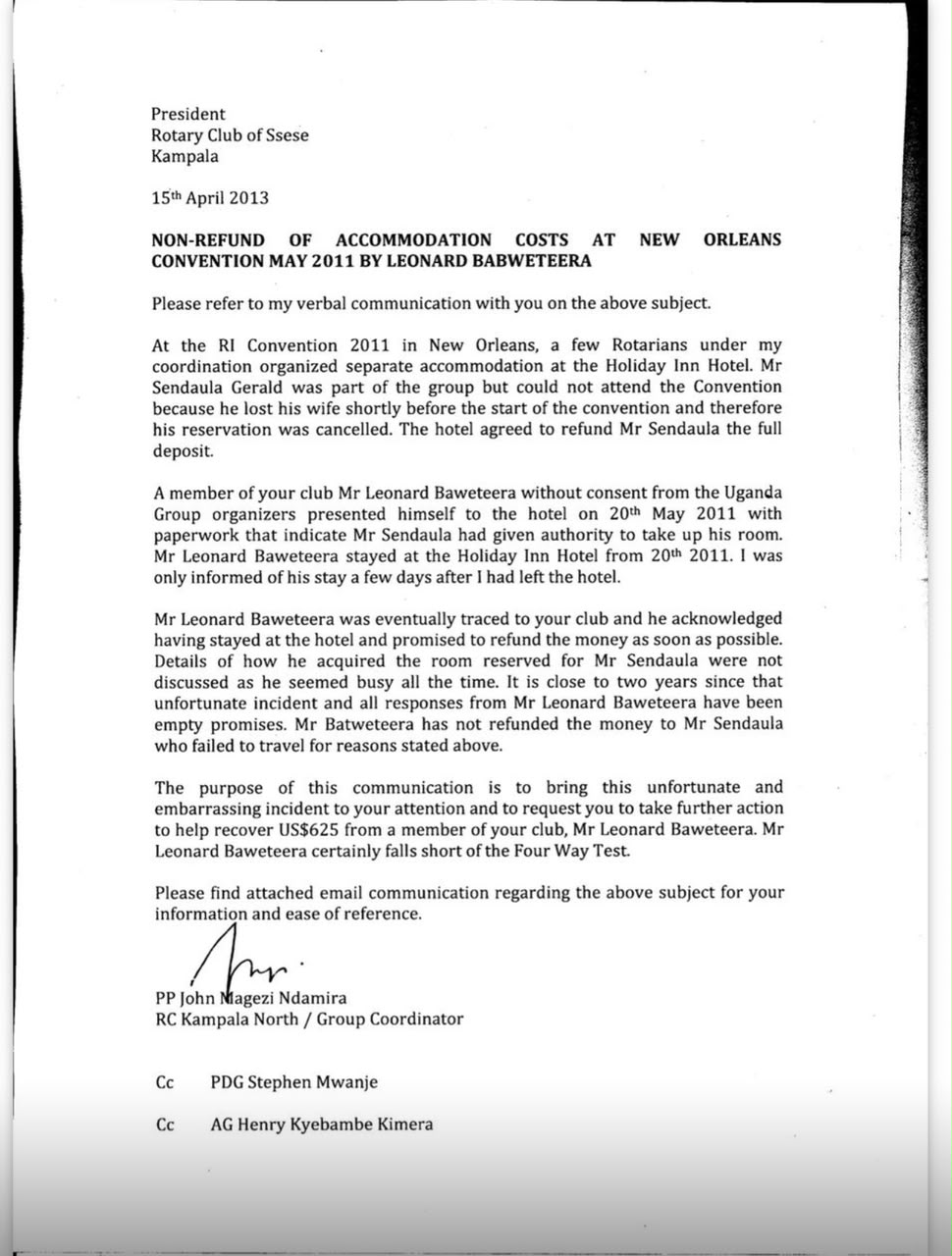
The dated 15 April 2013 from PP John Magezi Ndamira of Rotary Club Kampala North concerning what was described as “Non-Refund of Accommodation Costs at New Orleans Convention May 2011 by Leonard Babweteera.” The letter alleges that:
“A member of your club Leonard Baweteera without consent from the Uganda Group organizers presented himself to the hotel on 20th May 2011 with paperwork that indicate Gerald Sendaula had given authority to take up his room.”
The author further wrote:
“Leonard Babwetera stayed at the Holiday Inn Hotel from 20th 2011.”
The letter continues:
“Leonard Babwetera was eventually traced to your club and he acknowledged having stayed at the hotel and promised to refund the money as soon as possible.”
The author then complained that:
“It is close to two years since that unfortunate incident and all responses from Leonard Babwetera have been empty promises.”
The letter concludes by requesting assistance in recovering:
“US$625 from a member of your club, Leonard Babwetera.”
The allegations contained in those communications remain allegations and should not be interpreted as findings of liability by any court in relation to the current case.
Nevertheless, it is argued that the existence of past controversies involving individuals entrusted with disciplinary authority adds another layer to the concerns court is being asked to examine.
According to the petitioners, the dispute raises fundamental concerns about freedom of expression, fair hearing and the abuse of authority within the club’s leadership structures.
They contend that some leaders have become intolerant of alternative views and constructive criticism, allegedly creating an environment where members who express differing opinions or challenge decisions with what they believe are better ideas are sidelined, silenced or punished instead of being heard.
The petitioners further argue that their right to a fair hearing was compromised by what they describe as a disciplinary process that lacked independence and impartiality. They allege that members of the Disciplinary Committee unlawfully assumed powers reserved for the Management Board and conducted proceedings in which the same individuals effectively acted as investigators, prosecutors and judges. They also claim that the Board of Directors, allegedly influenced by the club president, usurped the powers of both the Management Board and the Club Assembly, which is recognised as the highest decision-making organ of the club.
The applicants additionally accuse the club leadership of abusing its authority by making arbitrary and unilateral decisions in disregard of the club’s bylaws.
They maintain that ordinary members were excluded from the process from the very beginning and were denied meaningful participation in decisions that directly affected the future of the club.
According to the petitioners, a small group of leaders allegedly took controversial decisions without wider consultation and are now attempting to make the broader membership bear responsibility for those actions by involving the club in costly and unnecessary legal battles that risk diverting it from its primary mission of community service.
These allegations form part of the declarations they are seeking from court.
The legal challenge comes at a particularly sensitive time because Rotary clubs are traditionally associated with community service, philanthropy, fellowship and professional networking rather than public legal battles.
Observers say the dispute risks overshadowing the club’s charitable work and could trigger broader discussions about governance, accountability and internal democracy within membership-based organisations.
The applicants insist that the case is bigger than their individual memberships.
They argue that the dispute raises important questions about freedom of expression, fair hearing rights, administrative justice and the limits of disciplinary authority within private organisations.
For them, the case represents a fight over whether members can challenge leaders without fear of punishment and whether disciplinary mechanisms can be used to settle internal political scores.
On the other hand, Rotary International guidelines generally recognise the authority of club boards to take disciplinary action against members under specified circumstances.
Whether the actions taken in this particular case complied with those standards and with the club’s own governing documents is one of the key questions that the High Court is expected to examine.
With emotions running high, reputations on the line and both sides preparing for battle, all eyes are now fixed on the courtroom where Justice Bonny Isaac Teko is expected to begin hearing a case that could have far-reaching consequences for the future of the Rotary Club of Kampala Ssese Islands and the individuals at the centre of the storm.
For the expelled members, the objective is clear: they want their names cleared, their expulsions nullified and their memberships restored.
For the club leadership, the proceedings are likely to become a test of whether the disciplinary measures they imposed can withstand judicial scrutiny.
What began as an internal disagreement among Rotarians has now transformed into a major legal confrontation whose outcome could reshape the future of the club for years to come.
GOT A HOT STORY? EMAIL: redpeppertips@gmail.
SOURCE PROTECTION/CONFIDENTIALITY IS OUR NO.1 PRIORITY.
About Post Author