ID NIGHTMARE! Ugandans Curse NIRA Over R.Nile Like-Long Queues, Confusing Collection Points & New Cards That Can’t Be Read
By Our Reporter
Ugandans are lining up across the country to collect new national identity cards, with the exercise turning into a nightmare of long queues, confusing collection points and citizens being sent from one district to another in search of their IDs.
Citizens who registered in Wakiso District say they are being forced to move from one collection centre to another, with some being directed to Kira, Nansana, Makindye-Ssabagabo, Entebbe and other areas to collect their cards.
The queues, according to frustrated citizens, are stretching for hours and, in some places, resemble the River Nile.
And now, with thousands of Ugandans rushing to collect renewed national IDs, the question being asked is simple: why can’t NIRA decentralise collection to parish level?
The pressure has been made worse by the fact that many old national IDs expired around the same period.
At the same time, children who were registered years ago have now grown into adults and are joining the queue to collect their first cards.
But there is another twist.
In some places, the new IDs are reportedly not yet being accepted for certain transactions, with citizens instead being asked to produce their old cards.
For Ugandans who have already spent hours in queues trying to obtain the new cards, the situation is becoming a source of anger and frustration.
And behind the current chaos lies a damning picture of the National Identification and Registration Authority (NIRA), contained in the Auditor General’s findings.
The institution charged with defining the identity of every Ugandan is itself facing what amounts to an identity crisis.
The audit exposes funding gaps, staffing shortages, system failures, delayed IDs, weak planning, procurement shortcomings, poor asset management and serious weaknesses in the country’s civil registration systems.
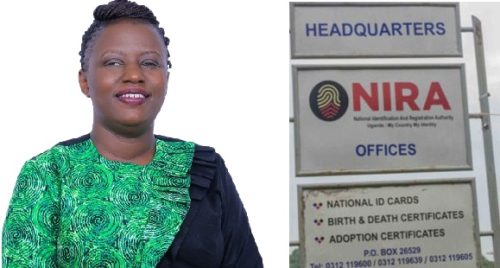
At the centre of the storm is former Executive Director Rosemary Kisembo, who took over on May 14, 2021, with a strong ICT background from the Uganda National Roads Authority (UNRA).
She replaced Judy Obitra Gama, whose tenure ended after a string of challenges at the authority.
Kisembo’s contract expired in May 2026, putting the leadership of NIRA under fresh scrutiny as the institution struggles to clear a massive backlog of national IDs.
“She came in as the technocrat to fix things,” an insider told RedPepper. “But now the system is exposing her. The pressure is unbearable.”
SHS6BN DEBT
According to the Auditor General, NIRA was sitting on domestic arrears amounting to UGX6.075 billion.
This was an increase from UGX6.025 billion recorded the previous year.
While the increase may appear relatively small compared with NIRA’s wider budget, the Auditor General’s findings point to broader financial and planning weaknesses within the authority.
But the biggest headache is manpower.
NIRA has an approved structure of 571 positions, but only 422 were filled.
That leaves 149 positions vacant — representing a 26 percent vacancy rate.
Several critical departments are badly understaffed.
Internal Audit has a 67 percent staffing gap.
Communication and Public Relations is also short by 67 percent.
ICT is missing nearly half of its required workforce.
Civil Registration Services and Legal Affairs are also severely depleted.
“How do you run a national identity system without people?” an insider asked. “This is not just a gap — it’s a collapse.”
NO PERMANENT HOME
NIRA is also operating without a permanent headquarters.
The authority has been operating from temporary premises at Kololo Independence Grounds.
The arrangement has raised concerns about efficiency and public service delivery.
Even more troubling, according to the audit findings, is the absence of a front desk or customer care officer at the headquarters to guide citizens seeking services.
For an institution serving millions of Ugandans, the lack of a proper customer-care structure has left citizens struggling to find information and direction.
“You go there and it’s confusion,” one citizen complained. “No direction, no help, just queues and frustration.”
PROCUREMENT TROUBLES
The problems extend into procurement.
NIRA failed to indicate procurements reserved for registered associations.
As a result, no contracts were awarded to such associations as required by the relevant guidelines.
The Procurement and Disposal Unit itself is understaffed and under-resourced.
Only two of the three required staff positions were filled.
The unit also conducted just one training out of four that had been planned.
“This is a system limping from one mistake to another,” a source said.
ASSETS IN CHAOS
NIRA has a transport policy, but the authority lacks a comprehensive framework for managing other important assets, including ICT equipment and furniture.
The audit also points to weaknesses in maintenance records, asset tracking and accountability.
“It’s like running a digital authority with analogue thinking,” an analyst remarked.
SHS69.7BN FUNDING GAP
NIRA’s strategic operations have also been hit by a major funding shortfall.
The authority planned to receive UGX751.9 billion, but faced a funding gap of UGX69.72 billion — about nine percent of the planned amount.
The shortfall affected implementation of key interventions.
Even more worrying, NIRA failed to finalise its new strategic plan aligned to national priorities by the July 2025 deadline.
The authority was therefore left operating without the strategic roadmap that was supposed to guide its next phase.
The National Planning Authority rated NIRA’s budget compliance at only 63.2 percent.
Performance indicators were also criticised for being vague, generic and, in some cases, inappropriate.
“It’s like they are measuring shadows,” a policy expert said.
THE ID NIGHTMARE
But it is the national ID exercise where the crisis becomes most visible to ordinary Ugandans.
NIRA’s mass enrolment and ID renewal programme has been hit by funding shortages, staffing gaps and operational challenges.
Over a three-year period, UGX666.85 billion was budgeted for the exercise.
However, only UGX410.05 billion was received.
That left a massive funding shortfall of UGX256.8 billion.
And even the money that was received was not fully utilised.
UGX15.24 billion remained unspent in the 2024/2025 financial year.
“They don’t have enough money, and the little they have, they don’t use properly,” an insider said.
The staffing problem made matters worse.
NIRA had planned to deploy 13,787 temporary workers for the mass enrolment exercise.
Only 9,809 were deployed.
That left a shortfall of nearly 4,000 workers.
The result has been slow processing, delayed approvals and mounting queues.
As of October 2025, more than 11.5 million Ugandans had applied for ID renewals.
But only 45 percent had been cleared for printing.
For first-time applicants, the situation was even worse.
Only 0.2 percent had been approved for printing.
“That is basically zero,” an analyst said. “It means the system is not working.”
Even among applicants who had been approved, only 41 percent of the cards had actually been printed.
And then came another shocking revelation.
Out of 4.3 million applications for new National Identification Numbers, or NINs, not a single one had been allocated as of the period covered by the audit.
By late October 2025, a staggering 17 million applicants were still waiting for their national IDs.
“This is not just delay,” a source said. “It is a complete system failure.”
WHY NOT PARISH COLLECTION?
The current situation has reignited calls for NIRA to rethink how IDs are distributed.
Citizens, particularly in heavily populated areas such as Wakiso, are asking why collection cannot be brought closer to the people.
Instead of forcing citizens to travel to distant district or municipal collection points, NIRA could decentralise the process to parishes.
Such an arrangement would reduce congestion at collection centres and cut the transport costs and time currently being spent by citizens chasing their cards.
For Wakiso residents, the problem is particularly acute.
A person who registered in one area can reportedly be directed to another location to collect the card.
One citizen may be sent to Kira.
Another to Nansana.
Another to Makindye-Ssabagabo.
Another to Entebbe.
The result is a frustrating game of “go there, come back, try another centre.”
And with millions seeking new cards at the same time, the pressure on collection points has become enormous.
SYSTEM CAN’T TALK TO ITSELF
The audit also exposes problems beyond national IDs.
Marriage registration systems are affected by ICT gaps and weak data security.
Birth and death registration processes face delays.
The National Security Information System (NSIS), which serves as the backbone of NIRA’s operations, cannot register births and deaths.
It is also not fully integrated with third-party systems.
Data migration has been delayed and some modules remain incomplete.
“There is nothing ‘national’ about a system that cannot talk to itself,” an ICT expert observed.
The authority also does not have a business continuity site.
That means a major disaster affecting its main systems could potentially disrupt the country’s entire identity infrastructure.
“This is a national security risk,” a senior official warned.
The audit further points to inconsistencies in data records, weaknesses in issuing death certificates and delays across civil registration services.
PARLIAMENT’S WARNINGS
Oversight has also come under scrutiny.
Of 11 recommendations issued by Parliament’s Public Accounts Committee, only two had been fully implemented.
The rest were either partially implemented or ignored.
At the top, Board Chairman Joseph N. Biribonwa faces mounting pressure over governance concerns.
Sources also describe an atmosphere of internal fights, leaks and lobbying.
“There is a war going on,” a source said. “People are feeding information to State House, trying to influence what happens next.”
KISEMBO’S FUTURE
The leadership question now hangs over NIRA.
Kisembo was appointed in May 2021 as the technocrat expected to bring an ICT-driven transformation to the authority.
But the Auditor General’s findings have put her tenure under intense scrutiny.
Sources claimed she was lobbying for another term as the problems mounted.
“It’s squeaky bum time,” an insider said.
The shadow of her predecessor, Judy Obitra Gama, also hangs over the situation.
Gama’s tenure ended after challenges surrounding NIRA’s performance.
Now the big question is whether the current leadership has done enough to justify continuity or whether the authority requires a fresh start.
“Yes, she has achievements,” a senior observer admitted. “The ID renewal process did start. Systems were introduced. But leadership is judged on outcomes — and right now, the outcomes are deeply troubling.”
For ordinary Ugandans, however, the debate is much simpler.
They want their IDs.
They do not want to travel across districts.
They do not want to spend entire days in queues.
And they certainly do not want to be handed a new card only to be told somewhere else that they must produce the old one.
As millions continue to wait, NIRA faces the biggest test of its credibility yet:
Can the authority fix the system before the queues become Uganda’s new national identity?
GOT A HOT STORY? LET US KNOW!
Got breaking news, explosive secrets, or hard evidence?
Email us: redpeppertips@gmail.com
We accept tips, documents, videos, photos, and recordings—the more evidence you have, the better.
CONFIDENTIALITY IS OUR TOP PRIORITY. SOURCES ARE ALWAYS PROTECTED!
About Post Author