SLEEPING SICKNESS FIGHT IN DISARRAY! Inside Missing Assets, Unclaimed Millions & Shambolic Handover at MAAIF’s COCTU
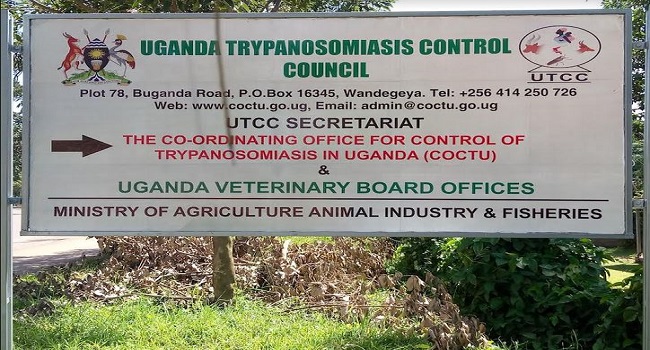
The government’s once-celebrated war against tsetse flies and sleeping sickness may have succeeded in wiping out Human African Trypanosomiasis in Uganda by 2020, but the closure of the agency that spearheaded the fight has left behind a catalogue of administrative, financial and asset management failures that have now been laid bare by the Auditor General.
The latest Auditor General’s report on the Coordinating Office for Control of Trypanosomiasis in Uganda (COCTU) for the financial year ended 30th September 2024 exposes glaring weaknesses in the management of public resources during the transition of the institution into the Ministry of Agriculture, Animal Industry and Fisheries (MAAIF).
Although the audit opinion remained unqualified, the report paints a troubling picture of poor accountability, incomplete asset transfers, outstanding receivables, undocumented government property and a transition process that appears to have been handled without sufficient attention to detail.
COCTU was established under the Uganda Trypanosomiasis Control Council Act of 1992 to coordinate Uganda’s national campaign against tsetse flies and trypanosomiasis using the internationally recognised One Health approach that brought together human, animal and environmental health sectors.
The institution worked closely with the Ministries of Agriculture, Health, Finance, Tourism, Local Government and Environment, while partnering with international organisations including the World Health Organization (WHO), Food and Agriculture Organization (FAO), International Atomic Energy Agency (IAEA), African Union, IFAD and other global agencies.
Following Uganda’s remarkable achievement of reducing Human African Trypanosomiasis cases to zero by 2020, Parliament passed the Uganda Trypanosomiasis (Repeal) Bill, 2024, dissolving COCTU and mainstreaming its functions into MAAIF under the Directorate of Animal Resources, Department of Entomology.
However, as officials celebrated the institutional transition, the Auditor General discovered numerous unresolved issues that now cast doubt on how the closure process was managed.
One of the first issues highlighted involves money that is still outstanding.
The Auditor General found that COCTU was owed USD 4,837, equivalent to about UGX 17.84 million, by the Liverpool School of Tropical Medicine (LSTM) for medicines that had never been delivered.
The outstanding receivable remained unresolved at the time of closure, raising questions about whether sufficient efforts had been made to recover public funds and ensure accountability before winding up the institution.
The biggest concern, however, revolves around government assets.
According to the audit, COCTU’s handover report dated 1st October 2024 listed a total of 238 government assets.
Shockingly, only 109 assets, representing just 46 percent of the total and valued at UGX 564.71 million, had been included in the handover process but had still not been integrated into MAAIF’s official assets register.
This means that nearly half of the assets formally handed over had not yet been captured in the ministry’s records, exposing them to risks associated with weak accountability and poor asset control.
The Auditor General’s physical inspection painted an even more disturbing picture.
Inspectors found that 15 government assets valued at UGX 4.90 million had never been engraved, making identification and tracking difficult.
Another 15 assets were already old and faulty, raising concerns about whether sufficient maintenance and replacement plans had been implemented before the institution was dissolved.
The most astonishing revelation came when auditors examined the remaining assets.
A staggering 129 assets listed in the handover report had no monetary values attached whatsoever.
Even more worrying, these assets could not be traced in MAAIF’s assets register, creating uncertainty over their official ownership, valuation and accountability.
Such omissions, the report suggests, leave public property vulnerable to mismanagement, loss or misuse during institutional transitions.
The Auditor General also highlighted uncertainty surrounding one of COCTU’s key physical properties.
The institution owns a resource centre building situated on a four-acre parcel of land in Njeru.
However, the land belongs to the National Animal Genetic Resources Centre and Data Bank (NAGRIC & DB).
Although both the resource centre and land appear in NAGRIC & DB’s register, the Auditor General noted that they were disclosed with encumbrances, signalling unresolved issues relating to ownership or legal interests that still require attention.
The audit further examined the handling of staff during the rationalisation process.
By the time COCTU officially closed on 30th September 2024, the institution had 16 employees.
Only three staff members were absorbed into MAAIF and the Ministry of Internal Affairs.
The contracts of the remaining 13 employees were simply allowed to expire without renewal or extension.
Among the three employees whose contracts extended beyond the closure date, two received all their accrued terminal benefits while the third employee was not paid because he had already transitioned to another public institution, the NGO Bureau.
The Auditor General independently recalculated the terminal benefits paid to the two officers and confirmed that the payments were accurate and consistent with their employment contracts.
While the staff payments themselves did not reveal irregularities, the report nevertheless illustrates the broader impact of institutional rationalisation on employees whose careers abruptly came to an end following the repeal of the governing law.
The audit concludes by noting that COCTU’s former responsibilities have now been fully mainstreamed under the Directorate of Animal Resources, Department of Entomology in MAAIF, effectively bringing to an end more than three decades of an institution that once coordinated Uganda’s battle against one of Africa’s deadliest neglected tropical diseases.
Yet despite the successful elimination of Human African Trypanosomiasis, the Auditor General’s report suggests that the administrative closure of the institution did not receive the same level of discipline that characterised Uganda’s public health success against the disease itself.
Instead, the transition has been overshadowed by unresolved receivables, incomplete asset transfers, assets without values, unregistered government property, equipment lacking proper identification and lingering questions over the management of public resources during one of government’s major rationalisation exercises.
The findings are likely to pile pressure on officials who managed COCTU’s final days and those responsible for receiving its functions within MAAIF to explain how an institution that coordinated national disease control for decades could be dissolved while leaving behind assets that cannot easily be traced, government property whose values remain unknown, outstanding receivables yet to be recovered and administrative gaps that the Auditor General says still require urgent attention before the chapter on COCTU can truly be closed.
GOT A HOT STORY? LET US KNOW!
Got breaking news, explosive secrets, or hard evidence?
Email us: redpeppertips@gmail.com
We accept tips, documents, videos, photos, and recordings—the more evidence you have, the better.
CONFIDENTIALITY IS OUR TOP PRIORITY. SOURCES ARE ALWAYS PROTECTED!
About Post Author