BILLIONS IN THE MUD! Leaked Dossier Exposes Unfinished Roads, Overpayments, Idle Medical Equipment & Shocking Gaps in OPM’s DRDIP Project
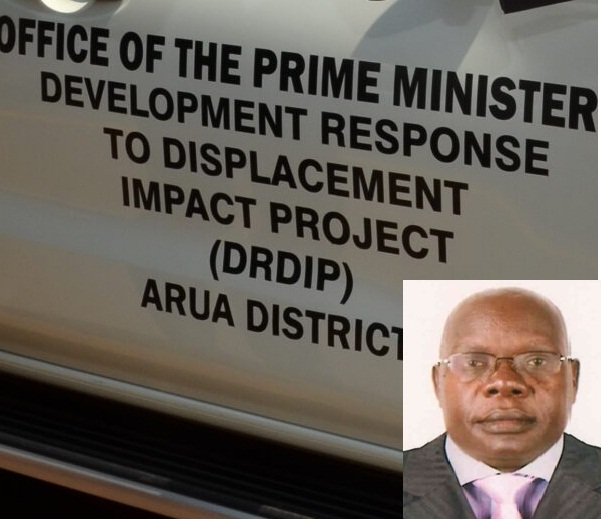
DRDIP donated car to Arua district. Inset is Robert Limlim Director DRDIP
A multi-billion-shilling World Bank-funded project established to improve the lives of refugees and host communities has been rocked by a litany of financial, procurement and implementation failures after the Auditor General exposed serious weaknesses in the management of the Development Response to Displacement Impacts Project (DRDIP) under the Office of the Prime Minister (OPM).
The findings, contained in the Auditor General’s report for the seven-month period from 1st July 2024 to 31st January 2025, reveal that despite the project receiving an unqualified audit opinion, those responsible for implementing the programme left behind incomplete roads, unfinished bridges, partially completed schools, idle medical equipment, questionable payments, unpaid contractors and nearly UGX 1 billion that remained in project accounts after closure.
The DRDIP, headed by Director Dr. Robert Limlim, is one of Uganda’s biggest refugee-support interventions financed by the World Bank through a USD 150 million grant and a USD 50 million IDA loan.
Implemented by the Office of the Prime Minister, the project was designed to improve access to health services, education, water, sanitation, roads, markets, livelihoods and environmental protection for refugees and host communities across refugee-hosting districts including Arua, Koboko, Yumbe, Moyo, Adjumani, Obongi, Lamwo, Hoima, Kikuube, Kiryandongo, Isingiro, Kyegegwa and Kamwenge.
The programme was established against the backdrop of Uganda becoming Africa’s largest refugee-hosting country, sheltering more than 1.35 million refugees, most of them from South Sudan, the Democratic Republic of Congo, Burundi and Somalia.
Yet instead of closing with a clean record after years of implementation, the Auditor General’s report exposes a project plagued by delayed works, weak financial management and questionable contract administration.
Ironically, the audit begins with good news that ultimately became overshadowed by administrative failures.
At project closure, DRDIP registered a net foreign exchange gain of USD 758,960 across both grant and credit components. The gain provided additional funds that were used to meet expenses such as rent, staff costs and motor vehicle maintenance.
However, the positive development was quickly eclipsed by concerns over how project finances were managed.
The Auditor General found that after the project officially closed, UGX 970.75 million that remained on the OPM District Support Account was never transferred back to the Consolidated Fund as required.
The report does not indicate any justification for why nearly one billion shillings remained outside the Consolidated Fund after project closure.
Contractors were also left counting losses.
The audit found that three project contracts had verified and approved variations amounting to UGX 836.75 million.
These variations had already been assessed and approved by the Project Engineer.
However, by the time the project closed, the contractors had not been paid a single shilling for the verified work, and no explanation was provided for the failure to settle the outstanding obligations.
Funding shortfalls also crippled implementation.
Although the revised budget for the seven-month period stood at UGX 12.63 billion, comprising UGX 5.85 billion in unspent balances and UGX 6.79 billion in savings realised from district activities, only UGX 10.03 billion was actually realised.
The resulting shortfall of UGX 2.61 billion meant the project achieved only 80 percent of its expected funding.
The consequences were immediate.
According to the Auditor General, several planned activities were either only partially implemented or never implemented at all.
These included the construction of markets, roads, classrooms, district headquarters and bridges that were intended to improve services for both refugees and host communities.
The audit further questioned expenditure in Isingiro District.
Project management transferred UGX 91.31 million to Isingiro District Local Government for payment of variations on the rehabilitation of the Kibwera-Kihihi Road.
However, the Auditor General found that the expenditure had never been budgeted for in the approved schedule of variations.
Even where money was available, not all of it was used.
Out of the UGX 10.03 billion available, only UGX 9.061 billion was spent, leaving UGX 971 million idle at project closure.
The audit says this resulted in an absorption rate of only 90 percent, and because the funds remained unused, some legitimate project expenses were never paid.
The Auditor General also uncovered worrying issues surrounding medical equipment procured under the project.
The programme purchased equipment for 39 health centres at a contract cost of UGX 9.076 billion.
Yet during inspection, auditors found that many facilities lacked adequate storage space for the equipment.
Some of the expensive equipment was also found to be underutilised, raising concerns that taxpayers and donors may not be getting value for money from the investment.
One of the most alarming findings concerns the construction of Ore Bridge in Yumbe District.
The project approved variation payments worth UGX 520 million.
However, auditors discovered that the contractor had been overpaid by UGX 370 million.
The report also found that works under the variation had been completed irregularly using the force account mechanism.
To make matters worse, the contractor’s performance contract had already expired even though key works remained unfinished.
These included gabion works, drainage works, grading of five kilometres on each side of the road and application of bituminous paint.
The audit then shifted attention to another bridge project connecting Belle and Kochi Boma Village in Itula Sub-county, Obongi District.
There, auditors found that the project failed to deduct UGX 379.92 million in retention money from payment certificates.
Retention funds are intended to safeguard government against defective works, yet they were not withheld as required.
Even after payments had been made, several critical components of the bridge remained incomplete.
These included approach slabs on both sides, approach fill works, gabion protection, deck slab works and drainage infrastructure.
Road projects also came under heavy criticism.
The construction of community access roads stretching from Labworoyeng, Pawena, Laliya, Pawic, Lagot Anyara to Beyogoya-Prelnor Junction, valued at UGX 1.50 billion, revealed numerous shortcomings.
According to the Auditor General, additional works were awarded without approval from both the District Implementation Support Team (DIST) and the Project Implementation Support Team (PIST).
The roads themselves remained incomplete, with missing gravel, poor grading, absence of culverts at critical crossing points and eventual abandonment of the construction site by the contractor.
Education infrastructure projects fared no better.
Inspection of building works at Palabek Secondary School in Lamwo District and Paluda Secondary School in Moyo District exposed another series of irregularities.
Additional works and costs were awarded before receiving approval from DIST and PIST.
Following changes in the scope of works, no revised contract was prepared or signed.
At Palabek Secondary School, auditors identified an overpayment of UGX 133.41 million.
Meanwhile, at Paluda Secondary School, final payments had already been processed despite the expected construction works remaining incomplete.
Beyond physical infrastructure, the Auditor General also questioned the long-term sustainability of the programme.
The report concludes that DRDIP failed to fully operationalise its own Project Sustainability Action Plan, casting uncertainty over whether the investments made over several years will continue benefiting refugee-hosting communities after donor support ends.
The findings present an uncomfortable picture for one of Uganda’s flagship refugee-development programmes.
Instead of leaving behind fully completed roads, bridges, schools, health facilities and community infrastructure, the closure audit paints a story of incomplete projects, overpayments, idle equipment, unpaid contractors, unbudgeted expenditures, unspent funds and weak contract management.
For a project established to improve livelihoods in communities carrying the enormous burden of hosting more than a million refugees, the Auditor General’s report raises difficult questions about accountability within the Office of the Prime Minister and project management.
The audit is likely to intensify pressure on officials responsible for DRDIP’s implementation to explain how billions of shillings were managed, why approved works remained unfinished, why contractors were overpaid in some cases but left unpaid in others, why expensive medical equipment lacks proper storage and utilisation, and why a programme intended to transform some of Uganda’s most vulnerable communities closed with so many unresolved issues still hanging over it.
GOT A HOT STORY? LET US KNOW!
Got breaking news, explosive secrets, or hard evidence?
Email us: redpeppertips@gmail.com
We accept tips, documents, videos, photos, and recordings—the more evidence you have, the better.
CONFIDENTIALITY IS OUR TOP PRIORITY. SOURCES ARE ALWAYS PROTECTED!
About Post Author