MAFIA BURN ENERGY BID DOCUMENTS! Shock as Mystery Fire at Amber House Throws World Bank’s Sh2.2Trn Electricity Project Into Chaos
By Pepper Intelligence Unit
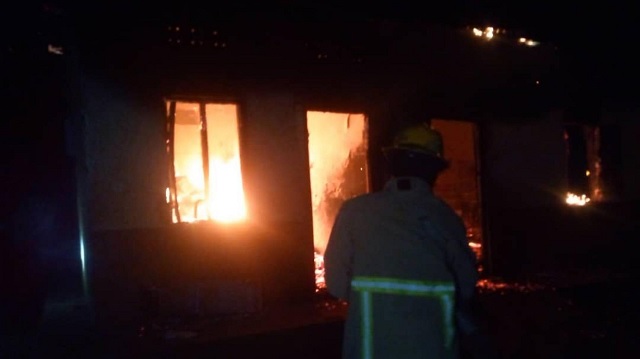
KAMPALA – A mysterious fire that reduced crucial electricity tender documents to ashes at the Ministry of Energy and Mineral Development has thrown a USD608 million (about Shs2.2 trillion) World Bank-funded electricity project into uncertainty, with insiders alleging a bitter procurement war involving powerful interests determined to control one of Uganda’s biggest infrastructure programmes.
RedPepper has learnt that the fire reportedly occurred shortly after the completion of the technical evaluation process for the procurement and supply of grid expansion and connection materials under the Electricity Access Scale-Up Project (EASP), just as the Ministry was preparing to submit the names of successful bidders to the World Bank for its mandatory “No Objection.”
The affected procurement, referenced MEMD/SUPLS/2024-25/00047/EASP, covers the procurement and supply of Grid Expansion and Connection Materials valued at about USD100 million (approximately Shs365 billion).
The procurement forms part of the larger USD608 million (approximately Shs2.2 trillion) World Bank financing for the Electricity Access Scale-Up Project.
The invitation to bid was published in April 2025, with bidders submitting their documents on August 11, 2025. The bids were opened in the presence of all bidders on the same day.
The technical evaluation process officially commenced on August 18, 2025, with a team of more than 30 evaluators drawn from the Ministry of Energy and affiliated agencies camping at Source of the Nile Hotel in Jinja.
The evaluation exercise continued until November 2025, when the committee concluded its work and prepared to move the procurement to the next stage.
However, after nearly four months of silence—from November 2025 to March 2026—bidders were stunned to learn that the original technical bid documents had allegedly been destroyed in a fire at the Ministry headquarters at Amber House in Kampala.
The incident forced the Ministry to cancel the entire procurement process.
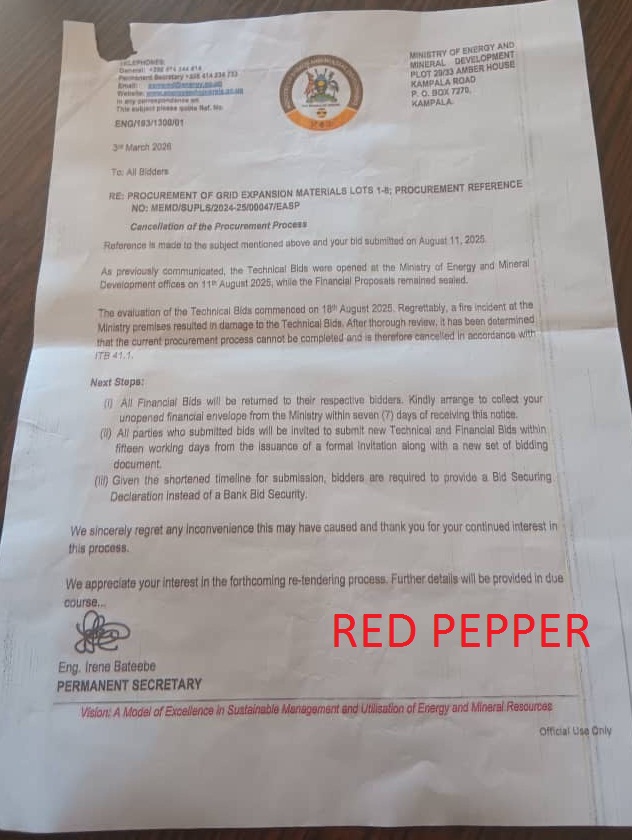
In a memo dated March 3, 2026, addressed to all bidders, the Permanent Secretary, Eng. Irene Bateebe, formally communicated the cancellation.
“The evaluation of the Technical Bids commenced on 18th August 2025. Regrettably, a fire incident at the Ministry premises resulted in damage to the Technical Bids.”
She further informed bidders:
“After thorough review, it has been determined that the current procurement process cannot be completed and is therefore cancelled in accordance with ITB 41.1.”
The communication shocked bidders who had waited several months for the outcome of the evaluation process.
BACKGROUND
The Electricity Access Scale-Up Project traces its origins to around 2020, when the Government of Uganda, through the now-defunct Rural Electrification Agency (REA), prepared a funding proposal to the World Bank seeking financing for a nationwide electricity expansion programme.
The proposal was approved, with the Government securing USD608 million from the World Bank to implement the project over a period of five years.
The Electricity Access Scale-Up Project is intended to support Uganda’s efforts to increase electricity access for households, refugee and host communities, industrial parks, commercial enterprises and public institutions.
The project also finances short grid extensions across the country.
The programme comprises five major components: Grid Expansion and Connectivity; Financial Intermediation; Energy Access in Refugee Host Communities; Project Implementation Support; and Affordable Modern Energy Solutions and Contingent Emergency Response.
OVER 1.5 MILLION CONNECTIONS TARGETED
Under the electricity connectivity component, Government plans to deliver approximately 1,571,500 electricity connections, covering both on-grid and off-grid beneficiaries.
Initially, the Ministry signed an Implementation Agreement with Umeme Limited, assigning the company responsibility for delivering 663,500 electricity connections under the EASP.
However, by the expiry of Umeme’s concession on March 31, 2025, the company had completed only 155,088 connections.
Following Umeme’s exit, her successor-the Uganda Electricity Distribution Company Limited (UEDCL) signed fresh Implementation Agreements with the Ministry in July 2025.
Under the agreements, UEDCL assumed responsibility for delivering 896,435 electricity connections.
The company has since commenced implementation.
Applicants seeking electricity connections under the programme are only required to pay UGX26,550, comprising UGX23,600 for inspection fees and UGX2,950 or UGX6,400 for the initial electricity units.
As of June 30, 2026, UEDCL had completed 79,040 electricity connections under the EASP Results-Based Financing programme.
The Grid Expansion component also provides for construction of approximately 2,900 kilometres of Medium Voltage (MV) lines, 3,100 kilometres of Low Voltage (LV) lines, and installation of approximately 1,200 distribution transformers across more than 100 districts.
Nearly 50 percent of the MV and LV network under the project is earmarked for refugee-hosting districts.
The project will electrify refugee-hosting districts including Adjumani, Isingiro, Kamwenge, Kikuube, Kiryandongo, Koboko, Kyegegwa, Lamwo, Obongi, Madi Okollo, Terego and Yumbe.
It also targets electricity infrastructure in the industrial parks of Nebbi, Pader, Soroti, Kasese, Rukungiri and Kisoro.
Another major procurement under the programme involves the supply of the remaining 70 percent of service connection materials required to facilitate nationwide electricity connections.
MISERABLE PERFORMANCE, PARLIAMENT HEAT & THE SHS365BN PROCUREMENT STANDOFF
Despite becoming effective on July 20, 2023, the Electricity Access Scale-Up Project (EASP) is now racing against time.
The project is being implemented jointly by the Ministry of Energy and Mineral Development (MEMD) and the Uganda Energy Credit Capitalisation Company (UECCC) and is expected to close on June 30, 2027.
However, with barely 10 months remaining before the project closes, implementation remains far behind schedule.
According to figures from the Ministry of Energy, the project’s financial performance as of the end of Quarter Four of Financial Year 2025/2026 stood at USD190,767,885, representing only 31.3 percent of the total USD608 million budget.
Critics have described the implementation rate as disappointing.
“If the project were to be graded under Uganda’s new Competency-Based Curriculum, it would score an F9—Elementary Performance, meaning it remains below the basic level of competency,” one analyst remarked.
The slow absorption of funds has raised concern among stakeholders, particularly because the project is expected to transform electricity access across Uganda through both grid expansion and subsidised household connections.
MINISTER BLAMES SUPPLIERS
Appearing before Parliament on Wednesday, State Minister for Energy Opolot Okasai attributed the slow implementation largely to delays by local suppliers.
The Minister told Parliament that some suppliers awarded contracts to supply electricity connection materials had failed to fulfil their obligations in time.
“Going forward, UEDCL was cleared to open up to international suppliers as we build capacity in local manufacturing of electricity connection materials alongside other local industries,” Okasai told Parliament.
His statement suggested that delayed material deliveries had significantly slowed implementation of the ambitious electrification programme.
DIFFERENT STORY EMERGES
However, information obtained by RedPepper presents a different account.
According to multiple sources familiar with the procurement, the major bottleneck is not suppliers but internal disputes over the procurement process.
Several sources alleged that powerful interests within the Ministry have been battling over control of the lucrative contracts under the World Bank-funded programme.
The sources alleged that highly connected suppliers were working with some Ministry officials in attempts to influence the procurement process.
One source told RedPepper: “Procurement of the Grid Expansion Materials and Bulk Materials Suppliers has been hit by a mafia syndicate at the Ministry of Energy. The bids were allegedly burnt in exchange for huge bribes.”
The source further disputed the Minister’s explanation.
“The Minister [Okasai] should not blame suppliers because no material supply contract has been awarded by the Ministry.”
RedPepper has not independently verified these allegations.
WAR INSIDE AMBER HOUSE
According to insiders, tensions have been building since the former Rural Electrification Agency (REA) was merged back into the Ministry following Government’s rationalisation programme.
Sources alleged that disagreements emerged between officials who originally served under the Ministry’s Rural Electrification Department and those absorbed from REA.
The disagreement allegedly centred on who would control implementation of one of the country’s biggest electricity programmes.
According to the sources, the internal rivalry eventually spilled into the procurement process.
They alleged that the destruction of the original bid documents significantly delayed procurement of service connection materials, which account for nearly 70 percent of the entire project.
THE SHS365BN TENDER
In April 2025, the Ministry invited bids under Procurement Reference MEMD/SUPLS/2024-25/00047/EASP.
The procurement covered eight separate lots for supply of Grid Expansion Materials valued at approximately USD100 million (about Shs365 billion).
More than 200 bidders responded.
Bid submission closed on August 11, 2025, before the bids were publicly opened in the presence of bidders.
Technical evaluation commenced on August 18, 2025 at Source of the Nile Hotel in Jinja, where evaluators spent several months assessing submissions.
The evaluation exercise concluded in November 2025.
The hotel where the evaluation was conducted has previously been linked to former Energy Minister Daudi Migereko.
Following completion of the evaluation exercise, bidders expected the Ministry to proceed with financial evaluation and contract award.
Instead, months passed without communication.
Then, in March 2026, bidders received official communication informing them that the procurement had been cancelled after the technical bid documents were damaged in a fire.
PS CANCELS PROCUREMENT
In the March 3, 2026 communication seen by RedPepper and referenced ENG/103/1500/01, Permanent Secretary Eng. Irene Bateebe instructed bidders that the procurement had been cancelled.
The memo stated: “Regrettably, a fire incident at the Ministry premises resulted in damage to the Technical Bids.”
It added: “After thorough review, it has been determined that the current procurement process cannot be completed and is therefore cancelled in accordance with ITB 41.1.”
The Ministry informed bidders that: All financial bids would be returned unopened. Bidders were required to collect their sealed financial envelopes within seven days. Fresh Technical and Financial Bids would be invited within fifteen working days. A Bid Securing Declaration would replace the earlier Bank Bid Security requirement because of the shortened timelines.
The Permanent Secretary concluded: “We sincerely regret any inconvenience this may have caused and thank you for your continued interest in this process.”
Fresh bid submissions were eventually received on May 11, 2026.
FIRE MYSTERY, CCTV QUESTIONS, OFFICIALS EXIT AS WORLD BANK LOSES PATIENCE
Even after the procurement was cancelled and fresh bids submitted, questions surrounding the mysterious fire at Amber House have continued to multiply.
According to information obtained by RedPepper, the Police report into the fire has never been made public despite repeated demands by some bidders during proceedings before the Public Procurement and Disposal of Public Assets Authority (PPDA).
The absence of the report has fuelled speculation among stakeholders seeking answers about how original bid documents for one of Uganda’s biggest electricity procurements could be destroyed after completion of the evaluation process.
INSIDERS SPEAK
Several insiders within the Ministry told RedPepper that they suspect the fire was not accidental.
According to these sources, some officials allegedly colluded with bidders whose technical submissions had not successfully progressed through the evaluation process.
The sources further alleged that certain officials had received substantial sums of money from some bidders but later failed to deliver the expected outcomes.
According to the allegations, the destruction of the bid documents became one way of collapsing the procurement process and forcing a fresh bidding exercise.
RedPepper has not independently verified these allegations, and no official investigation has publicly concluded that the fire was deliberately started or identified those responsible.
One insider told RedPepper: “Some officials had allegedly received huge sums of money from bidders but later failed to account for the funds. It is alleged that the bids were burnt, leading to cancellation of the procurement.”
CCTV CAMERAS ‘NOT WORKING’
Another issue raising eyebrows among insiders is the reported state of the security surveillance system at Amber House.
Sources claimed that at the time the fire occurred, the Ministry headquarters’ CCTV cameras were reportedly not functioning.
If true, the failure of the surveillance system at the time such sensitive procurement records were allegedly destroyed has raised further questions among bidders and other stakeholders.
One source told RedPepper:
“This points to an insider job. It is very wrong for the Minister to blame suppliers when the problems are allegedly within the Ministry itself.”
Again, this allegation has not been independently verified.
TOP OFFICIALS LEAVE PROJECT
RedPepper has also established that some officials associated with the project have since left their positions.
Among those mentioned by sources is John Kokas Omiat, who served as the Procurement Specialist under the Electricity Access Scale-Up Project.
According to sources, Omiat was the custodian of the original bid documents that were later destroyed in the fire.
Sources further alleged that Omiat was recruited during the establishment of the project and that his recruitment was influenced by former Energy Minister Ruth Nankabirwa.
The same sources also claimed he was considered close to former Speaker of Parliament Anita Among.
RedPepper has not independently verified these claims.
Sources further alleged that after bid submissions were completed, disagreements emerged between the project’s implementation unit, headed by the Procurement Specialist (Omiat), and the Ministry’s mainstream Procurement Department over who should retain custody of the original bid documents.
According to insiders, the disagreement reflected wider tensions following the integration of the former Rural Electrification Agency into the Ministry.
PROJECT RACING AGAINST TIME
With only about 10 months remaining before the project closes on June 30, 2027, observers question whether the Ministry can realistically implement the remaining work within the available timeframe.
The procurement of service connection materials alone accounts for approximately 70 percent of the project.
Delays in procurement therefore continue to affect implementation of household electricity connections across the country.
WORLD BANK CONCERNS
Sources familiar with the project told RedPepper that the World Bank is increasingly concerned about the slow absorption of funds and the delayed procurement of suppliers.
According to the sources, the lender has expressed dissatisfaction with both the implementation rate and the pace of supplier selection.
The sources further claimed there are concerns that unless implementation significantly improves before June 30, 2027, the financing could be affected.
RedPepper could not independently confirm the status of any discussions between the World Bank and Government regarding the future of the loan.
Some sources also alleged that while the World Bank has encouraged participation of local suppliers as part of building domestic capacity, some officials within the Ministry have shown preference for foreign suppliers and in particular Chinese who allegedly offer huge bribes and in advance.
These allegations have not been independently verified.
PARLIAMENT REJECTS MINISTER’S REPORT
The procurement controversy has now reached Parliament.
During Wednesday’s sitting, Members of Parliament rejected the Minister’s explanation regarding implementation of the Electricity Access Scale-Up Project.
Parliament directed officials from the Ministry of Energy and Mineral Development to return next Tuesday with a comprehensive report explaining the status of the project, procurement delays and implementation challenges.
Several MPs also complained that electricity poles intended for rural electrification remain abandoned in their constituencies.
REA MERGER UNDER SCRUTINY
Analysts argue that the challenges being experienced under the Electricity Access Scale-Up Project mirror wider problems that emerged after the former Rural Electrification Agency was merged into the mainstream Ministry of Energy and Mineral Development.
According to analysts, REA had established systems that enabled faster implementation of rural electrification projects.
Following the merger, they argue, several projects slowed considerably while others stalled altogether.
It is against this background that Parliament is demanding detailed accountability from Energy Ministry officials as implementation of one of Uganda’s biggest electricity projects falls behind schedule.
For now, the destruction of bid documents, the cancelled procurement, delayed re-tendering, unanswered questions surrounding the fire, and the slow pace of implementation continue to cast a long shadow over the USD608 million (about Shs2.2 trillion) World Bank-funded Electricity Access Scale-Up Project.
Watch this space!
GOT A HOT STORY? LET US KNOW!
Got breaking news, explosive secrets, or hard evidence?
Email us: redpeppertips@gmail.com
We accept tips, documents, videos, photos, and recordings—the more evidence you have, the better.
CONFIDENTIALITY IS OUR TOP PRIORITY. SOURCES ARE ALWAYS PROTECTED!
About Post Author