TOTAL MESS! Farmers Curse Sh1.3Trn World Bank Funded Smart Agriculture Project (UCSATP) As Systems Reject New NIRA IDs
By Our Reporter
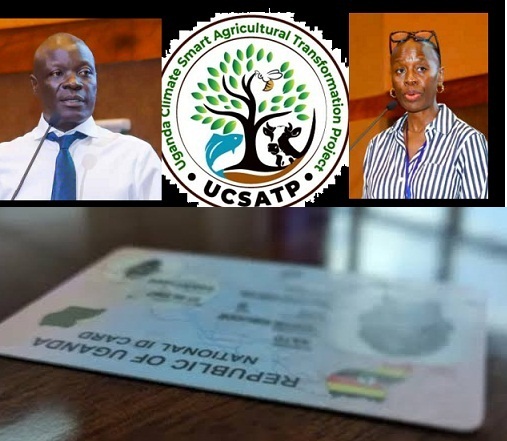
Uganda’s new national ID rollout has hit another embarrassing snag, with farmers enrolled under a major World Bank-funded agriculture project complaining that the project’s systems cannot read their newly issued NIRA identification cards.
The development has left some beneficiaries frustrated and asking how a national identification system can issue new cards that government-backed digital platforms are unable to recognise.
The affected farmers are beneficiaries of the Uganda Climate-Smart Agricultural Transformation Project (UCSATP), a $350 million project — about Shs1.3 trillion — funded by the World Bank and implemented under the Ministry of Agriculture, Animal Industry and Fisheries.
They are now cursing the project officials for not finding a solution.
The project leadership team is headed by National Project Coordinator Eng. Boniface Okanya.
The project, which became effective on June 25, 2024, was designed as a major intervention to transform Uganda’s agricultural sector by increasing productivity, improving market access and helping farmers withstand climate-related shocks.
It covers 69 districts and promises interventions including modern irrigation, mechanisation centres, climate-smart seeds, better roads and improved access to markets.
But some of the farmers expected to benefit from the ambitious project are now facing a bizarre problem.
Their new NIRA IDs cannot be read by the UCSATP systems.
Farmers who have gone through the national ID renewal process say they are being asked to produce their old IDs because the project’s systems reportedly fail to recognise the new cards.
The situation has raised fresh questions about coordination between government agencies as Uganda moves towards a new generation of national identification cards.
For farmers, the problem is particularly frustrating.
They have complied with NIRA’s demand to renew or obtain new identification cards, only to reach another government programme and be told that the new document cannot be accepted.
“Why are we being given new IDs if government systems cannot read them?” one frustrated beneficiary asked.
The farmers want answers.
They are asking whether government agencies adequately tested their systems before the new IDs began circulating.
They also want to know how quickly the UCSATP systems will be upgraded to recognise the new cards.
The problem comes at a time when NIRA itself is struggling with a nationwide ID collection nightmare.
Ugandans are currently lining up in huge numbers to collect their new national identity cards, with long queues reported at collection centres.
In some areas, citizens are also complaining about confusing collection arrangements.
People who registered in Wakiso District say they are being directed to different locations to collect their cards.
Some are reportedly sent to Kira.
Others are directed to Nansana, Makindye-Ssabagabo, Entebbe and other areas.
The result is a frustrating journey from one collection point to another.
The queues, according to citizens, are becoming as long as the River Nile.
And the pressure is particularly heavy because many old national IDs expired around the same period.
At the same time, children who were registered years ago have now grown into adults and are joining the queues to obtain their first cards.
This has created a huge rush for the new IDs.
But for some Ugandans, getting the new card is proving to be only half the battle.
Once they finally obtain the new card, some discover that the very systems they need to use cannot read it.
For UCSATP beneficiaries, this means a farmer can successfully obtain a new national ID from NIRA and still be told to produce the old card when accessing services under the agriculture project.
WHY NOT PARISHES?
As the ID collection crisis grows, citizens are also questioning why NIRA cannot decentralise collection points further.
Instead of requiring people to travel to district-level collection centres, citizens argue that IDs should be distributed through parishes.
This would bring the service closer to the people and reduce congestion.
The Wakiso experience has particularly exposed the challenge.
A person who registered in Wakiso can reportedly be directed to Kira.
Another may be sent to Nansana.
Another to Makindye-Ssabagabo.
Another to Entebbe.
For citizens, the experience means more transport costs, more time away from work and hours spent in queues.
And after all that effort, they may still discover that the new ID is not recognised by a government system they need to access.
SHS1.3TRILLION PROJECT
UCSATP is a major national investment.
The $350 million project, worth approximately Shs1.3 trillion, is intended to help transform Uganda’s agricultural sector.
Its interventions include modern irrigation, mechanisation centres, climate-smart seeds, improved roads and better access to markets.
The project is being implemented in 69 districts.
It is also designed to help farmers adapt to climate shocks while improving productivity and market access.
For beneficiaries, therefore, the project is expected to provide important opportunities to improve agricultural production and livelihoods.
But the ID problem risks creating unnecessary barriers for farmers who are already expected to navigate a complicated agricultural support system.
The farmers now want the Ministry of Agriculture, UCSATP managers and NIRA to resolve the apparent incompatibility.
They argue that citizens should not be forced to carry expired or old identification documents simply because a government system has not been updated to recognise the new cards.
A DIGITAL COMPATIBILITY CRISIS?
The problem has also raised a wider question about Uganda’s digital transformation.
As more government services become dependent on digital identification, institutions must be able to communicate with the national identification system.
If one government programme recognises the new NIRA ID while another does not, ordinary citizens are left carrying the burden.
The UCSATP experience could therefore be an early warning of a much bigger problem.
If similar incompatibility exists in other government programmes, banks, agencies and service platforms, the new NIRA rollout could become more than a national ID collection crisis.
It could become a national digital compatibility crisis.
For now, farmers under the Shs1.3 trillion smart agriculture project are demanding answers.
They have their new IDs.
They simply want government systems to recognise them.
GOT A HOT STORY? LET US KNOW!
Got breaking news, explosive secrets, or hard evidence?
Email us: redpeppertips@gmail.com
We accept tips, documents, videos, photos, and recordings—the more evidence you have, the better.
CONFIDENTIALITY IS OUR TOP PRIORITY. SOURCES ARE ALWAYS PROTECTED!
About Post Author