FROM CODE TO COMMERCE! How MTN Is Turning Uganda’s Young Innovators into Digital Entrepreneurs

By Amos Tayebwa
For Uganda’s growing army of young developers, the journey from an idea to a digital product used by thousands can be long, expensive and uncertain.
Across the country, innovators are developing solutions in agriculture, transport, finance, health and commerce. Startups such as SafeBoda, Numida, Emata and XENO have demonstrated the potential of home-grown technology.
But having a good idea is only the beginning.
For many young entrepreneurs, the bigger challenge is turning code into a commercially viable business. Access to payment systems, technical support, customers and digital skills can determine whether a promising prototype remains an idea or becomes a sustainable enterprise.
This is where MTN and MTN MoMo Uganda are increasingly playing a role, providing platforms that help innovators move from development to commercialisation.
At the centre of this opportunity is the MTN Mobile Money Open API platform.

Launched first in Uganda in November 2018, the platform opened MTN’s Mobile Money system to third-party developers, allowing them to integrate payments into their applications.
Developers can access documentation, a testing sandbox and technical support before taking applications live. The APIs support collections, disbursements, remittances, transaction-status updates and payment checkouts.
Registration, API use and sandbox testing are free, allowing developers to experiment without having to build an entire payment infrastructure from scratch.
For Ugandan fintech startup Culipa, that access became a practical business advantage.

Culipa, which provides payment aggregation and money transfer services, integrated MTN MoMo Collections, Disbursements and Transaction Status APIs. According to co-founder Patience Ankunda, the company completed the integration in just one week.
“We decided to include the MTN MoMo API because we wanted to tap into the big subscriber base that it offers and then enabling us over our services to millions of Ugandans,” Ankunda says.
She says the transaction-status API enables Culipa to provide customers with real-time information about their payments.
“The MoMo APIs have enabled us be efficient in our service, especially through the transaction API that enables us to relay real-time information to our customers as they are making their transactions,” she says.
The technology has also improved the experience for Culipa customers such as African Fit. Previously, customers had to navigate several USSD prompts to make payments. Through Culipa’s payment link, they can complete transactions in fewer steps.
“They just have to put in their phone number and put in their PIN to authorize the payment, which then improves their customer experience,” Ankunda explains.
The integration has also helped Culipa reach a wider market and expand its payment options.
For e-commerce company Lusuku, meanwhile, MTN MoMo helped address a different business challenge: cash collection.
The company initially relied heavily on cash-on-delivery, exposing it to losses and reconciliation problems.
“There were two scenarios where riders disappeared with money and then we reconciled after two weeks,” co-founder and developer Medhi Matovu says.

The MoMo Collections API enabled Lusuku to receive payments digitally before delivery.
“With the API, the MoMo API, you get the monies, then the rider only needs to worry about the products, making sure they’re delivered intact,” Matovu says.
Customers also receive payment prompts in real time, improving reliability.
“When a customer authorizes a payment… they would get a prompt in real time, I’m talking five seconds, so it’s reliable,” he says.
Matovu says Lusuku has seen increased revenues because digital payments reduced losses associated with cash collection.
These examples show how technology that may appear technical to the user can have direct commercial consequences for a young business—from reducing losses and improving reconciliation to simplifying payments and reaching more customers.
BUILDING THE SKILLS BEHIND ENTREPRENEURSHIP
Technology platforms alone are not enough. Young innovators also need the skills to use them.
Last month, MTN Uganda graduated 503 young people from its ACE digital-skilling programme, bringing the total number of graduates to more than 1,190, including people with disabilities and refugees.
The graduates trained through a hybrid learning model covering computer and online essentials, digital marketing, e-commerce, cybersecurity and artificial intelligence.
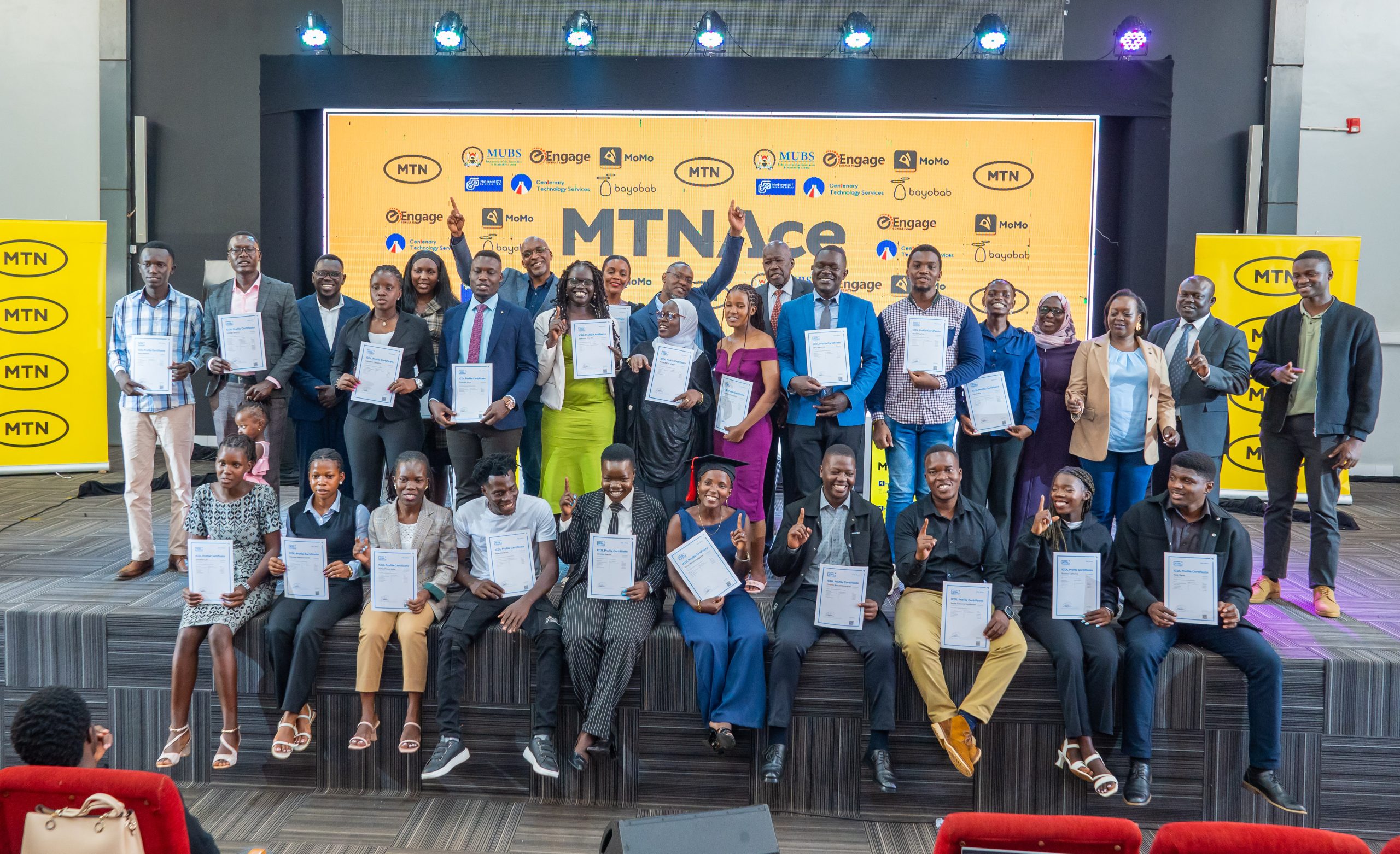
They can progress to the ACE Career & Enterprise track for advanced digital and entrepreneurship training aligned with MTN’s Ambition 2030 strategy.
George William Egaddu, Chairperson of the Board of Trustees of MTN Foundation, said the programme is designed to turn digital access into economic opportunity.
“Digital access creates the opportunity, but it is skills that enable people to turn that access into livelihoods, businesses and solutions,” Egaddu said.
The programme comes as Uganda seeks to harness its youthful population for economic transformation. Three-quarters of the population are below 30, creating both employment pressure and a large pool of potential entrepreneurs.
An independent assessment of MTN Foundation economic empowerment projects implemented between 2022 and 2024 found that 88% of youth participants secured employment after training, while 93% reported improved business performance. More than 22 startups were supported.
MTN is also taking innovation support beyond Kampala through regional innovation hubs, including the MTN Spark Hub at Kabale University.

The wider initiative involves Shs4 billion over three years for four regional hubs and refurbishment of the National ICT Innovation Hub in Nakawa. The hubs provide computers, connectivity, workspaces and mentorship.
Prof William Bazeyo, Trustee of the MTN Uganda Foundation Board, says the approach is about taking opportunity to where talent exists.
“Talent is widely distributed, even where access is not,” Bazeyo says.

For Uganda’s young entrepreneurs, the emerging ecosystem provides more than connectivity. It offers access to payment platforms, skills, innovation spaces and tools that can help turn ideas into products and products into businesses.
As the digital economy expands, the measure of success will not simply be how many young people learn to code, but how many can use those skills to solve real problems, attract customers and build sustainable enterprises.
That is the journey from code to commerce.
About Post Author