DEGREE DREAMS! Uganda opens university pathways for vocational students under new TVET framework
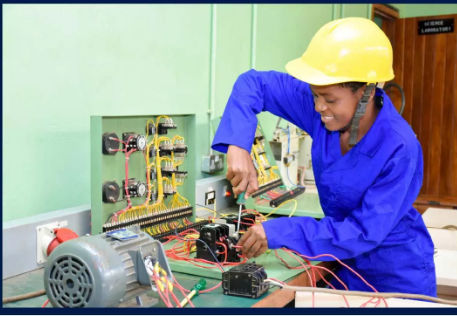
A TVET female student-fixing-a-motar
By Evans Najuna
KAMPALA – Uganda is set to overhaul its Technical and Vocational Education and Training (TVET) system with a new national qualifications framework designed to give artisans formal recognition, open pathways to university degrees and equip employers with a more reliable pool of skilled workers.
The Uganda TVET Qualifications Framework (UTQF), which will officially be launched on Friday, November 13, 2026, at Serena Hotel in Kampala, seeks to transform vocational training by establishing clear national standards for skills acquisition, assessment, certification and career progression. The launch will be presided over by the Acting Minister of Education and Sports.
Speaking during a press briefing at the Uganda Media Centre in Kampala, TVET Council Executive Director Moses Kasakya said the framework would address longstanding challenges facing Uganda’s skills development sector, particularly the disconnect between formal qualifications and practical competence.
Kasakya said the framework was designed to benefit learners, employers, parents, training institutions and thousands of Ugandans who have acquired professional skills through years of practical experience but lack certificates to prove their competence.
One of the biggest changes introduced under the UTQF is the Recognition of Prior Learning (RPL), which will allow experienced mechanics, carpenters, welders, tailors, builders, hairdressers and other artisans to have their skills formally assessed and certified without necessarily returning to conventional classrooms.
Under the arrangement, an individual will be assessed against nationally approved competency standards and awarded certification based on demonstrated ability rather than the number of years spent in a particular trade.
For instance, a mechanic with ten years of experience who demonstrates competence in engine servicing and brake systems but falls short in vehicle electrical systems can receive recognition for the skills already proven and undertake additional training only in the area where he has gaps.
Assessment will involve practical skills tests, workplace demonstrations, portfolios of evidence, challenge tests and professional interviews.

However, Kasakya cautioned that experience alone would not guarantee certification, emphasising that candidates must demonstrate their competence against the prescribed national standards.
He said the RPL system would give informal-sector workers an opportunity to compete for formal employment, secure contracts, access further training and improve their prospects in international labour markets.
The framework also introduces a structured progression pathway that allows vocational trainees to advance from artisan qualifications to higher technical qualifications and eventually degree-level education.
Under the proposed pathway, a learner completing primary education can enrol at Level 2 and obtain a National Artisan Certificate before progressing to Level 3 for a National Craftsperson Certificate.
Depending on academic performance and admission requirements, the learner can subsequently advance to a National Technician Diploma at Level 4 or pursue a Bachelor of Technology at Level 6.
The framework extends through doctoral-level qualifications, linking technical and vocational education to conventional academic pathways through defined progression points.
Kasakya stressed that TVET would no longer be viewed as a dead-end option for learners who fail to pursue conventional academic education, but rather as a viable career pathway with opportunities for further advancement.
The new framework is also expected to strengthen confidence among employers by ensuring that graduates possess practical competencies required in the workplace.

According to Kasakya, employers and industry practitioners have been involved in identifying priority occupations, developing qualifications and validating training standards through Sector Skills Expert Committees established under the TVET Act.
Assessments will focus on actual performance, including practical assignments, real-life projects and industrial training evaluated by workplace supervisors.
The Council will also monitor employer satisfaction and use feedback to update qualifications in response to emerging technologies, new equipment and changing workplace demands.
In a major warning to prospective students and parents, Kasakya urged Ugandans to verify the legitimacy of vocational training programmes before paying tuition fees.
He advised the public to establish whether an institution is licensed, whether the specific programme is accredited and whether the qualification appears on the official TVET Qualifications Register.
He warned that qualifications not listed on the Register would have no official standing for employment, further education or professional recognition under the framework.
Each approved qualification will carry a unique identification code indicating its sector, level and version, making it easier for employers and learners to verify its authenticity.
The framework will also require qualifications to undergo periodic reviews to ensure that training programmes remain relevant to industry demands.
Where employers identify gaps in graduates’ competencies, the Council may review and update existing qualifications or introduce redesigned versions, with transition arrangements for learners already undertaking training.
Kasakya further said the UTQF was designed to promote research, innovation and technology development, particularly at higher qualification levels.

He said Uganda’s ambition was to produce technicians and technologists capable of not only operating imported technologies but also adapting and improving them to address local production and service challenges.
On international competitiveness, the Executive Director said the framework would facilitate comparison of Ugandan TVET qualifications with conventional education and foreign qualifications, with particular attention to the East African Community and other key labour markets.
However, he clarified that international comparability would not automatically guarantee employment, professional licensing or recognition in another country, as such decisions remain subject to the laws and requirements of the respective countries.
The framework also provides for inclusive participation by women, men, rural communities, persons with disabilities and individuals who have previously been excluded from formal education.
Through multiple entry and exit points, modular learning, credit-based progression and recognition of prior learning, the Council hopes to reduce barriers to vocational training.
Kasakya said the Council would monitor enrolment, completion and progression figures by gender, region, sector and training pathway to establish whether the framework was delivering meaningful inclusion.
He called on the media to help educate the public about the new system, particularly artisans, young people choosing career paths, parents and small businesses seeking skilled workers.
He, however, cautioned against creating unrealistic expectations, clarifying that the UTQF does not guarantee every certificate holder a job, automatic university admission or a fixed income.
Instead, he said, the framework guarantees clear competency standards, fair recognition of skills and defined opportunities for career progression.
The Executive Director invited journalists to cover the official launch scheduled for Friday, November 13, at Serena Hotel, Kampala. A press kit containing a summary of the framework and fact sheets is expected to be shared with media houses ahead of the launch.
The UTQF is a major Government initiative intended to strengthen Uganda’s technical and vocational education system, improve the quality of skills training and produce a competitive workforce capable of meeting national and international labour market demands.
GOT A HOT STORY? BLOW THE WHISTLE!
Have breaking news, explosive revelations, juicy leads or evidence of wrongdoing?
WE WANT TO HEAR FROM YOU!
Send your tips, documents, videos, photos and audio recordings to:
redpeppertips@gmail.com
Whether it’s corruption, scandals, abuse of office, injustice or stories others are afraid to tell, help us bring the truth to light.
SOURCES ARE PROTECTED.
CONFIDENTIALITY IS OUR NO.1 PRIORITY!
About Post Author