URSB SHAKE-UP! Mao Exposes How ‘False Alarm’ Letter With Broad, Unverified Corruption Claims Was Sent Directly To M7, Landing Top Bosses In Trouble
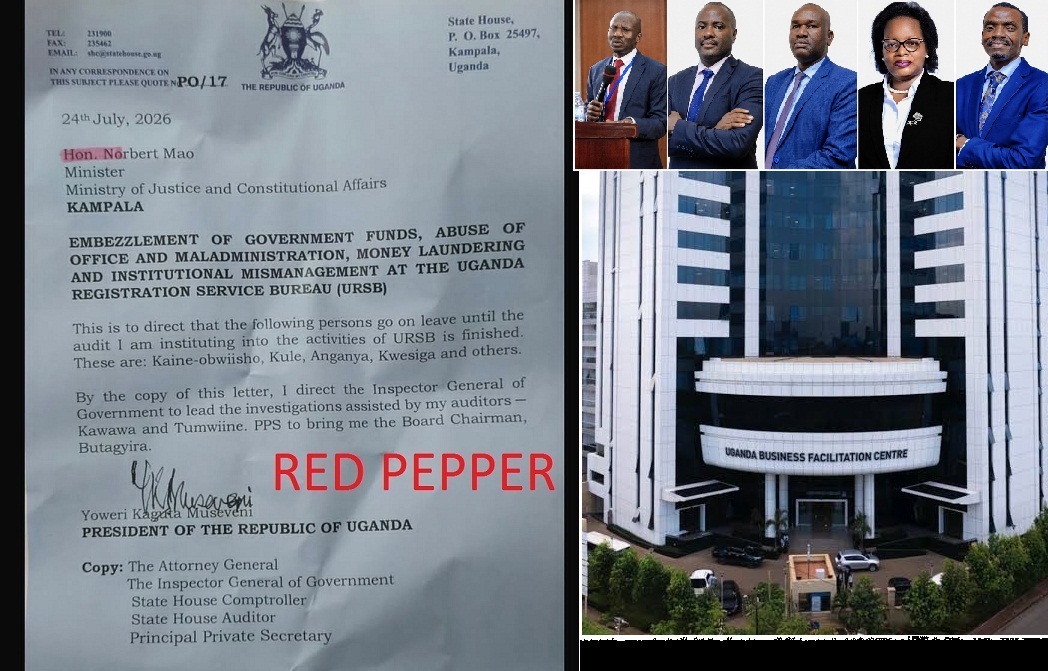
The dramatic shake-up that swept Uganda Registration Services Bureau (URSB), sending Registrar General Mercy Kainobwisho and three senior managers out of office, has taken a fresh twist after Justice Minister Norbert Mao revealed that the crisis was triggered by what he described as a “false alarm” letter containing broad and unverified allegations against the institution’s leadership.
Mao’s bombshell revelation before Parliament’s Committee on Commissions, Statutory Authorities and State Enterprises (COSASE) has reopened serious questions about how an internal management dispute escalated into a presidential intervention, an institution-wide audit and the removal of some of URSB’s most senior officials from their offices.
The minister’s account has also strengthened calls for fairness and due process for the affected officials, whose careers and reputations have been caught up in a controversy that began with a bitter internal dispute involving Commissioner for Business Registration Gilbert Agaba.
At the centre of the unfolding drama is a troubling question: Were senior public servants pushed out of their positions before the allegations against them had been properly examined and their side of the story heard?
MAO: PRESIDENT RECEIVED FALSE ALARM!
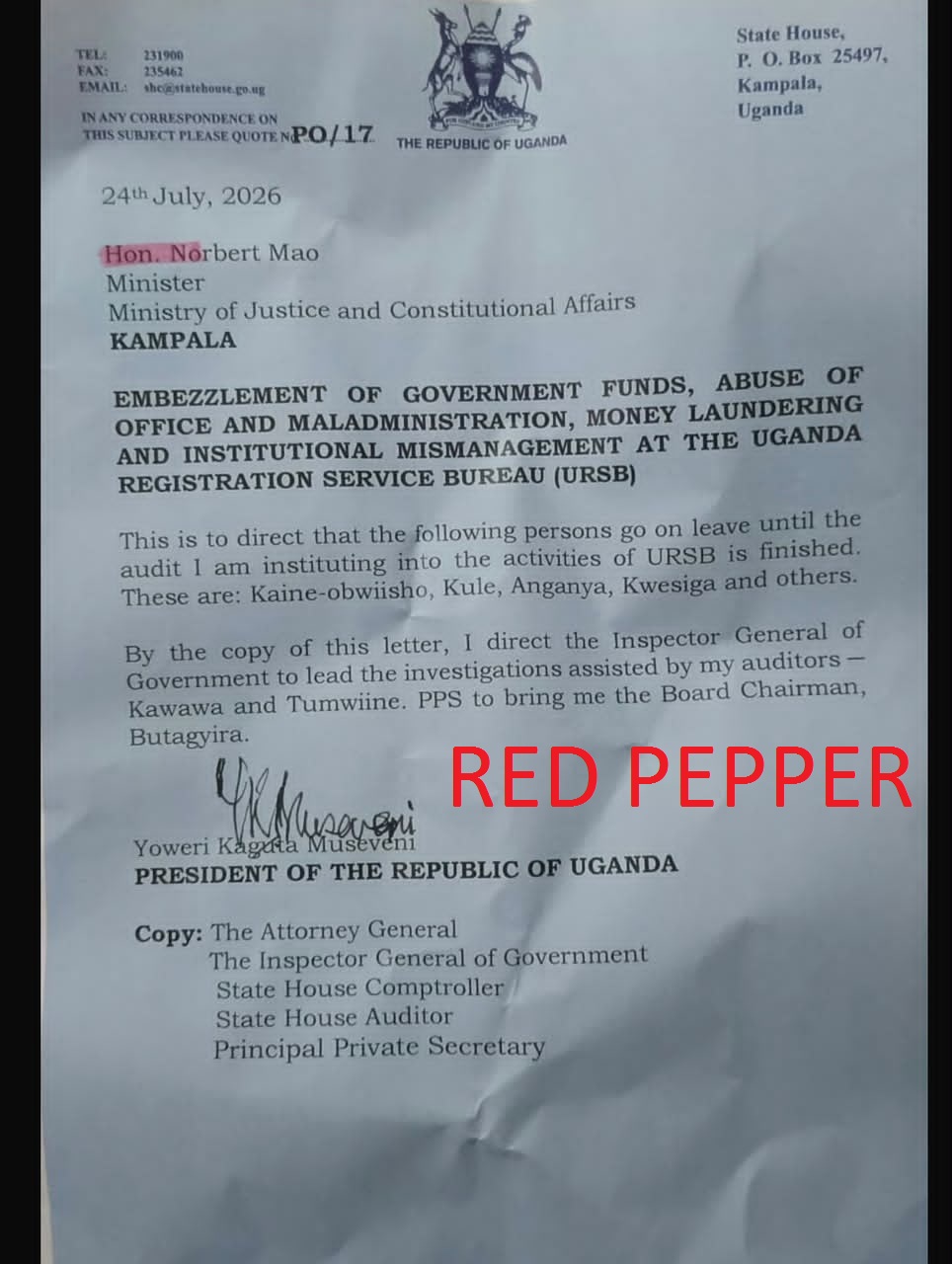
Appearing before COSASE on Wednesday, November 11, 2026, Mao told MPs that President Yoweri Museveni’s July 24 directive, which triggered the URSB management crisis, followed an alarming letter sent directly to the Head of State.
According to Mao, the communication contained general allegations that lacked sufficient detail.
“The President received an alarming letter and on that basis he issued the order to investigate. But to the best of my knowledge, it is alarming because many of the allegations were general,” Mao told the legislators.
The minister said he subsequently met Museveni alongside URSB Board Chairman Ambassador Francis Butagira to provide context on the allegations and address staff grievances.
He further assured MPs that the internal disagreements had been addressed and there was no longer any cause for alarm at the Bureau.
But the minister’s explanation raised more questions than answers.
Committee member George Musisi challenged how an allegedly unverified communication could reach the President and result in several senior officials being sent out of office before a prima facie case had been established.
“With the fact that a false alarm goes to the Head of State, to the point of sending senior officials not one, but several on interdiction, how can we avoid this false alarm? As a lawyer, you know interdiction should not be based on allegations,” Musisi questioned.
Mao blamed the escalation on failures in administrative procedures, arguing that some officials had bypassed established institutional channels and taken internal grievances directly to State House.
He said complaints about URSB management only reached his desk after the President had already written to him.
“Avoiding false alarms means having some sense of responsibility among decision makers,” Mao said.
He added that ministers should not rush to escalate matters to the President before exhausting their own administrative responsibilities.
“As Ministers, we should not rush to escalate matters to the President before we have dealt with them. That’s why we were appointed as Ministers. If the President is to solve every problem, then the Cabinet should be dissolved and we leave everything to him,” he said.
The minister also acknowledged the reputational and operational damage suffered by URSB, saying some officials had gone wild over internal grievances that could have been handled through the Board and management structures.
THE OFFICIALS CAUGHT IN THE STORM
The July 24 presidential directive affected some of the most senior figures at URSB.
Those named included Registrar General Mercy Kainobwisho, Deputy Registrar General for Finance and Administration Alex Anganya, Commissioner for ICT and Innovations Arthur Kwesiga and Assistant Commissioner for Business Registration Services Walid Kule.
The President directed that the officials step aside pending an audit into URSB’s activities.
The audit was to be led by the Inspector General of Government (IGG), with assistance from presidential auditors Kawawa and Tumwiine.
The allegations cited in the directive included embezzlement of government funds, abuse of office, maladministration, money laundering and institutional mismanagement.
These were grave accusations capable of destroying professional reputations and careers.
However, the allegations were not findings of guilt.
The officials were sent on mandatory leave, with the IGG subsequently directing their formal interdiction to facilitate investigations.
HOW THE AGABA-MANAGEMENT WAR STARTED
But how did an internal URSB disagreement end up at the President’s desk?
Documents seen by Red Pepper trace the roots of the crisis to Gilbert Agaba, the Commissioner for Business Registration.
According to an internal management brief, the Bureau had received repeated complaints about Agaba’s leadership, performance, communication and working relationships within the Business Registration Department.
Management reportedly accused him of persistent absenteeism, inadequate supervision, failure to convene departmental meetings, poor coordination and failure to implement management decisions.
The brief further claimed that similar concerns had emerged during his earlier tenure as Commissioner for Intellectual Property.
Management reportedly viewed his transfer to Business Registration as an opportunity to improve leadership and teamwork in the department.
However, the relationship allegedly deteriorated further.
The Deputy Registrars General reportedly intervened on several occasions, counselling Agaba and proposing corrective measures to improve communication, supervision and departmental coordination.
When these interventions reportedly failed to resolve the dispute, Registrar General Kainobwisho personally intervened.
Agaba was directed to engage his team, agree on clear working arrangements and submit proposals aimed at improving departmental performance.
According to management, he did not comply with the directive.
The matter was subsequently escalated into a formal disciplinary process under the URSB Human Resource Manual.
AGABA FIRES BACK!
Before the internal administrative process could be concluded, Agaba reportedly took his grievances outside the Bureau.
He raised allegations against management before Board Chairman Butagira and subsequently referred substantially similar complaints to external authorities, including the Economic Crimes Division of the Uganda Police Force and the Attorney General’s office.
His allegations reportedly included claims of criminal conduct, corruption and misuse of institutional resources.
The URSB Board then constituted an investigation committee to examine both sides of the dispute.
On June 8, 2026, Agaba was invited to respond to concerns regarding leadership and governance challenges in his department.
The matter subsequently reached an extraordinary Board meeting held on July 15.
The Board made findings against Agaba and communicated them through a warning letter.
Among the findings was that the Business Registration Department had reportedly gone through the entire 2025/2026 financial year without holding a departmental meeting or retreat to plan and evaluate performance.
The Board also accused him of failing to implement and report back on management decisions, treating the conduct as insubordination under Section 7.2.4(b)(viii) of the URSB Human Resource Manual.
The most explosive finding concerned language he allegedly used against Kainobwisho.
According to the Board’s findings, Agaba had referred to the Registrar General as a criminal and accused her of running a criminal enterprise within URSB.
The Board reportedly ordered him to submit a written apology within five days and placed him on a proposed 12-month Performance Improvement Plan under the supervision of the Deputy Registrar General for Finance and Administration.
But Agaba reportedly rejected the findings, the apology demand and the proposed improvement plan.
ATTORNEY GENERAL ENTERS THE BATTLE
The dispute then moved to another level.
On July 8, 2026, Attorney General Dr Sam Mayanja wrote to URSB Board Chairman Butagira in a letter titled “Investigations into Agaba Gilbert, Commissioner Business Registration.”
Mayanja acknowledged receiving information from Agaba concerning alleged criminal activities at URSB.
He told the Board that he had escalated the allegations to President Museveni for guidance.
Then came an extraordinary instruction.
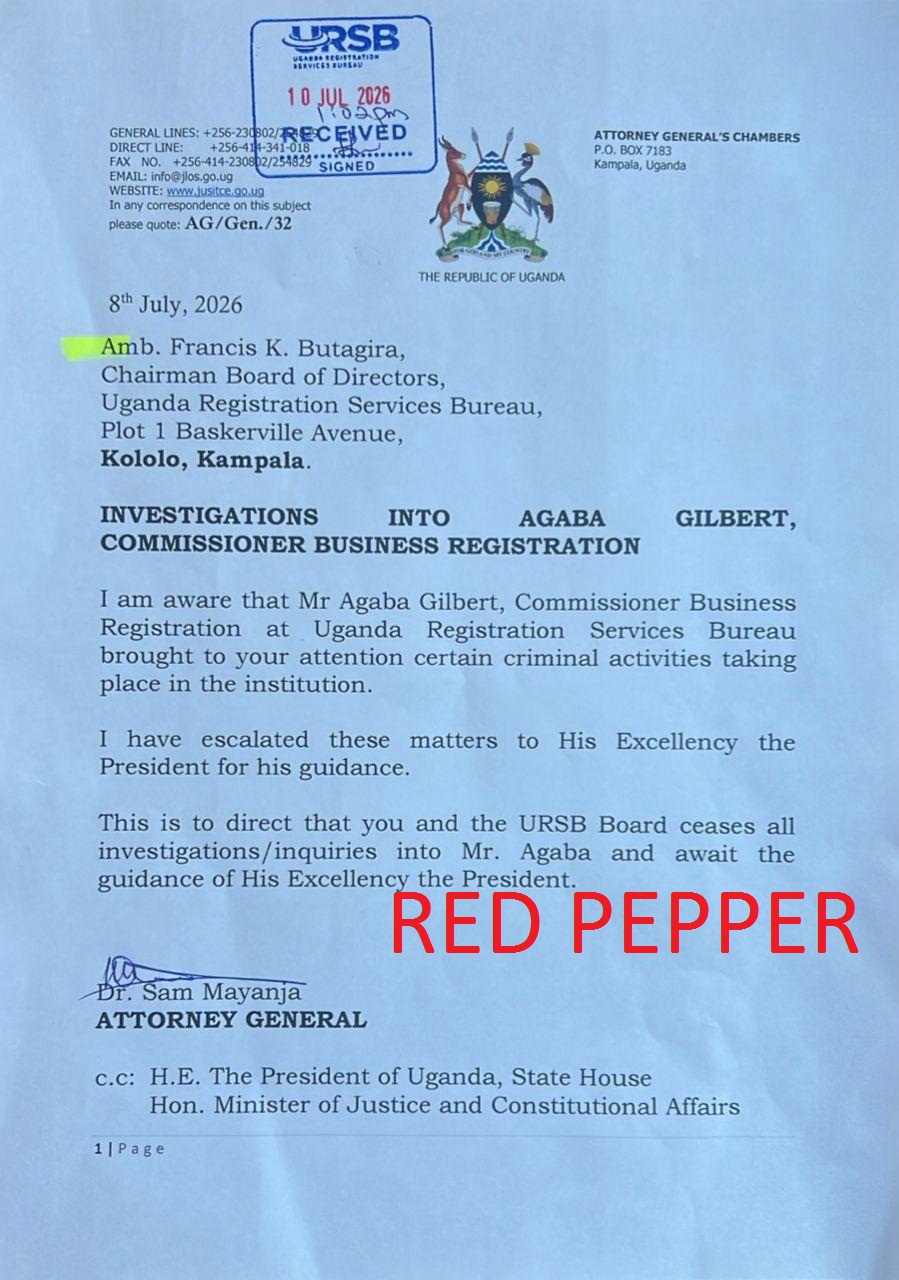
Mayanja directed the Board to halt its investigations into Agaba pending further guidance from the President.
“This is to direct that you and the URSB Board ceases all investigations/inquiries into Mr. Agaba and await the guidance of His Excellency the President,” the letter stated.
The communication was copied to Museveni and Minister Mao.
This effectively put the internal disciplinary process on hold as the matter moved to the highest political office in the country.
But insiders are now asking a pointed question:
Why did the matter go through the Attorney General instead of being handled directly by the Minister of Justice and Constitutional Affairs, Nobert Mao, who is the political head of the ministry responsible for URSB?
The question has become even more important because the Attorney General’s office operates within the Justice and Constitutional Affairs docket headed by Mao.
According to watchers, this is the same issue Mao tried to raise with COSASE MPs when he said the matter shouldn’t have escalated to State House quickly.
Mao blamed the escalation on failures in administrative procedures, arguing that some officials had bypassed established institutional channels and taken internal grievances directly to State House.
He added that ministers should not rush to escalate matters to the President before exhausting their own administrative responsibilities.
“As Ministers, we should not rush to escalate matters to the President before we have dealt with them. That’s why we were appointed as Ministers. If the President is to solve every problem, then the Cabinet should be dissolved and we leave everything to him,” he said.
JULY 24: THE PRESIDENTIAL HAMMER
Three weeks after the Attorney General’s letter, Museveni wrote to Mao.
The July 24 communication, bearing State House reference NPO/17, carried the dramatic title: “Embezzlement of Government Funds, Abuse of Office and Maladministration, Money Laundering and Institutional Mismanagement at the Uganda Registration Services Bureau (URSB).”
The President directed that Kainobwisho and the other named officials step aside until an audit was completed.
He assigned the IGG to lead the investigations with assistance from presidential auditors.
The directive dramatically transformed what had started as a disciplinary dispute involving one commissioner into a much wider investigation of URSB’s leadership and operations.
The affected officials were subsequently placed on mandatory leave.
The consequences were immediate, with the institution’s top leadership effectively removed from their day-to-day responsibilities.
WE WERE NOT HEARD
According to the affected officials, URSB management does not oppose investigations.
Instead, management says it is ready to cooperate with all lawful investigations.
Its major complaint is about the circumstances in which the presidential directive was reached.
Management argues that the President may not have received the full picture because, according to them, the Attorney General reported the allegations to State House without first giving management an opportunity to present its side.
The officials affected by the suspension therefore want the presidential directive reviewed.
They have also asked for support to expedite a meeting between the URSB Board Chairman, the affected officials and President Museveni so that the Board can present its side of the story.
IGG TURNS UP THE HEAT
In August, IGG Lady Justice Aisha Naluzze Batala announced investigations into the allegations against Kainobwisho and the three senior officials.
On August 18, the Inspectorate directed Mao to immediately interdict Kainobwisho and instructed the URSB Board chairman to interdict Anganya, Kwesiga and Kule.
The Inspectorate argued that formal interdiction was necessary to safeguard the integrity of the investigations and prevent possible interference.
It also directed that URSB’s planned executive residential training at the National Leadership Institute in Kyankwanzi be halted pending investigations.
But another disagreement emerged over the manner in which the IGG’s orders were implemented.
Instead of formal interdiction, Mao had placed the officials on mandatory leave.
On October 26, the Inspectorate renewed its demand, saying the officials had remained on mandatory leave beyond their statutory leave entitlement.
It again directed Mao to enforce Kainobwisho’s interdiction and ordered the Board chairman to interdict the other three officials.
The IGG also directed the reinstatement of Agaba, arguing that he was not a subject of the investigations and that placing him on forced leave amounted to victimisation.
The Inspectorate invoked Section 9 of the Whistleblowers Protection Act, which protects individuals from adverse treatment arising from protected disclosures.
The directive further cited Article 230(2) of the Constitution and Section 13(6) of the Inspectorate of Government Act.
The fresh directive has, however, sparked questions about the direction of the probe, with some critics arguing that the Inspectorate appears to be putting more energy into securing interdictions than investigating and establishing the allegations against the officials.
WHO PROTECTS THE RIGHTS OF THE AFFECTED BOSSES?
Mao’s latest revelations have brought the fairness of the entire process back into focus.
If, as the minister told MPs, the communication that triggered the presidential intervention contained broad and unverified allegations, what administrative safeguards were applied before the careers of several senior officials were disrupted?
Why were the concerns not first subjected to a comprehensive examination through the established URSB Board and management structures?
And did the affected officials receive a meaningful opportunity to respond before the matter escalated into a presidential directive?
These questions do not mean that allegations of corruption should be ignored or that the IGG should abandon its investigations.
On the contrary, any credible evidence of embezzlement, abuse of office, money laundering or maladministration must be investigated thoroughly.
But investigations must also respect the rights of those under scrutiny.
Mao’s appearance before COSASE has exposed the danger of allowing internal administrative disputes to escalate without adequate scrutiny and procedural safeguards.
It has also placed the spotlight on the relationship between statutory institutions, their governing boards, ministers and the Presidency.
GOT A HOT STORY? BLOW THE WHISTLE!
Have breaking news, explosive revelations, juicy leads or evidence of wrongdoing?
WE WANT TO HEAR FROM YOU!
Send your tips, documents, videos, photos and audio recordings to:
redpeppertips@gmail.com
Whether it’s corruption, scandals, abuse of office, injustice or stories others are afraid to tell, help us bring the truth to light.
SOURCES ARE PROTECTED.
CONFIDENTIALITY IS OUR NO.1 PRIORITY!
About Post Author