DAM SAFETY ALARM! Isimba Defects Haunt UEGCL, Raise Power Supply Fears as Rains Loom…Report Flags Rotting Structure After 2017 Quality Warning
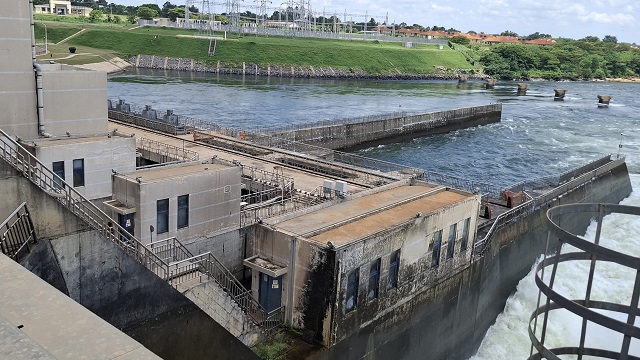
This photo taken on 25 April, 2025, shows a seemingly dilapidated exterior of Isimba Hydropower Plant in Kayunga District. Beti Kamya, the IGG, described the plant as ‘looking as though it was constructed in the 1950s.’ Isimba HPP was commissioned in 2019 by President Yoweri Museveni
KAMPALA — Nine years after concerns were raised about the quality of construction at Isimba Hydropower Project, the dam’s troubled spillway remains under scrutiny, with the latest inspection raising fresh questions about the pace of repairs as Uganda heads into another rainy season.
Government officials led by Engineer Dr Badru Kiggundu and managers from Uganda Electricity Generation Company Limited (UEGCL) returned to the 183-megawatt plant on Friday to follow up on outstanding defects that have continued to dog the facility.
The closed-door meeting reportedly lasted more than five hours, with the parties reviewing efforts by the contractor, China International Water and Electric Corporation (CIWE), to rectify structural problems, including concrete erosion and damage to the spillway.
But the outcome of the inspection was not immediately available, including whether the contractor had committed to a firm deadline for completing the outstanding works.
Sources said concerns remained over continuing erosion at the facility.
UEGCL, CIWE have been contacted for a comment.
The timing of the latest inspection is significant, coming as Uganda enters the October–December rainy season, when increased rainfall could push up river flows and place greater demands on the dam’s water-discharge system.
The big question is whether the outstanding repairs will be completed in time to address the risks identified by engineers.
AUDITOR GENERAL RAISES RED FLAGS
The concerns are not new. The Auditor General’s 2025 report on UEGCL documented unresolved defects at Isimba, pointing to weaknesses that go beyond cosmetic damage.
The report noted that the spillway structure was eroded, equipment and parts at the intake gate were corroded, and the open intake pits showed deterioration. The defects remained unresolved beyond the Defects Liability Period.
The audit also found that inspections at Isimba, Karuma and Nalubaale hydropower plants had established that none of the facilities had a floating boom, while significant water weeds had accumulated at their intake points.
The findings raise questions about maintenance, asset protection and how quickly critical defects are being addressed at infrastructure that Uganda relies on for electricity generation.
At Isimba, the spillway is a particularly sensitive component. Designed to discharge up to 4,500 cubic metres of water per second, it releases excess water that cannot pass through the turbines, helping prevent the reservoir from rising to dangerous levels.
UEGCL has previously reported that concrete erosion, damaged buffer blocks and gaps between concrete slabs have compromised the structure.
During an inspection in 2025, officials reportedly said the spillway could discharge less than 40 per cent of its design capacity without causing dangerous vibrations across the structure.
If river flows rise sharply, the ability of the spillway to safely handle excess water becomes critical.
NINE YEARS AFTER QUALITY WARNING
Perhaps the most troubling part of the Isimba story is that concerns about construction quality were raised while the project was still being built.
In 2017, then-UEGCL Board Chairperson Engineer Proscovia Njuki warned that physical progress at the site needed to be matched by quality.
“The contractor has made good physical progress but there is need to match quantity with quality,” Njuki said during an inspection of the construction site.
She also raised concerns about structural repairs and the lack of clarity over the repair schedule.
“There are several areas that require structural repairs yet the repair schedule is not very clear. We are also concerned that the numerous repairs will compromise the quality of the finished product,” she warned.
At the time, construction was reported to be about 76 per cent complete, with concrete works nearing 88 per cent.
The warnings came roughly two years before President Yoweri Museveni commissioned the plant on March 21, 2019.
Nearly a decade after Njuki’s concerns, the continued need for spillway repairs raises a difficult question: why have the outstanding defects remained unresolved for so long, and who should be held accountable?
The available findings do not, on their own, establish the cause of every defect or assign individual liability. But the persistence of the problems calls for clear answers from the project managers, contractor and other parties responsible for construction quality and supervision.
2022 FLOODING, MORE DAMAGE
The defects have persisted despite emergency repair attempts following flooding in August 2022.
Subsequent inspections reportedly found continued erosion and damage to the spillway’s concrete components. Engineers have warned that gaps between slabs and the erosion of buffer blocks could expose the structure to further deterioration.
The risks include hydraulic jacking, a process in which water penetrates beneath concrete slabs and exerts pressure capable of lifting them. If the process continues, it could trigger backward erosion and potentially extend damage towards the dam’s foundation.
UEGCL Chief Executive Officer Eng. Dr Harrison E. Mutikanga has previously expressed concern about the spillway’s ability to handle heavy flows.
“When you have a spillway that is likely not to deal with its flood design capacity, and then you are getting a lot of rain, then you can’t stop worrying,” Mutikanga said during an earlier inspection.
His warning underscores the importance of completing durable repairs rather than relying indefinitely on emergency interventions.
Repairing the structure is also technically challenging. Engineers have previously reported difficulties conducting underwater works while the River Nile continues to discharge large volumes of water. Some repair attempts were suspended as river flows increased.
MAY MEETING, SAME QUESTIONS
In May 2026, UEGCL held further technical discussions with the contractor and engineering experts to assess emergency repairs and consider longer-term rehabilitation.
The meeting brought together the Owner’s Engineer and Professor Mark Alexander of the University of Cape Town to review progress and agree on the next steps.
Participants discussed the urgent need for concrete coring, sampling and laboratory tests to establish the condition of the spillway structure. They also considered engineering options for long-term rehabilitation and protection.
UEGCL said underwater inspections had identified additional erosion on the upstream side of the spillway, reinforcing the need for urgent intervention.
The latest inspection suggests that the outstanding work remains a pressing issue, although details of the decisions reached on Friday were not available by press time.
The government has maintained that CIWE remains responsible for rectifying outstanding defects under the engineering, procurement, construction and commissioning contract.
A completion certificate has not been issued because defects remain unresolved. Government safeguards have included a performance guarantee valued at about US$39 million, alongside other guarantees intended to protect its interests.
The outstanding question is whether these contractual safeguards and repeated technical engagements will translate into timely, lasting repairs.
SUPERVISION ALSO UNDER SCRUTINY
Questions have also been raised about the quality of supervision during construction.
Energy Infratech Pvt Limited, the Indian firm contracted to supervise construction at Isimba and Karuma, had its contract terminated in 2017 following concerns about inadequate technical supervision.
A project steering team led by Engineer Badru Kiggundu reportedly found that the firm had failed to deploy some of the experienced specialists required for supervision, including quality-control and geotechnical personnel.
Those earlier concerns do not, by themselves, establish the cause of the current defects. However, they add to the questions surrounding how construction quality was monitored and whether the necessary checks were effective.
The former Inspector General of Government, Beti Kamya, also launched an investigation in 2025 to establish accountability for omissions at the dam. She left office before the findings were made public.
Whether that investigation produced conclusions, and what action followed, remains an important part of the accountability question.
GENERATION IS NOT THE WHOLE STORY
Isimba continues to generate electricity, but operating the plant does not automatically resolve concerns about its ability to safely discharge excess water during extreme river flows.
UEGCL’s Strategic Plan for 2025–2030 identifies dam failure at Isimba as a risk being monitored and links the continuing risk to delays in resolving spillway defects by the engineering, procurement, construction and commissioning contractor.
The Auditor General’s report also highlighted broader operational and financial challenges at UEGCL, including delays in settling some contractor payments, unfilled staff positions and low utilisation of available generation capacity at some plants.
At Isimba, however, the immediate concern is the condition of a critical structure whose job is to manage excess water safely.
The latest inspection must now be followed by clear information on the repair schedule, the technical findings, the measures being taken to protect the structure during heavy rains and the deadline for completing lasting rehabilitation.
SHs6.61BN TRAINING CASH STILL IDLE!
As questions mount over Isimba’s unresolved spillway defects, another issue is confronting Uganda Electricity Generation Company Limited (UEGCL): whether the country is getting full value from a major programme designed to strengthen the technical skills needed to operate and maintain its hydropower plants.
The Hydropower Operations and Maintenance Excellence (HOME) Project, implemented by UEGCL, ended its original implementation period in December 2024 with Shs6.61 billion still unspent, prompting a two-year, no-cost extension running to December 2026.
According to project figures as of December 31, 2024, the programme had a total budget of Shs30.19 billion. Although Shs27.92 billion had been disbursed, only Shs24.76 billion had been spent, leaving the balance of Shs6.61 billion on the project account at Stanbic Bank Uganda.
Funded through a grant of NOK84.4 million from Norway’s Ministry of Foreign Affairs, the programme was designed to build Uganda’s capacity to operate and maintain major hydropower assets, particularly the 600MW Karuma plant and the 183MW Isimba facility.
The initiative is not primarily about constructing new power infrastructure. It is intended to strengthen the people and systems responsible for keeping existing plants operating safely and efficiently.
Under the programme, international and local experts support operations and maintenance frameworks, while UEGCL staff receive training in advanced plant maintenance, risk identification, safety and professional asset management.
The objective is to build a technically competent, self-sustaining hydropower operator capable of managing complex facilities in line with international standards.
But with the original project period having expired and millions of shillings still unspent, the key question is whether the extension will deliver the intended training, technical systems and institutional improvements before the revised deadline.
The balance is not, by itself, proof of misuse or failure. However, the delay raises questions about implementation, the pace of planned activities and whether the remaining resources will translate into lasting improvements in the operation and maintenance of the plants.
SUSTAINABILITY TEST FOR UEGCL
The Isimba spillway controversy highlights why technical skills, maintenance systems and long-term asset management matter as much as the construction of new power plants.
A hydropower facility is not judged only by the electricity it generates. Its long-term value also depends on the ability to detect defects early, maintain critical structures, carry out timely repairs and manage operational risks throughout its lifespan.
The HOME Project was designed to help UEGCL build precisely that capacity. Its success should therefore be measured not simply by the amount of money spent or the number of training sessions conducted, but by whether the company can independently identify problems, maintain its infrastructure and respond effectively to emerging risks.
At Isimba, the unresolved spillway defects provide a stark test of that objective. The plant has continued generating electricity, yet the Auditor General has documented erosion and other deterioration requiring attention.
UEGCL now faces two linked tests: ensuring that the immediate spillway repairs are completed to the required standard, and demonstrating that its technical workforce and maintenance systems can prevent, detect and address similar problems in the future.
With the HOME Project extension due to end in December 2026, the company should account for the remaining funds, explain which training and institutional targets are outstanding, and show how the programme’s gains will be sustained after donor support ends.
For a country investing heavily in hydropower, sustainability means more than keeping turbines running. It means protecting the structures behind the power, retaining skilled personnel and ensuring that public investments remain safe, reliable and productive for decades.
GOT A HOT STORY? LET US KNOW!
Got breaking news, explosive secrets, or hard evidence?
Email us: redpeppertips@gmail.com
We accept tips, documents, videos, photos, and recordings—the more evidence you have, the better.
CONFIDENTIALITY IS OUR TOP PRIORITY. SOURCES ARE ALWAYS PROTECTED!
About Post Author