ENTEBBE AIRPORT MESS REPORT (PART 4)! MUGA Services contractor on spot over cutting airport power cables supplying lights for pilots during aircraft approach… VVIP access road, Threshold house exposed as security nightmare
KAMPALA — A construction contractor working on the VVIP access road at Entebbe International Airport has been implicated in damaging electrical cables supplying critical airport lighting infrastructure, while separate suspected vandalism incidents at the same location exposed further weaknesses in the protection of sensitive installations.
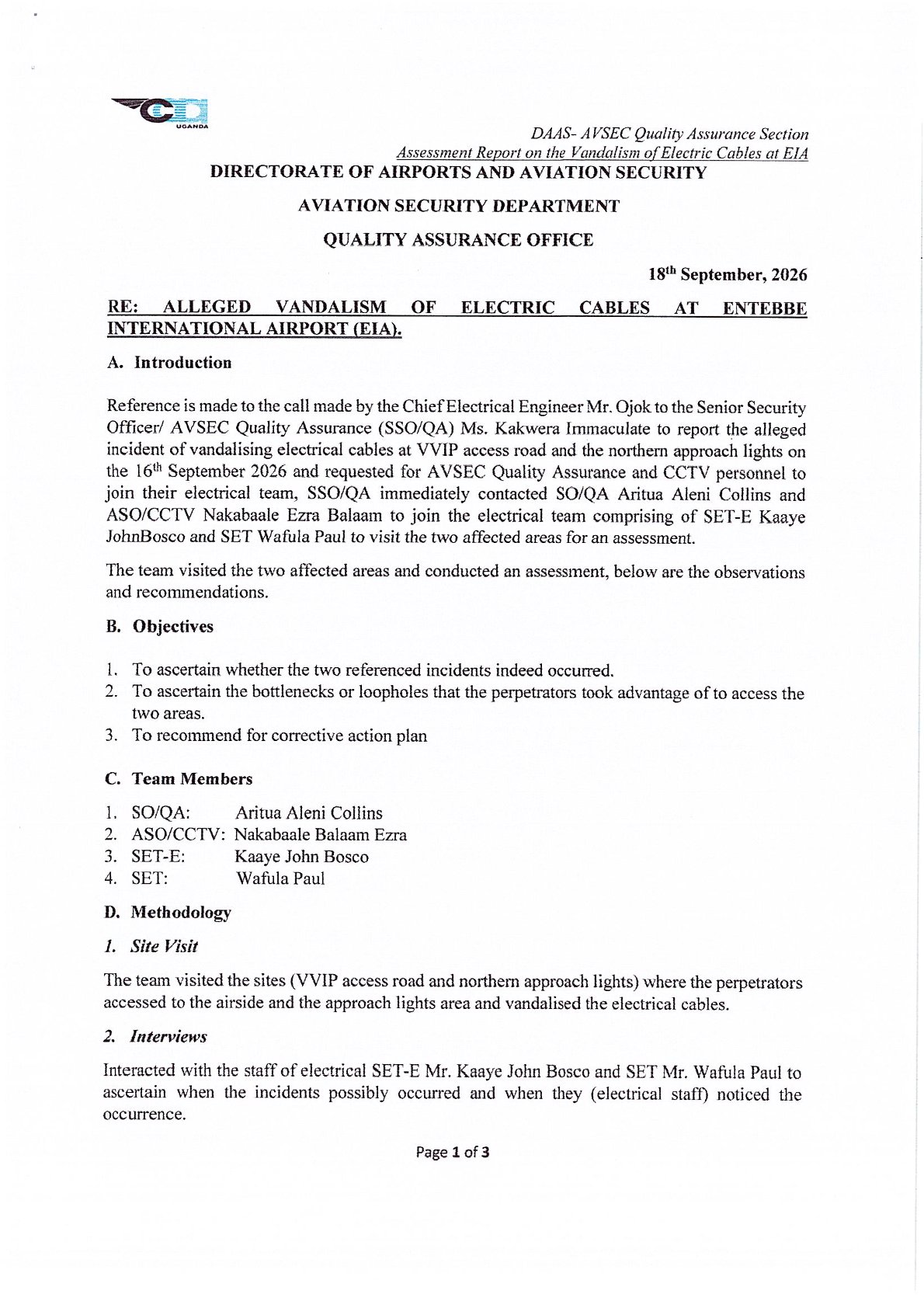
An internal Uganda Civil Aviation Authority (UCAA) Aviation Security Department report dated September 18, 2026, identifies MUGA Services, a contractor undertaking drainage system works along the VVIP access road, as responsible for ‘accidentally’ cutting an electrical cable during construction activities.
The contractor reportedly committed to repairing the damage after the incident was brought to its attention.
But the revelations do not end there.
The same security assessment identifies another incident at the VVIP access road involving two Ring Main Units (RMUs) supplying power from the VVIP sub-power station to the approach lights.
The two units were reportedly vandalised, with their cables cut in an incident suspected to have occurred on August 18, 2026.
Even more disturbing, the security team established that the area where the RMUs were located had neither security lighting nor CCTV cameras.
The findings raise questions about how construction activities, electrical installations and security arrangements are being coordinated at an international airport where damage to critical infrastructure can interfere with aviation operations.
MUGA SERVICES CUTS CABLES!
According to the three-page assessment report compiled by Airport Security Inspector Collins Aritua Aleni, investigators visited the VVIP access road and northern approach lighting areas following reports of electrical cable vandalism on September 16, 2026.
The first affected area was a section of the VVIP access road where construction works were underway on the drainage system.
The security team established that an electrical cable had been cut during the works.
The report specifically identifies MUGA Services as the contractor responsible for the damage and states that the company had committed to repairing it.
Although the report describes the damage as accidental, the incident raises questions about how construction works were being supervised around existing electrical installations.
Were the contractor’s workers adequately briefed about underground and adjoining electrical infrastructure before excavation and drainage works commenced?
Was the location of the cables properly identified and marked before construction equipment was deployed?
Who was supervising the works to ensure that airport electrical installations were protected?
The incident also raises questions about coordination between UCAA’s engineering department, airport management and contractors undertaking works within sensitive operational areas.
TWO RMUs VANDALISED!
The second incident at the VVIP access road was even more worrying.
The Aviation Security team established that two Ring Main Units (RMUs), which supply electricity from the VVIP sub-power station to the approach lights, had been vandalised.
Investigators observed that cables belonging to both units had been cut.
The incident was suspected to have occurred on August 18, 2026.
Unlike the damage attributed to MUGA Services during drainage construction, the RMU incident was treated as suspected vandalism.
The report does not identify the perpetrators.
The two installations are important because they form part of the electrical supply infrastructure serving the airport’s approach lighting system.
Damage to their cables therefore threatened the reliability of power supply to lighting installations used by pilots during aircraft approach operations.
But what makes the incident particularly troubling is the security environment in which the installations were located.
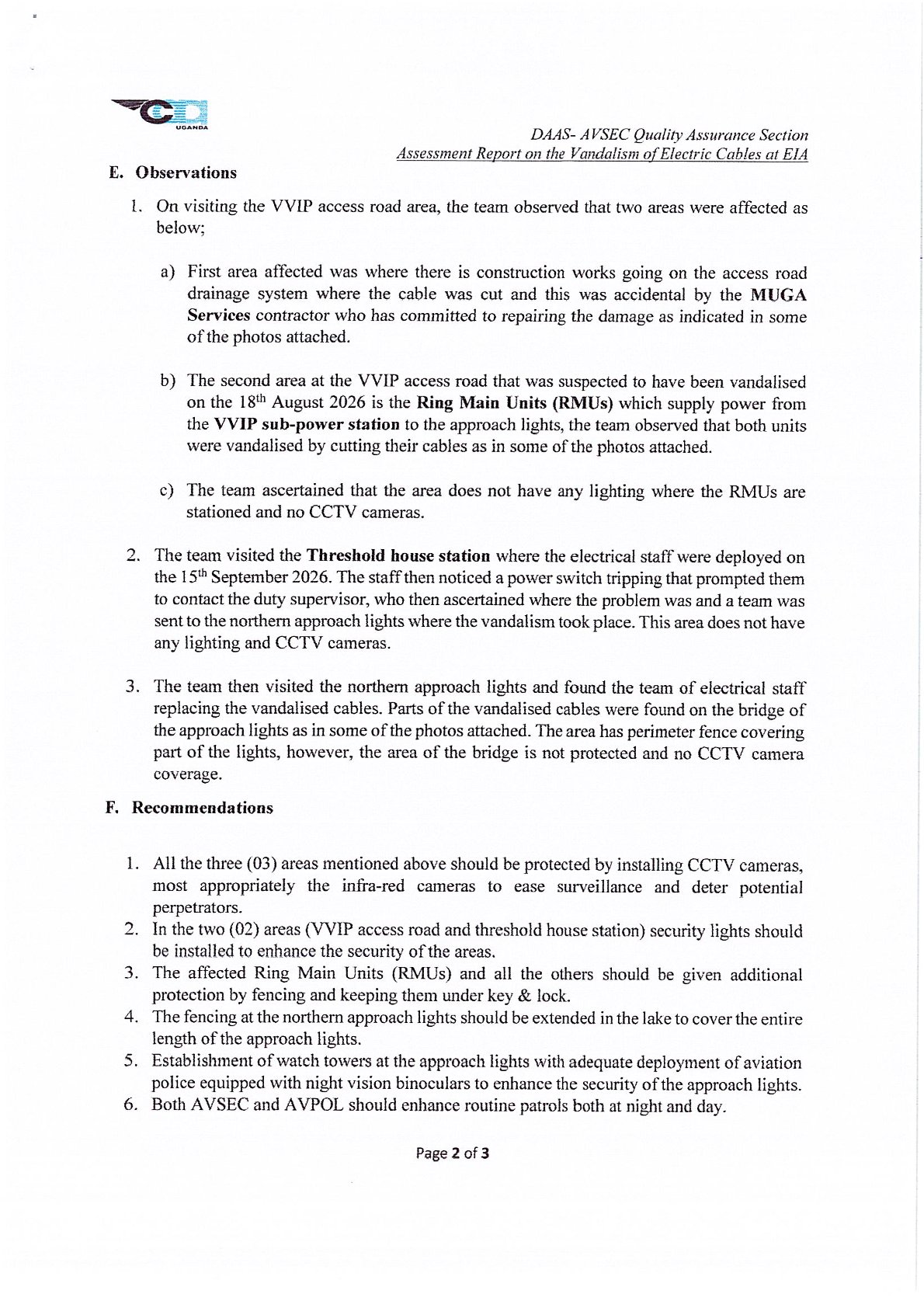
The security assessment established that the area had no security lighting and no CCTV cameras.
This meant that the installations lacked two important layers of protection that could help detect suspicious activity and identify people interfering with the electrical infrastructure.
How could two critical electrical installations supplying airport approach lights be left in an area without basic surveillance?
THRESHOLD HOUSE: POWER SWITCH TRIPS, VANDALISM EXPOSED!
The Aviation Security report also documents a separate incident involving the Threshold House station.
On September 15, 2026, electrical staff had been deployed to the station when they noticed a power switch tripping.
The staff contacted their duty supervisor, who subsequently established where the problem was occurring.
A team was then dispatched to the northern approach lights, where the electrical cable vandalism had taken place.
The security assessment established that the Threshold House area also lacked adequate security lighting and CCTV coverage.
The incident illustrates how an electrical fault can become the first indication of interference with critical airport infrastructure.
It also raises questions about why sensitive installations such as Threshold House were not adequately illuminated and monitored before the incident.
The security team recommended that both the VVIP access road and Threshold House be fitted with security lights to improve surveillance and deter unauthorised access.
APPROACH LIGHTS IN DANGER!
The three incidents are significant because they involve electrical infrastructure connected to the airport’s lighting systems.
The VVIP sub-power station supplies the approach lights through the two affected Ring Main Units.
The approach lighting system provides pilots with visual guidance as they prepare to land, making the reliability of its electrical supply critical to safe airport operations.
The September 18 assessment therefore went beyond documenting the damaged cables and examined the security weaknesses that could allow similar incidents to happen again.
Investigators found that parts of the northern approach lighting bridge had perimeter fencing, but other sections remained unprotected.
The bridge had no CCTV coverage, while the surrounding areas presented additional access challenges.
The security team consequently recommended extending the fencing to cover the entire length of the approach lighting installation, including the section extending into the lake.
SECURITY BOSSES UNDER PRESSURE!
The revelations place the Aviation Security Department, Aviation Police and airport management under renewed scrutiny.
The assessment was conducted by a team comprising Airport Security Inspector Collins Aritua Aleni, CCTV personnel Nakabaale Balaam Ezra, and electrical staff Kaaye John Bosco and Wafula Paul.
Its findings expose security weaknesses at two separate locations: the VVIP access road and Threshold House.
The fact that the VVIP access road had no security lighting or CCTV around the affected RMUs raises questions about how security assessments and infrastructure protection were being handled.
The MUGA Services incident also raises questions about the level of supervision exercised over contractors working around sensitive airport installations.
Meanwhile, the suspected August 18 vandalism demonstrates that the problem was not limited to accidental damage arising from construction works.
The report’s conclusion warns that vandalism of electrical installations and materials at Entebbe had become too frequent and that previous incidents had not been successfully resolved.
It calls for coordinated action by the Electrical Department, Aviation Security, Aviation Police and the entire airport joint security establishment.
SIX SECURITY MEASURES PROPOSED!
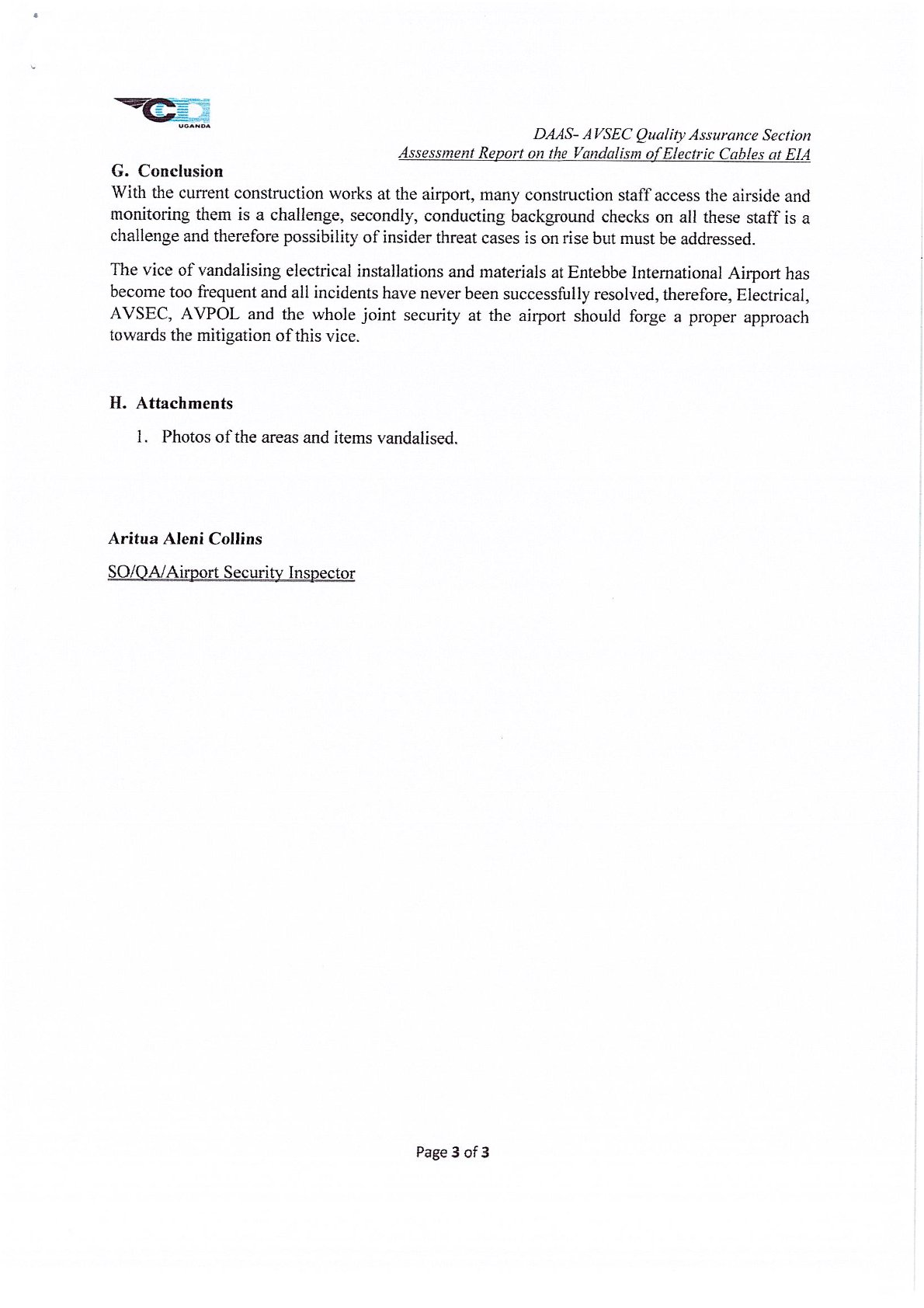
To address the weaknesses, the September 18 report recommends six major interventions.
First, all three affected areas — the VVIP access road, Threshold House and northern approach lights — should be fitted with CCTV cameras, preferably infrared cameras to improve surveillance and deter potential perpetrators.
Second, security lighting should be installed at the VVIP access road and Threshold House.
Third, the affected Ring Main Units and other similar installations should receive additional protection through fencing and secure locking arrangements.
Fourth, fencing around the northern approach lights should be extended into the lake to cover the entire length of the installation.
Fifth, watchtowers should be established at the approach lights and equipped with adequate Aviation Police deployment and night-vision binoculars.
Sixth, Aviation Security and Aviation Police should intensify routine patrols during both daytime and night-time.
The report also raises concerns about the growing number of construction workers accessing the airport’s airside during ongoing projects, warning that monitoring them is difficult and conducting background checks on all of them presents a challenge.
It cautions that this increases the possibility of insider threats.
The latest findings add another layer to the growing scrutiny of UCAA, with questions now extending beyond cable theft to construction supervision, electrical infrastructure protection and the security of installations serving the airport’s aviation operations.
GOT A HOT STORY? BLOW THE WHISTLE!
Have breaking news, explosive revelations, juicy leads or evidence of wrongdoing?
WE WANT TO HEAR FROM YOU!
Send your tips, documents, videos, photos and audio recordings to:
redpeppertips@gmail.com
Whether it’s corruption, scandals, abuse of office, injustice or stories others are afraid to tell, help us bring the truth to light.
SOURCES ARE PROTECTED.
CONFIDENTIALITY IS OUR NO.1 PRIORITY!
About Post Author