LEGS LOAN CRISIS! Sh2.7Bn MSC Lending Scandal, Sh62.53Bn Write-Offs and 52% Default Rate Expose Microfinance Support Centre Collapse Under Rural Growth Programme
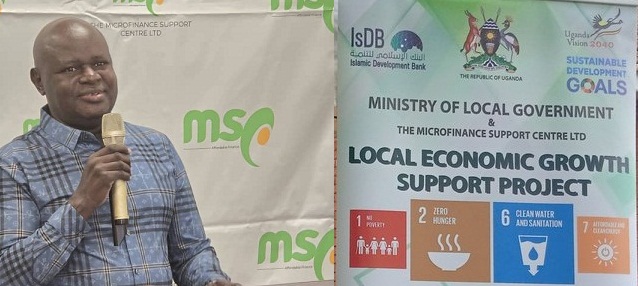
Executive Director John Peter Mujuni
By Our Reporter
A deepening financial crisis has engulfed the Microfinance Support Centre (MSC), the main lending arm of Government’s Local Economic Growth Support Project (LEGS), after revelations that Sh2.7 billion in project loans were disbursed under questionable conditions, alongside massive loan write-offs, weak recovery systems and a soaring default rate that now threatens the entire rural financing programme.
The developments place MSC Executive Director John Peter Mujuni and Board Chairperson Kiiza Aliba Emmanuel under intense scrutiny, as concerns grow over the institution’s ability to manage public funds under the Sh545 billion LEGS programme implemented by the Ministry of Local Government.
The LEGS programme, designed to support rural enterprises, SACCOs, agriculture, agro-processing and financial inclusion across 55 districts, is now facing credibility questions as its key financing channel struggles with financial instability.
SH2.7BN LEGS LOANS SPARK COMPLIANCE QUESTIONS
At the centre of the controversy is the disbursement of UGX.2.725 billion in LEGS-related loans to SACCOs that were not legally licensed.
According to the Auditor General, the loans were issued in violation of MSC’s own credit policy, which requires all borrowing SACCOs to hold valid operating licences from the Uganda Microfinance Regulatory Authority (UMRA).
“Loans amounting to UGX.2.725Bn were paid out to various SACCOs, however, these SACCOs did not possess valid operating licenses from UMRA contrary to the credit policy of the company,” the report states.
The finding raises serious concerns about due diligence, risk management and compliance within MSC’s LEGS lending operations, which are meant to support grassroots economic transformation.
Financial experts warn that such breaches expose public funds to avoidable risk and undermine the integrity of Government-backed credit programmes.
SH62.53BN WRITE-OFFS SHAKE MSC FINANCIAL STABILITY
The loan controversy comes against the backdrop of a much larger financial crisis at MSC.
The 2025 Auditor General’s report reveals that the institution wrote off UGX.62.53 billion in loans, a move that significantly weakened its financial position and contributed to a reported loss of UGX.22.67 billion.
“The Company made loan write-offs worth UGX.62.53Bn in respect of receivables, and this affected the reported performance for the year, contributing to a loss of UGX.22.67Bn,” the report states.
The scale of the write-offs has raised alarm within financial oversight circles, with analysts questioning the sustainability of MSC’s lending model under LEGS and other Government programmes.
WEAK RECOVERY SYSTEMS EXPOSE BILLIONS AT RISK
Further findings show that MSC’s loan recovery performance is far below expectations.
Out of UGX.1.271 billion projected for recovery from written-off loans, the institution only managed to collect UGX.0.167 billion, leaving an under-collection of UGX.1.104 billion.
This poor recovery rate has intensified concerns that billions of shillings in public funds may remain permanently unrecovered.
DELAYED LOAN PROCESSING UNDER LEGS PROGRAMME
The Auditor General also flagged inefficiencies in loan processing under MSC’s operations.
Seventeen loans worth UGX.7.78 billion were found to have taken excessively long to process, with some applications exceeding one year before approval.
“17 loans worth UGX.7.78Bn disbursed during the year exceeded the maximum lead times prescribed and sometimes even took over a year to complete processing,” the report notes.
These delays are said to be affecting service delivery to SACCOs and rural enterprises that depend on timely access to credit under LEGS.
OUTDATED COLLATERAL VALUES INCREASE RISK EXPOSURE
The report further highlights that MSC relied on outdated collateral valuations for loans worth UGX.6.526 billion, with some valuations dating back nearly a decade.
Experts say this practice exposes the institution to significant financial risk, as collateral values may no longer reflect current market conditions.
NON-PERFORMING LOANS HIT CRITICAL 52%
Perhaps the most alarming revelation is the state of MSC’s loan portfolio.
As of June 2024, non-performing loans stood at 52%, equivalent to UGX.44.7 billion out of UGX.83 billion in outstanding conventional loans.
“A 52 percent default rate is not just high—it is catastrophic. It signals systemic failure in loan recovery and credit management,” a financial analyst warned.
UNDERUTILISED LEGS FUNDS AND FUNDING SHORTFALLS
The crisis is further compounded by underutilisation of funds intended for rural lending.
Out of UGX.44.7 billion planned for disbursement, only UGX.23.4 billion was actually lent out.
Under the Emyooga programme, UGX.120.996 billion was spent out of UGX.134.206 billion, leaving UGX.13.210 billion idle.
At the same time, MSC failed to meet its funding mobilisation targets, raising UGX.969.37 billion against a target of UGX.1.792 trillion, leaving a shortfall of UGX.823.48 billion.
Government support also fell short, with MSC receiving UGX.133.341 billion out of UGX.161.23 billion appropriated.
GOVERNANCE GAPS AND WEAK CLIENT PROTECTION
The Auditor General also flagged the absence of a client service charter, leaving borrowers without a formal framework outlining service standards and protections.
“The company does not have an approved client service charter that informs clients and stakeholders,” the report states.
Experts say this weakens accountability and transparency in MSC’s dealings with SACCOs and rural borrowers.
LEGS PROGRAMME UNDER THREAT
MSC is a key implementing partner under the LEGS programme, a Sh545 billion Government initiative targeting nearly 16 million Ugandans across 55 districts.
The programme is designed to boost agriculture, water access, agro-processing and financial inclusion in rural areas.
However, the financial instability at MSC now raises serious concerns about whether the institution can effectively support the programme’s expansion and deliver on its mandate.
LEADERSHIP UNDER INTENSE SCRUTINY
As the findings accumulate, pressure is mounting on MSC leadership, particularly Executive Director John Peter Mujuni and Board Chairperson Kiiza Aliba Emmanuel, to account for the deepening financial crisis.
The combination of UGX.62.53 billion in write-offs, UGX.2.7 billion in questionable LEGS loans, weak recovery systems, outdated risk assessments and a 52% default rate has placed the institution at the centre of a major accountability storm.
A concerned observer summed up the situation:
“This is no longer just a financial issue. It is a trust crisis. And it is growing by the day.”
With billions in public funds at stake and rural livelihoods depending on MSC’s performance under LEGS, urgent reforms are now being demanded to restore confidence in Government-backed microfinance operations.
GOT A HOT STORY? LET US KNOW!
Got breaking news, explosive secrets, or hard evidence?
Email us: redpeppertips@gmail.com
We accept tips, documents, videos, photos, and recordings—the more evidence you have, the better.
CONFIDENTIALITY IS OUR TOP PRIORITY. SOURCES ARE ALWAYS PROTECTED!
About Post Author