LEGS PROJECT MESS! Sh545Bn Rural Growth Programme Hit by Land Disputes, Unaccounted Sh216M and Sh2.7Bn Loan Scandal Under Local Govt Ministry
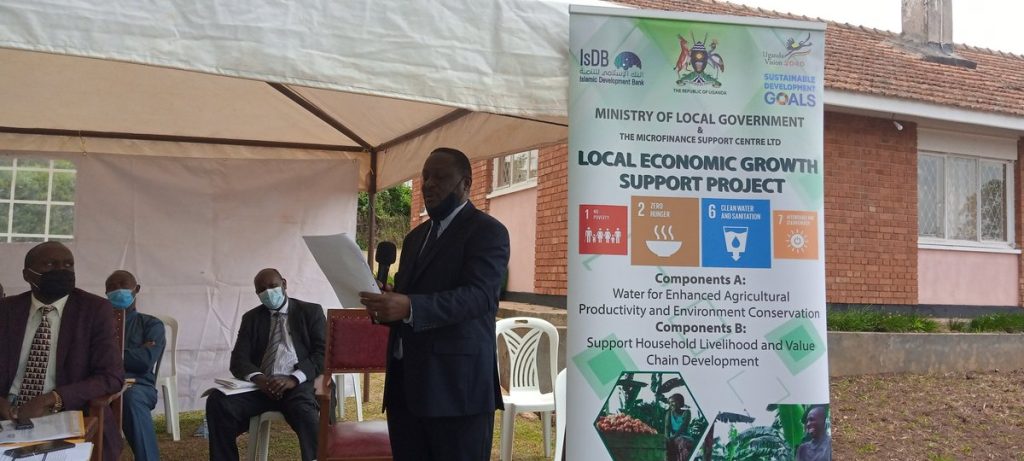
Eng. Paul Kasule Mukasa, the LEGS coordinator at a recent event
By Our Reporter
A multi-billion-shilling Government programme designed to lift millions of Ugandans out of poverty through agriculture, water access, agro-processing and financial inclusion has come under a cloud of accountability questions, with serious weaknesses exposed in the management of the Local Economic Growth Support Project (LEGS) under the Ministry of Local Government.
The findings put the spotlight on the Ministry’s leadership, headed by Eng. Paul Mukasa Kasule, with operational responsibilities also involving officials such as Madam Maria Nakitende, after the latest examination of the project uncovered contested land ownership, funds that were not accounted for and loans disbursed contrary to financing agreement provisions.
The LEGS project is a $150 million initiative, approximately Sh545 billion, being implemented through the Ministry of Local Government with financing from the Government of Uganda, the Islamic Development Bank and the Lives and Livelihoods Fund.
The project is intended to improve household incomes and reduce poverty in dry and remote rural areas by supporting agriculture, water access, agro-processing, local enterprises and financial inclusion.
But the latest findings show that some of the very projects intended to transform rural communities have themselves become entangled in land, financial management and implementation problems.
One of the major concerns is the ownership of land on which infrastructure financed under the project has been constructed.
The ownership of a portion of the land on which the Rwakibira Valley Dam in Gomba District was constructed is contested by a private individual.
The situation presents a potential ownership dispute over infrastructure developed using public project resources.
In Nakaseke District, the problem is even more direct.
The land on which the Katalekamese market shade was constructed is privately owned.
The findings raise questions over how land was identified, verified and secured before public funds were committed to construction projects.
SH2.73BN LOANS DISBURSED TO PRIVATE COMPANIES
The financial management of the project has also come under scrutiny over loans disbursed through the Microfinance Support Centre (MSC).
In the financial years ended June 30, 2024 and June 30, 2025, the Microfinance Support Centre disbursed loans amounting to Sh2.73 billion to private companies.
The disbursements were contrary to provisions contained in the financing agreement.
The finding puts the project managers and responsible officials under pressure to explain how the loans came to be extended to private companies despite the conditions governing the financing arrangement.
The concern is particularly significant because LEGS is intended to support local economic growth, household incomes and rural enterprises, meaning the management of its financing arrangements is central to whether the programme achieves its objectives.
SH216M ADVANCE NOT ACCOUNTED FOR
Another financial accountability concern involves Kyenjojo District Local Government.
The project advanced Sh216.53 million to Kyenjojo District Local Government to facilitate dairy breed and nutritional improvement.
However, the funds were not accounted for.
The absence of accountability for the Sh216.53 million raises questions about the controls in place to track project money transferred to local governments and to ensure that funds are used for their intended purposes.
It also puts pressure on those responsible for supervising project implementation and financial reporting to account for how the money was utilised.
MARKET SHED UNDER-UTILISED
Physical inspection of projects funded under the programme also exposed problems with utilisation and design.
At Magoma Market shed in Nakaseke District, the facility was found to be under-utilised.
The finding raises concerns over whether some of the infrastructure being constructed under LEGS is adequately matched to the needs and activities of the communities it is intended to serve.
At Kiwoko in Nakaseke District, the maize processing plant was found to be small in size and lacking proper ventilation.
The inadequate ventilation was identified as posing a health risk.
The issue raises questions about the planning and design of the facility before construction and whether the infrastructure adequately meets the operational requirements of a maize processing plant.
WATER PROJECT HIT BY ACCESS ROAD PROBLEM
The project’s water infrastructure has also encountered implementation difficulties.
Part of the water supply system for Kinoni in Nakaseke District had not been constructed because there was no access road to the proposed site.
This means that a project intended to improve access to water was unable to complete part of its planned infrastructure because the location could not be accessed through an adequate road.
The finding underscores the importance of proper site assessment and coordination before infrastructure projects are undertaken.
SH545BN PROJECT AIMED AT 16 MILLION UGANDANS
The issues are emerging at a time when LEGS is being expanded under a second phase of implementation.
The $150 million project, approximately Sh545 billion, was designed as a major Government intervention to boost rural incomes, improve access to water and strengthen agricultural production.
The first phase targeted 17 districts, while the second phase has been expanded to 55 districts and is expected to benefit nearly 16 million Ugandans.
The programme focuses on boosting crop yields through better seeds, tractors and irrigation systems, improving access to safe water for households and agriculture, constructing storage facilities and processing plants, improving market roads and supporting financial inclusion.
It also seeks to support youth, women and disabled entrepreneurs through microfinance and other forms of enterprise support.
The second phase, which was rolled out earlier this year, is a five-year programme focusing on climate change, youth and women entrepreneurship, small-scale irrigation, agro-processing and improved post-harvest handling.
The project is being implemented by the Ministry of Local Government with financing from the Lives and Livelihoods Fund, the Islamic Development Bank and the Government of Uganda.
Its expansion to 55 districts means that the management weaknesses now exposed could have implications far beyond the districts already covered by the inspected projects.
The LEGS project is a direct response to Uganda’s National Local Economic Development Policy adopted in 2014 and is intended to support community-driven solutions, enterprise development and stronger local value chains.
Its broader objective is to improve the economic wellbeing of rural communities through increased access to water, enhanced agricultural productivity, environmental conservation and stronger local economic activity.
However, the findings highlight the gap that can emerge between the ambitious objectives of a major Government programme and the effectiveness of controls used to deliver it.
With LEGS carrying a financial envelope of about Sh545 billion and targeting nearly 16 million Ugandans in its expanded phase, the findings put the Ministry of Local Government and the officials responsible for the programme’s administration under renewed scrutiny.
The central question now is whether the Ministry’s leadership and project management structures are doing enough to ensure that the enormous resources committed to LEGS translate into properly planned, legally secure, functional and fully accountable projects for the rural communities they are intended to serve.
GOT A HOT STORY? LET US KNOW!
Got breaking news, explosive secrets, or hard evidence?
Email us: redpeppertips@gmail.com
We accept tips, documents, videos, photos, and recordings—the more evidence you have, the better.
CONFIDENTIALITY IS OUR TOP PRIORITY. SOURCES ARE ALWAYS PROTECTED!
About Post Author