SH1.6BN PR SCANDAL ROCKS UGANDA AIRLINES! PRO Shakila, Top PR Agencies TBH, Metropolitan On Spot
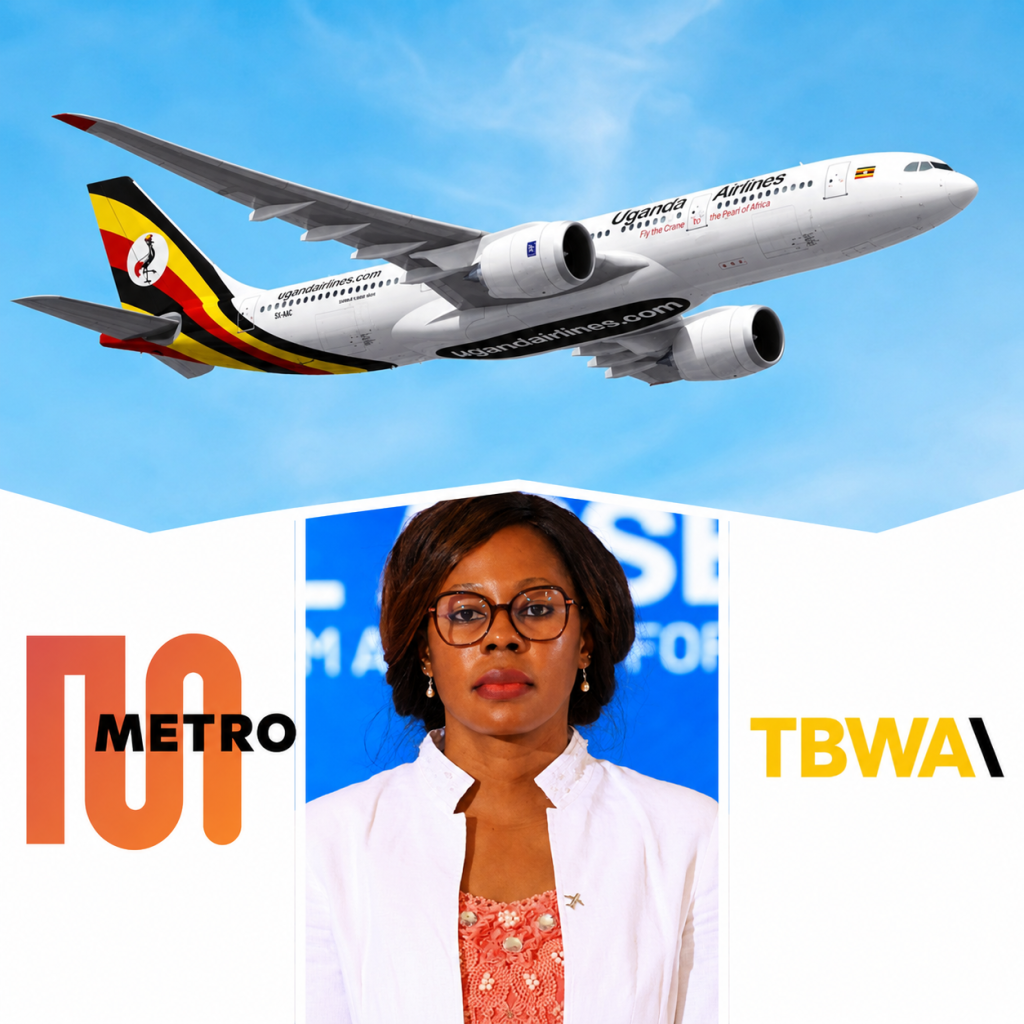
KAMPALA — Uganda Airlines has been rocked by a damning internal audit into its global communications strategy, with more than Sh1.6bn billion in questionable, unsupported or irregular expenditure coming under scrutiny and the airline’s Head of Public Relations and Corporate Affairs, Shakila Rahim Lamar, emerging as a key official in the audit findings.
The explosive findings reviewed by RedPepper are contained in a Management Letter on the Audit of the Contract Management Process dated February 16, 2026, prepared by Uganda Airlines’ Internal Audit department.
The audit specifically examined the procurement of the Global Communications Strategy, referenced as UNACL/CONS/22-23/00188, and flagged a string of procurement, contract management, expenditure and accountability concerns involving TBH Holding Ltd and Metropolitan Republic Uganda Ltd.

At the centre of the storm is a communications contract that was initially estimated at about Sh1.117 billion, but which eventually recorded actual expenditure of Sh1.628 billion, representing a Sh478.7 million overrun against the contracted amount.
But the audit trail goes even deeper.
Auditors questioned how TBH Holding Ltd ended up with a contract in the first place, arguing that the bidding documents did not reflect the recommendation of the Evaluation Committee to divide the work between the two firms.
According to the audit, the Evaluation Committee had recommended TBH Holding Ltd for global footprint content and Metropolitan Republic Uganda Ltd for content creation.
However, the original terms of reference did not divide the scope in that manner.
More dramatically, the audit states that Metropolitan Republic Uganda Ltd was the only bidder that submitted a bid within Uganda Airlines’ USD300,000 budget, quoting USD276,231.
TBH Holding Ltd, on the other hand, had an evaluated price of USD382,013 and, according to the audit, should therefore not have been recommended for the contract award.
Then came the negotiations.
On November 30, 2023, Uganda Airlines negotiated with both firms, eventually agreeing to pay Sh500 million to Metropolitan Republic Uganda Ltd and Sh650 million to TBH Holding Ltd.
The audit says the two entities were contracted for a similar scope and that the negotiations “may be inferred” to have been aimed at bringing TBH in as an additional Best Evaluated Bidder within the airline’s overall USD300,000 budget.
The Contracts Committee subsequently awarded TBH the contract despite the deviation from the pre-approved terms of reference.
SH1.63BN SPENDING — BUT WHERE DID THE MONEY GO?
The audit found that while the communication strategy had been estimated at Sh1.117 billion, the two contracts were eventually signed at a combined Sh1.15 billion.
But actual execution, based on purchase orders and invoices, shot up to Sh1.628 billion — a 42 percent overrun, amounting to Sh478.755 million.
Metropolitan Republic Uganda Ltd had been contracted for Sh500 million but had actual reported expenditure of Sh408.451 million.

TBH Holding Ltd, however, had a contract value of Sh650 million, yet the audit recorded actual expenditure of Sh1.220 billion against it.
That means TBH’s actual spending was about Sh570.3 million above its contracted amount.
Auditors recommended that management should continuously compare actual expenditure against estimated and contracted amounts and ensure that any variations or additional expenditure are properly reviewed, approved and documented by the Contracts Committee.
SH258.6M CREATIVE BILL
The audit also put a spotlight on Sh258.647 million spent on creative and brand design work.
Auditors questioned why Uganda Airlines was paying external agencies for creative services when the airline already employed graphic designers whose job descriptions included creating images, developing visuals and testing graphics across different media.
Among the expenditure flagged were payments to Metropolitan for billboard skins and monitoring, office branding and interior design, public holiday graphics, as well as other branding and content-related services.
TBH was also paid for agency creative resources covering projects including new routes, the airline’s five-year anniversary, the London route, Flightpath Sustainability and Tier 3 creative jobs.
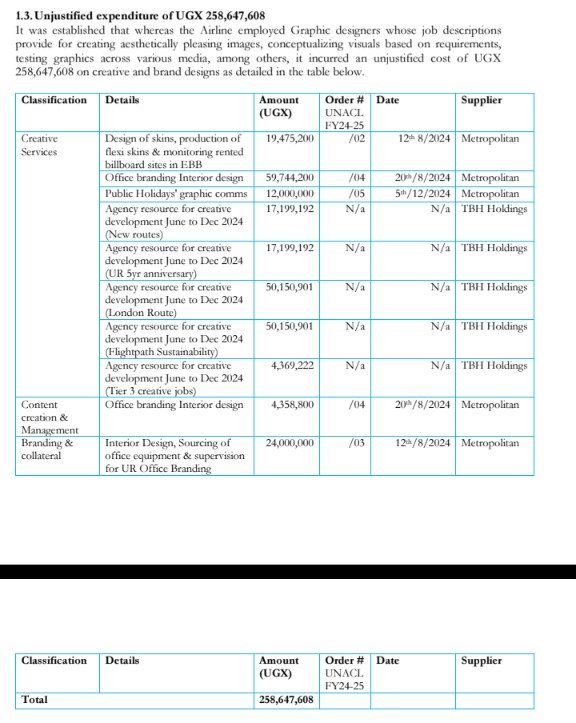
The total flagged under this section was Sh258,647,608.
The auditors recommended that future creative and brand design work should be handled internally by Uganda Airlines’ employed graphic designers.
More significantly, the audit specifically recommended that the Manager Corporate Affairs and Public Relations should justify and account for the Sh258.647 million expenditure in the presence of the airline’s internal graphic designers.
SH164M PAID WITHOUT PURCHASE ORDERS
The audit then uncovered another eyebrow-raising issue.
TBH Holdings Ltd invoiced Uganda Airlines for Sh164.101 million, and payments were made despite the absence of call-off or purchase orders.
The invoices included payments of Sh59.178 million, Sh20.295 million, Sh5.155 million, another Sh20.295 million and Sh59.178 million, bringing the total to Sh164.101 million.
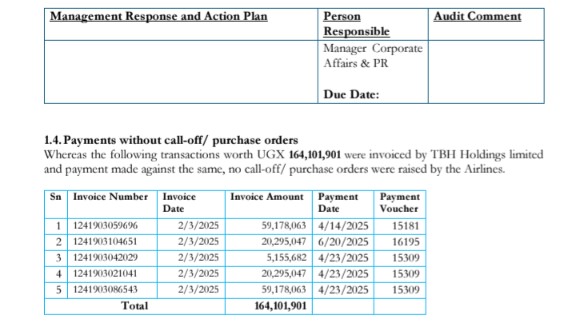
Auditors recommended that, as contract manager, the Manager of Corporate Affairs and Public Relations should provide justification and an account for the money paid without call-offs or purchase orders.
The Chief Finance Officer was also advised to enforce complete procure-to-pay documentation before vendors are paid.
SH778.9M AFTER CONTRACT EXPIRY
And this is where the audit takes another dramatic turn.
The auditors established that Metropolitan Republic Uganda Ltd’s contractual period ended on February 23, 2025.
TBH Holding Ltd’s contract subsequently ended on March 12, 2025.
Yet Uganda Airlines continued procuring services from TBH after the contract had expired.
According to the audit, there was no documented approval from the Contracts Committee for an extension of TBH’s contract.
The result?
A staggering 40 transactions worth Sh778,932,924 were procured from TBH without a valid contract.
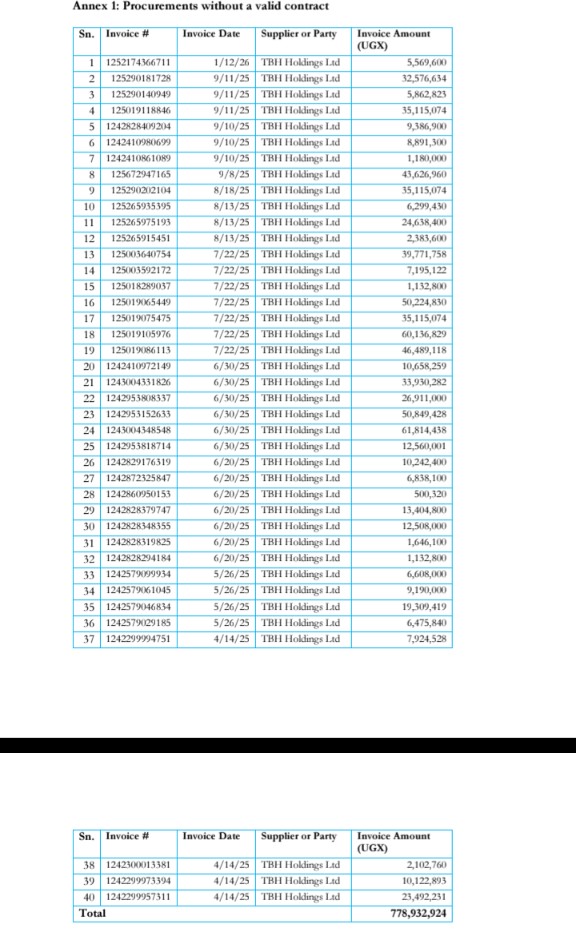
Auditors warned that operating without a valid contract exposes the airline to payments for undelivered, partially delivered or poor-quality services, retrospective justification of irregular procurements and the inability to enforce service levels, timelines and quality standards.
They recommended a strict “no contract, no service, no payment” policy, except for properly authorised emergency procurement.
SH1.575BN — NO PROOF OF DELIVERY
The audit also found that Sh1.575 billion had been spent under the global communications strategy contract, but auditors could not find sufficient evidence showing that the contracted services had actually been delivered.
Apart from quotations, call-off orders and invoices, auditors said there were no documented delivery records or contract management reports in the procurement files or Oracle Fusion ERP system.
Missing evidence included delivery notes or job cards, monitoring reports for media houses and social media, proof of billboard installations, repositories of developed photos, videos, audio and visual advertisements, graphical designs, meeting minutes, performance evaluations and budget reports.
Auditors consequently recommended that the Manager Corporate Affairs and Public Relations provide the contract management records and prove delivery of the deliverables under the contract.
NEW DEAL RAISES FRESH FEARS
As if the findings were not enough, auditors discovered that a new procurement process for the global communications strategy was already ongoing.
The concern was that the new procurement was based on the same terms of reference and scope of work as the previous contract that had generated the audit findings.
Auditors warned that this could result in duplication of services or deliverables, potentially causing further financial loss to Uganda Airlines.
The Contracts Committee was therefore advised to review the new procurement to ensure that proper needs assessment, scoping and resource allocation had been undertaken.
THE TBH MONEY TRAIL
The audit annex provides a detailed list of the 40 transactions made to TBH after the contract had expired.
The transactions range from millions to tens of millions of shillings.
Among them was a Sh5.56 million invoice dated January 12, 2026; Sh32.57 million and Sh5.86 million invoices dated September 11, 2025; and a Sh35.1 million invoice dated September 10, 2025.
Other payments included Sh43.6 million, Sh35.1 million, Sh24.6 million, Sh39.7 million, Sh50.2 million, Sh35.1 million, Sh60.1 million and Sh46.4 million, among numerous other transactions.
The annex ultimately totals the disputed post-contract transactions at Sh778,932,924.
The audit letter was signed by Ronald Otukol, Manager Internal Audit, and copied to the Chairperson of the Contracts Committee and the Acting Manager of the Procurement and Disposal Unit.
For Shakila Rahim Lamar, Uganda Airlines’ Head of Public Relations and Corporate Affairs, the audit places the office responsible for Corporate Affairs and PR squarely in the accountability chain, particularly regarding the creative expenditure, payments made without call-offs and purchase orders, and contract management records.
The audit, however, does not by itself establish that Lamar personally received money, committed fraud or acted corruptly.
Rather, it identifies expenditure and contract-management weaknesses and assigns accountability actions to the relevant management offices.
The findings now raise hard questions over how Uganda Airlines manages multimillion-shilling communications contracts, why external agencies were engaged for work apparently capable of being performed internally, why payments continued after contract expiry, and why billions in expenditure were not backed by the delivery documentation expected by auditors.
For an airline operating on public resources, the big question is no longer simply how much was spent on public relations.
It is: What exactly did Uganda Airlines get for the money?
GOT A HOT STORY? LET US KNOW!
Got breaking news, explosive secrets, or hard evidence?
Email us: redpeppertips@gmail.com
We accept tips, documents, videos, photos, and recordings—the more evidence you have, the better.
CONFIDENTIALITY IS OUR TOP PRIORITY. SOURCES ARE ALWAYS PROTECTED!
About Post Author