WAR ON TERROR! Ex-Guantanamo Bay Prisoner Jailed 6 Years for Supporting ADF
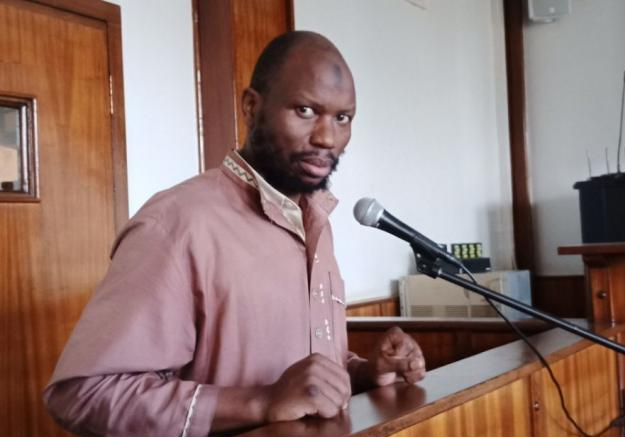
Ex Guantanamo Bay Prisoner Jamal Kiyemba Appearing Before Court
The International Crimes Division of the High Court has sentenced former Guantanamo Bay detainee Jamal Kiyemba, also known as Abdullah or Tonny Kiyemba, to six years’ imprisonment after convicting him of soliciting or inviting support for the Allied Democratic Forces (ADF), a designated terrorist organisation.
In her sentencing decision delivered on Tuesday, Justice Susan Okalany ordered that the four years, two months and 19 days Kiyemba has already spent on remand be deducted from the sentence, leaving him with a remaining prison term of one year, nine months and 11 days.
Kiyemba had been charged with three offences under the Anti-Terrorism Act: rendering support to a terrorist organisation, belonging to or professing to belong to a terrorist organisation, and soliciting or inviting support for a terrorist organisation. But he was acquitted of the first two charges, and found guilty of soliciting support for the ADF.
The court held that the prosecution had failed to prove that he rendered material support to the group or that he belonged to it, but established the offence of solicitation.
During sentencing, Chief State Attorney Jacquelyn Okui argued that the offence was serious because it endangered national security, public safety and public order. She told the court that the ADF has been responsible for killings, abductions, destruction of property, displacement of civilians and widespread fear in Uganda.
Okui further submitted that terrorist organisations rely on external support to sustain their operations and that encouraging such support facilitates terrorism. She noted that Kiyemba committed the offence at Kampala’s Old Taxi Park, a busy public place, and urged the court to impose a custodial sentence of at least seven years to deter similar conduct.
In mitigation, defence lawyers Musa Kabega and Faisal Balikurungi described Kiyemba as a 47-year-old first offender, husband and father of seven children who had served as a cleric at Masjid Taqwa and was the sole breadwinner for his family before his arrest.
The defence told the court that Kiyemba had expressed genuine remorse, undergone treatment for bipolar disorder while in custody and had been rehabilitated during more than four years on remand. Counsel also argued that there was no evidence his actions resulted in recruitment, financing or any act of violence linked to the ADF.
The defence further urged the court to consider Kiyemba’s lengthy history of detention without conviction. The court heard that he spent six months in prison after his 2013 arrest before obtaining mandatory bail, another seven months on remand following a 2014 arrest, and four years and seven months in custody after a 2015 arrest before the charges were withdrawn.
The court also heard that Kiyemba had previously spent more than four years at the United States detention facility at Guantanamo Bay without being convicted and was later issued a clearance certificate.
Justice Okalany said the earlier arrests and withdrawn charges could not be treated as evidence of criminal conduct or aggravating factors. Instead, she said they demonstrated the exceptionally long periods Kiyemba had spent in detention without conviction and were therefore relevant to his personal circumstances during sentencing.
In determining the sentence, the judge observed that soliciting support for a terrorist organisation is inherently serious because it can facilitate terrorism and threaten national security. She added that committing the offence in a crowded public place heightened its gravity.
However, the court found that the offence arose from a single incident and that there was no evidence Kiyemba recruited members, raised funds, provided material support or committed acts of violence on behalf of the ADF. Justice Okalany also considered his status as a first offender, his family responsibilities, his remorse and his mental health condition as mitigating factors.
After balancing the seriousness of the offence against the mitigating circumstances and the lengthy period already spent in custody, the judge concluded that a longer custodial sentence was unnecessary. She therefore imposed a six-year prison sentence effective from the date of conviction and directed that the period Kiyemba spent on remand from May 12, 2022, to July 29, 2026, be credited in accordance with the law.
Before concluding the proceedings, Justice Okalany addressed an administrative error involving two detention warrants held by the Uganda Prisons Service under separate criminal case numbers. She explained that the duplication resulted from a mistake at Buganda Road Chief Magistrate’s Court, where the same case had inadvertently been assigned two different case numbers.
The judge noted that the error had been corrected during committal proceedings in December 2022 and directed the Uganda Prisons Service to recognise that Kiyemba has only one case before the International Crimes Division.
Kiyemba has the right to appeal both his conviction and sentence before the Court of Appeal within 14 days.
GOT A HOT STORY? LET US KNOW!
Got breaking news, explosive secrets, or hard evidence?
Email us: redpeppertips@gmail.com
We accept tips, documents, videos, photos, and recordings—the more evidence you have, the better.
CONFIDENTIALITY IS OUR TOP PRIORITY. SOURCES ARE ALWAYS PROTECTED!
About Post Author