DNA DISASTER! Investigation Exposes Rot, Chaos, Ghost Systems & Multi-Billion Failures At Govt Chemist Lab
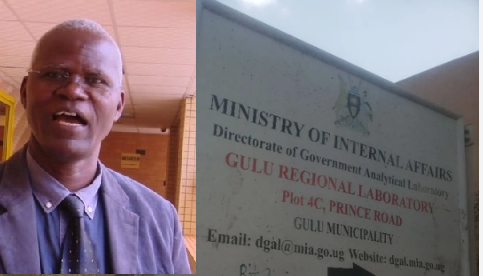
The explosive findings place the spotlight directly on DGAL top management led by Chief Chemist Kepher Kuchana
A shocking Auditor General’s report has blown the lid off massive operational failures, crippling funding gaps, stalled forensic projects, underutilized laboratories, staffing crises and alarming inefficiencies at the Directorate of Government Analytical Laboratory (DGAL), exposing serious weaknesses at one of Uganda’s most sensitive justice and forensic institutions.
The explosive findings place the spotlight directly on DGAL top management led by Chief Chemist Kepher Kuchana as the institution tasked with providing scientific and forensic analytical services to support justice delivery finds itself buried in shocking accountability and operational failures.
DGAL, formerly known as the Government Chemist and Analytical Laboratory, is a constituent directorate under the Ministry of Internal Affairs and is mandated to provide forensic and scientific services to support legal proceedings, environmental safety and justice administration.
For over 80 years, the institution has positioned itself as Uganda’s leading independent forensic and analytical service provider operating within the Justice Law and Order Sector.
But the latest December 2025 Auditor General report paints a disturbing picture of an institution drowning in inefficiency, stalled projects, poor planning, underfunding and weak implementation despite handling critical national forensic responsibilities.
The report reveals that DGAL closed the financial year with a staggering outstanding arrears balance of UGX1.39 billion, signaling deep financial strain within the institution.
Auditors further noted that out of the total expenditure of UGX42 billion, an amount of UGX5.65 billion related to classified expenditure which was audited and reported separately.
The report also uncovered procurement irregularities after auditors established that DGAL’s published procurement plan failed to indicate procurements reserved for registered associations as required under government guidelines.
Auditors additionally established that at least 14 assets owned by DGAL were either lying idle or severely underutilized, raising fresh questions over resource management and value for taxpayer money.
In another alarming revelation, auditors discovered that although DGAL owns the Mbarara regional office building, the institution does not possess ownership rights over the land on which the building stands, exposing government property to potential ownership and legal disputes.
The Auditor General further exposed a catastrophic funding crisis within DGAL’s strategic plan implementation.
Out of the UGX668.8 billion budget projected under the Strategic Plan for 2020/2021 to 2024/2025, only UGX137.902 billion was realized, leaving an unfunded balance of UGX530.915 billion representing a crippling 79.4 percent funding shortfall.
As a result, DGAL only managed to achieve 35 percent of its planned targets, effectively crippling implementation of key strategic initiatives.
The report further reveals that although DGAL had prepared a draft Strategic Plan for 2025/26 to 2029/30 aligned to the National Development Plan IV, the plan had not yet been approved by the National Planning Authority as required.
Auditors also reviewed DGAL’s Certificate of Compliance for the 2024/2025 financial year and found that the institution scored only 58.6 percent compliance due to failure to report on critical indicators under the Parish Development and Industrialisation agenda including institutionalisation of a research and development agenda and the number of research profiles.
Despite the numerous failures, DGAL however managed to surpass its Non-Tax Revenue target after collecting UGX637 million against a target of UGX564 million representing 112.7 percent performance.
But even more troubling are the shocking revelations surrounding the multi-billion DNA Data Bank project.
The Auditor General revealed that DGAL entered into a contract worth UGX103 billion to construct a 16-storey DNA Data Bank building at its headquarters.
However, the project has already been hit by massive payment delays and poor financial controls.
Auditors discovered an average payment delay of 77 days on four payment certificates totaling UGX7.07 billion while no contract ledger had been maintained to track project costs.
The report further uncovered possible financial losses after auditors reviewed Payment Certificates 1 to 7 and discovered that the supervising engineer recognized only UGX11.34 billion as advance payments while omitting another UGX5 billion advance payment.
This error reportedly led to wrong computations during recovery processes and consequently caused under-recovery of advances.
But perhaps the most embarrassing revelation in the entire report is that despite the billions being pumped into forensic infrastructure, Uganda still does not have a functional National Forensic DNA Database.
The Auditor General revealed that by the close of Financial Year 2024/25, there was no functional National Forensic DNA Database, no DNA Information System and no centralized repository for DNA profiles because implementation had not moved beyond the planning stage.
This means Uganda’s critical forensic DNA system largely remains a dream despite years of planning and massive spending.
Auditors further exposed shocking weaknesses in crime scene management after establishing that DGAL lacks a crime scene response van equipped with proper tools for securing, preserving and transferring exhibits from crime scenes to laboratories in line with international forensic standards.
The report also revealed severe underfunding of regional forensic laboratories.
According to DGAL’s approved Regional Laboratories Operational Plan covering 2020/21 to 2024/25, the institution required UGX14.34 billion to fully operationalise regional forensic laboratories.
However, only UGX71.7 million was available, leaving the laboratories crippled and unable to perform effectively.
The Auditor General also carried out a special review into operations of the DNA Central Laboratory and exposed even more shocking failures.
Auditors established that although establishment of a National Forensic DNA Database had been listed as a flagship initiative in DGAL’s Strategic Plan, nothing substantial had been implemented by the end of FY2024/25.
The report further reveals that the DNA division suffers from severe laboratory space shortages so serious that only one analyst can perform procedures at a time because of limited workspace.
This bottleneck has reportedly caused massive delays in processing forensic cases.
The backlog crisis inside the DNA laboratory has also worsened dramatically over the last five years.
According to the report, DNA case backlogs increased from 786 cases in FY2020/21 to 923 cases by FY2024/25 representing a 17 percent growth.
Auditors additionally found shocking underutilization of expensive DNA equipment.
DGAL currently has four genetic analysers used for processing DNA samples.
However, one analyser was found obsolete, another designated for wildlife DNA analysis was functional but rarely used, a third was operating below capacity while the fourth machine procured in January 2025 had not been put to use eight months after procurement.
The Accounting Officer blamed most of the failures on funding gaps.
The Auditor General also investigated operations at DGAL’s central and regional laboratories in Mbale, Gulu, Moroto and Mbarara and uncovered more shocking inefficiencies.
Auditors found that only Gulu Regional Laboratory was partially performing limited forensic biology analyses.
Mbale and Mbarara laboratories were functioning merely as exhibit collection and sub-sampling centres while Moroto laboratory remained completely non-operational.
Out of DGAL’s total workload of 6,109 cases, regional laboratories handled only 503 cases representing just 8 percent of the institution’s work.
Gulu accounted for 111 cases while Mbale and Mbarara jointly handled 392 cases.
The report further established that headquarters laboratories in Kampala were forced to conduct quarterly outreach visits to regional laboratories simply to collect exhibits and samples for analysis.
However, the limited frequency of these visits caused delayed case transfers and turnaround times exceeding the 30-day benchmark established in DGAL’s own strategic plan.
Auditors also exposed a severe staffing crisis across the regional laboratories.
Although DGAL’s approved structure provides for 60 positions across the four regional laboratories, only 28 positions had been filled by June 30, 2025 leaving a staffing gap of 32 positions representing 53 percent.
Among the missing positions are two Assistant Commissioner roles responsible for overseeing regional laboratory operations.
The Auditor General has now advised DGAL management to urgently liaise with the Ministry of Finance and Ministry of Internal Affairs to mobilize resources and improve DNA laboratory operations.
Management was also advised to adopt phased operationalization of regional laboratories while prioritizing recruitment of critical technical and managerial staff.
But as the shocking findings continue to raise eyebrows within justice and security circles, tough questions are now emerging over whether DGAL leadership has failed to properly manage one of Uganda’s most critical forensic institutions despite billions allocated over the years.
Time to crack the whip at the top?
GOT A HOT STORY? EMAIL: redpeppertips@gmail.
SOURCE PROTECTION/CONFIDENTIALITY IS OUR NO.1 PRIORITY.
About Post Author