UHRC IN THE DOCK! Billions Spent, Rights Delayed as Probe Exposes Asset Chaos, Case Backlog & System Failures — Heat Mounts On Wangadya
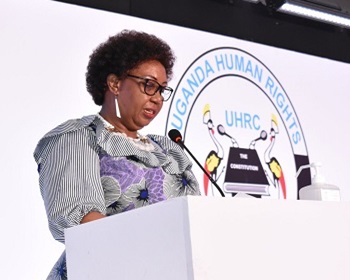
Uganda’s human rights watchdog has been thrown into the spotlight after a blistering Auditor General’s report exposed a trail of administrative lapses, weak systems, delayed justice and questionable reporting practices inside the Uganda Human Rights Commission — raising uncomfortable questions about leadership effectiveness just as its top boss eyes contract renewal.
At the centre of the storm is Chairperson Mariam Fauzat Wangadya, whose six-year term runs out in September next year amid intense lobbying behind the scenes. A seasoned lawyer and former Deputy Inspector General of Government, Wangadya has recently found herself in the public eye after testifying against Members of Parliament in a corruption case that ultimately failed to stick — and now, the Auditor General’s findings are piling even more pressure onto her leadership.
The report lays bare a commission struggling with basic accountability, starting with a glaring anomaly in asset management that auditors say distorted the institution’s financial position. Assets worth UGX 334.80 million had already been disposed of but shockingly remained in the asset register and continued to be depreciated.
In simple terms, the books were not telling the truth.
“This misstated the total assets in the Statement of Financial Position and expenditure in the Statement of Financial Performance,” the report states, pointing to a fundamental breakdown in financial reporting controls.
Procurement processes were equally messy. The Commission failed to reserve procurements for registered associations as required by guidelines, while several procurement plans were so vague they barely made sense.
Instead of clearly listing what was to be bought, the plans were filled with broad and ambiguous descriptions.
“Activities such as welfare and entertainment, travel inland, meetings with identified stakeholders and consultative meetings were listed instead of the actual goods or services,” auditors noted, exposing a system that leaves room for confusion and potential abuse.
In one particularly baffling case, UHRC received UGX 70.41 million to partition its former head office — but the work was never done. Yet management went ahead and reported the activity as completed in both official performance reports.
This is the kind of paper success that looks good in reports but does not exist on the ground.
Questions are now being asked: who signed off on work that was never done?
The procurement woes deepen further. Two procurements worth UGX 233.94 million attracted only one bidder out of five shortlisted companies, raising concerns about transparency and competitiveness.
Meanwhile, contract management appears to have been virtually non-existent. Files for 11 contracts valued at UGX 1.72 billion were missing critical documentation, including management plans, progress reports, correspondence and even basic tracking registers.
“This means there was no clear way to monitor the progress of these contracts,” an insider remarked, describing the situation as “a free fall in oversight.”
The Commission also operated without a formal asset management policy, leaving the use and tracking of government property largely unchecked. Auditors found that assets lacked details such as physical location, users and condition, while some items worth UGX 2.74 million had no identification tags at all.
Even more alarming, 20 motor vehicles worth UGX 2.484 billion had exceeded their recommended five-year lifespan but were still being held onto, raising questions about efficiency and maintenance costs.
Land management was no better. While some properties in Gulu and Kampala are developed and another in Moyo is under development, three pieces of land in Soroti, Masaka and Lira remain idle. Worse still, three properties in Soroti, Moyo and Lira were not even recorded in the asset register.
Back in Kampala, structures along Buganda Road — already condemned by Kampala Capital City Authority as unfit for human occupation — are still partially being used as a library.
If the administrative cracks are worrying, the operational failures are even more disturbing.
Despite being mandated to investigate and address human rights violations, UHRC is struggling to keep up with cases. Out of 272 complaints received, only 80 were entered into the Human Rights Integrated Information System, while 192 were left in manual files.
Even within the system, updates were missing, signaling that digital tools meant to improve efficiency are not being fully utilised.
As of June 30, 2025, only 36 percent of complaints had been fully investigated. A significant number remain stuck in limbo, with 264 cases lingering at the investigation stage for more than two years.
At the tribunal level, the situation borders on crisis.
Out of 1,154 cases carried forward, only 61 — a mere 5.3 percent — were resolved. Even more shocking, 563 cases, representing 52 percent, have been pending for over 10 years.
The reason? The absence of a Chairperson for more than two years at some point, which crippled tribunal operations.
For a body tasked with defending human rights, the delays paint a painful picture of justice deferred.
“Justice delayed is justice denied,” one legal observer remarked, warning that prolonged case backlogs erode public trust in the institution.
The Commission has also failed to consistently monitor places of detention for four consecutive years, citing funding constraints and competing priorities — a gap that potentially leaves vulnerable detainees without oversight.
Yet amid the storm, there are glimmers of positive performance that cannot be ignored.
UHRC exceeded its non-tax revenue target, collecting UGX 87.56 million against a planned UGX 57.47 million — a performance of 153 percent. Its budget absorption rate also stood at a strong 97 percent, with UGX 28.869 billion spent out of UGX 29.717 billion received.
Additionally, out of 22 strategic targets, 13 were fully achieved — showing that despite the challenges, parts of the institution are functioning.
However, the broader picture remains one of an underfunded and overstretched commission. The strategic plan was short of UGX 7.50 billion, limiting its ability to fully execute its mandate, while recurrent non-wage funding fell short by UGX 1.209 billion.
Even recommendations from Parliament’s Public Accounts Committee are still hanging, with only three fully implemented and six only partially addressed.
As UHRC prepares to relocate from Nakasero’s Rumee Building to the new JLOS Towers in Naguru — a move expected to improve coordination with other justice sector institutions — the timing could not be more critical.
The relocation offers a chance for a fresh start, but the Auditor General’s report makes one thing painfully clear: bricks and mortar alone will not fix systemic weaknesses.
With her contract ticking toward its end and scrutiny intensifying, Mariam Fauzat Wangadya now faces the ultimate test — convincing both the public and appointing authorities that she can turn around a commission weighed down by inefficiencies, delays and accountability gaps.
Because in the court of public opinion, the verdict is already forming.
GOT A HOT STORY? EMAIL: redpeppertips@gmail.
SOURCE PROTECTION/CONFIDENTIALITY IS OUR NO.1 PRIORITY.
About Post Author