KCCA IN SHOCKER! Sh328Bn Arrears, DARK CITY, BROKEN SYSTEM…As Investigation Pokes Holes in Buzeki’s Authority
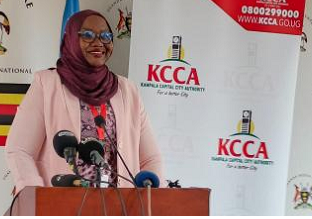
A damning report by the Auditor General of Uganda has blown the lid off a festering crisis inside Kampala Capital City Authority (KCCA), exposing a capital city drowning in debt, crippled by inefficiency, and struggling under what insiders are calling “a system on life support.”
At the center of the storm is the Office of the Executive Director, led by Sharifah Buzeki, whose administration is now under intense scrutiny following explosive findings covering the financial year 2025.
What emerges from the audit is a troubling picture of a city authority tasked with transforming Kampala through ambitious pillars like agro-industrialisation, digital transformation, integrated transport, and tourism development—but instead bogged down by ballooning arrears, stalled projects, poor planning, and glaring service delivery failures.
BILLIONS IN ARREARS—A CITY IN DEBT DISTRESS
The report reveals a sharp and alarming increase in revenue arrears, which surged from UGX 281.13 billion in June 2024 to a staggering UGX 328.16 billion by June 2025.
That is a jump of UGX 47.03 billion in just one year.
The Auditor General did not mince words, noting the growing burden choking the authority’s financial stability.
Alongside this, domestic arrears also climbed from UGX 231.71 billion to UGX 239.23 billion—an increase of UGX 7.52 billion—raising serious questions about KCCA’s ability to meet its financial obligations.
Insiders say the figures point to “a system bleeding money while struggling to collect what is owed.”
PROCUREMENT CHAOS AND SECRETIVE DEALS
The audit further exposes cracks in KCCA’s procurement processes, with shockingly low bidder participation recorded in 32 procurements valued at UGX 8.47 billion.
Such limited competition raises red flags about transparency and value for money, the auditors point out.
Even more concerning were delays in evaluating bids for critical services—including the procurement of service vans and cleaning maintenance services for public toilets at the new Busega Market Complex.
“These delays undermine service delivery and raise questions about efficiency,” the Auditor General observed.
Behind the scenes, sources whisper of bureaucratic bottlenecks and possible manipulation of procurement processes—allegations that now demand urgent answers.
STRATEGIC PLAN IN TATTERS
Perhaps the most devastating revelation is that KCCA’s Strategic Plan—meant to drive transformation across key sectors like infrastructure, public sector transformation, and human capital development—was underfunded by a shocking 72%.
In simple terms, the city’s grand vision has largely remained on paper.
The Auditor General noted that this massive funding gap directly resulted in failure to implement critical activities needed to achieve the authority’s objectives.
“It is clear that without adequate funding, the Strategic Plan cannot be effectively implemented,” the report indicates.
BUDGET RELEASED—BUT NOT USED
In a twist that has left many stunned, Parliament allocated UGX 704.776 billion to KCCA, and all of it was released.
But here is the catch—only UGX 541.74 billion was actually spent.
That translates to an absorption capacity of just 77%.
In a city crying out for better roads, lighting, healthcare, and sanitation, billions of shillings sat unused.
Observers are now asking: Is this incompetence, poor planning, or something more troubling?
KAMPALA IN DARKNESS AND TRAFFIC CHAOS
The audit paints a grim picture of Kampala’s infrastructure, exposing a city literally in the dark.
Out of 200 junctions, only 66—just 33%—have traffic lights.
This leaves the majority of intersections vulnerable to chaos, congestion, and accidents.
The situation is even worse when it comes to street lighting.
Out of 2,311 kilometres of roads that require lighting, only 260 kilometres—just 11%—have streetlights installed.
A staggering 2,051 kilometres remain in darkness.
“This leaves large parts of the city exposed to insecurity and poor visibility,” the report highlights.
And even where streetlights exist, the story is far from rosy.
Of the 7,405 installed streetlights, only 5,858 are functional.
That means 1,547 streetlights—21%—are dead, leaving entire stretches of the city plunged into darkness.
For many residents, this is not just an inconvenience—it is a daily risk.
HEALTH SYSTEM STRAINED TO BREAKING POINT
The Auditor General also turned the spotlight on public health, revealing a system buckling under pressure.
KCCA health facilities have seen a steady increase in the population they serve over the past three financial years from 2022/2023 to 2024/2025.
But staffing has not kept pace.
Out of 758 approved positions, only 405 are filled.
That leaves 353 positions vacant—a staffing level of just 53%.
Eight KCCA health facilities are critically understaffed.
Health workers are overstretched, patients are overcrowded, and service delivery is under serious strain.
“This staffing gap is significant and affects service delivery,” the report notes.
THE BIGGER PICTURE—A CITY AT A CROSSROADS
The findings also tie into a broader audit of the Treasury Memorandum on Parliament’s review of the Auditor General’s earlier report for the 2021/22 financial year—indicating that many of the issues raised are not new but persist year after year.
This raises a haunting question: Is anyone fixing the problem?
As Kampala pushes forward with ambitious agendas in agro-industrialisation, digital transformation, transport infrastructure, and climate resilience, the reality on the ground tells a different story.
A story of missed targets, underfunded plans, weak systems, and a city struggling to keep up with its own growth.
GOT A HOT STORY? EMAIL: redpeppertips@gmail.
SOURCE PROTECTION/CONFIDENTIALITY IS OUR NO.1 PRIORITY.
About Post Author