PSC ON THE CLOCK! Inquiry Exposes Recruitment Delays & System Failures as Kabogoza Team Faces Contract Renewal Pressure
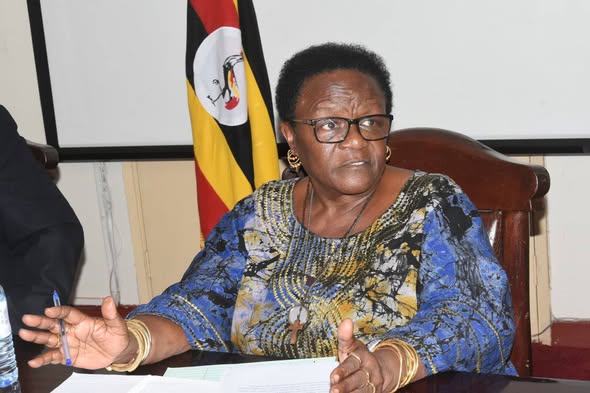
Winnie Agnes Kabogoza ( Chairperson Public Service Commission
The Public Service Commission is under intense scrutiny after a revealing Auditor General’s 2025 report exposed deep operational cracks, delayed processes and systemic weaknesses at the very institution entrusted with managing Uganda’s public workforce.
At the centre of the unfolding audit storm is Chairperson Winnie Agnes Kabogoza Musoke, deputised by Francis Oryang Lagony, whose leadership now faces mounting questions just months before the Commission’s four-year term expires amid reports of intense lobbying for renewal.
Despite securing an unqualified audit opinion, the details within the report tell a far more troubling story of inefficiencies and missed targets in an institution that sits at the heart of public sector transformation.
The Auditor General points to delays in core recruitment processes, revealing that the Commission “took an average of 43 days to receive, conduct competence assessments and communicate results to the requesters.” In a system where timely recruitment is critical to service delivery, such delays risk creating bottlenecks across government institutions.
Even more concerning is the Commission’s failure to build capacity within the system it oversees. The report notes that PSC “did not develop the institutional and national training program and manual for training of trainers, Boards, Panels and Commissions contrary to Section 4.1 (2) of the Competence-Based Recruitment and Selection Manual.” This gap leaves a critical component of public service recruitment without a structured framework.
The shortcomings extend to the development of competence profiles, a key requirement for effective human resource management. Out of all the expected profiles for the Uganda Public Service, the Commission managed to develop only 60, covering just three entities. This limited progress raises questions about how effectively the Commission can standardise recruitment and performance across the entire public sector.
Procurement systems at the Commission have also come under fire. The Auditor General found that the Procurement and Disposal Unit is not enrolled on the e-GP system, with all 71 procurements worth UGX.2.53Bn carried out manually. In an era where digital systems are meant to enhance transparency and efficiency, this reliance on manual processes opens the door to inefficiencies and potential irregularities.
Asset management appears equally neglected. The report highlights that PSC “did not have maintenance logs, or a system for tracking maintenance history or forecasting future needs, and a budget for the maintenance of assets,” pointing to a lack of basic planning for safeguarding government resources.
Financial constraints have further compounded the Commission’s challenges. Out of UGX.99.72Bn budgeted to implement its strategic plan between 2020/21 and 2024/25, only UGX.61.47Bn was realised, leaving a massive funding gap of UGX.38.25Bn. This underfunding directly affected operations, with five major strategic activities not implemented at all and instead pushed into the next financial year.
The ripple effects are evident in national performance metrics. The Commission was only 49.6% compliant in delivering outputs under the National Development Plan III for the financial year 2024/2025, a figure that underscores the gap between expectations and reality.
Ironically, while struggling with funding shortfalls, the Commission did not even plan to collect non-tax revenue, yet ended up generating UGX.21.30 million from disposal of assets. This points to gaps in revenue planning and forecasting.
On budget absorption, the Commission received its full allocation of UGX.16.535Bn and spent UGX.16.37Bn, leaving a relatively small unspent balance of UGX.162 million. However, even this leftover amount tells a story, as it relates largely to unpaid pensions, gratuity and staff salaries resulting from fewer pensioners after validation and unfilled vacancies by year-end.
Performance on outputs presents a mixed picture. Eleven outputs worth UGX.10.599Bn were fully implemented, two outputs worth UGX.5.723Bn were only partially implemented, while one output worth UGX.0.05Bn was not implemented at all, reflecting uneven progress across the Commission’s mandate.
Perhaps most striking is the absence of a monitoring and evaluation framework or department within the Commission. For an institution responsible for overseeing recruitment, promotions and discipline across the entire public service, the lack of a system to track performance and outcomes raises fundamental concerns about accountability and effectiveness.
As the Commission’s term ticks toward its June deadline, these findings place Chairperson Kabogoza and her team under the spotlight at a critical moment. With whispers of lobbying intensifying behind the scenes, the Auditor General’s report now adds a new dimension to the debate over whether the current leadership deserves another term.
For an institution tasked with shaping the backbone of Uganda’s public service, the message from the audit is unmistakable: delays, underfunding and weak systems cannot be ignored. The question now is whether those at the helm can turn things around—or whether the cracks exposed will define their legacy.
GOT A HOT STORY? EMAIL: redpeppertips@gmail.
SOURCE PROTECTION/CONFIDENTIALITY IS OUR NO.1 PRIORITY.
About Post Author