“BUVEERA MUST GO!” NEMA Boss Barirega Declares War On Polythene Bags as Gov’t Plots 100% Total Ban Next Year
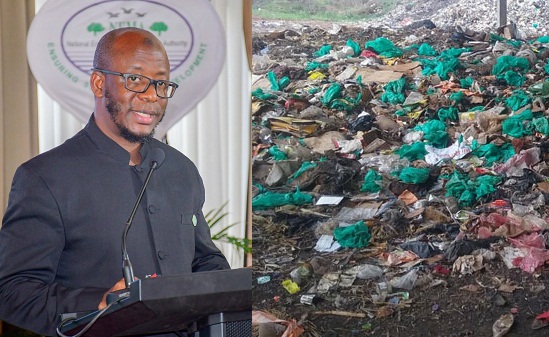
Uganda is bracing for a major environmental shake-up after the Executive Director of the National Environment Management Authority, Akankwasah Barirega, fired a bold warning shot—polythene bags, commonly known as buveera, are living on borrowed time.
With high-level political discussions already underway and amendments to the National Environment Act in motion, government is now gearing up for what could be the most aggressive crackdown on plastic pollution Uganda has ever seen.
And Barirega is not mincing his words.
“They must go!” he declared during a meeting with selected journalists last week, sending a clear message to manufacturers, traders, and millions of Ugandans who have relied on buveera for decades.
He says the planned elimination, set to take effect in the next financial year, is not just another policy announcement—it is shaping up to be a full-scale environmental revolution aimed at rescuing a country choking on plastic waste.
Across Uganda’s towns and cities, the crisis is already visible.
According to the National State of the Environment Report 2026, polythene bags have become a nightmare for waste management systems. In urban centers like Mukono Municipality and Lira City, Clean Development Mechanism waste plants are struggling under the weight of increasing volumes of unsorted garbage, much of it plastic.
Even worse, cities such as Masaka and Mbarara lack composting facilities altogether, resorting to open dumping—turning entire areas into environmental time bombs.
It is this growing crisis that has pushed NEMA into action.
But Barirega says banning buveera alone is not enough. Ugandans must rethink how they live.
He is now championing a radical shift from the traditional “three Rs” of waste management to a broader, more aggressive framework—the nine Rs of sustainable living.
At the heart of this philosophy is a simple but powerful question: does your daily action harm the environment or add value to it?
“Refuse,” Barirega urges, calling on citizens to reject harmful products like single-use plastics, straws, and chemical-heavy inputs.
“Rethink,” he adds, challenging consumption habits—questioning unnecessary purchases, encouraging sharing, and tackling food waste.
“Reduce” follows closely, with a call to use only what is necessary, conserve water and electricity, and cut down excess.
Then comes “Reuse,” pushing for durable, refillable alternatives, and “Repair,” encouraging Ugandans to fix broken items instead of throwing them away.
“Refurbish” and “Remanufacture” go even further, promoting restoration of old items and turning waste into new products—laying the foundation for a circular economy.
“Repurpose” encourages creativity, from turning old tyres into playground equipment to transforming plastic bottles into construction materials.
And finally, “Recycle”—processing waste into new products to reduce pressure on natural resources.
It is a sweeping vision—but one that comes against a backdrop of years of stalled enforcement.
Uganda has technically had a plastic ban in place for years.
Under Section 76 of the National Environment Act 2019, the importation, manufacture, and use of plastic carrier bags below 30 microns is prohibited. Standards set by the Uganda National Bureau of Standards further reinforce these rules, defining strict requirements for plastic bag production.
Yet enforcement has remained inconsistent.
Since 2020, NEMA and UNBS have conducted inspections across the country. Out of 47 factories inspected, 21 were found non-compliant and suspended. Authorities have also seized over 133 tonnes of substandard plastic bags in enforcement operations.
Still, buveera continues to flood markets, clog drainage systems, and pollute the environment.
Officials admit that multiple factors have delayed full enforcement, but now insist that the tide is turning.
A renewed joint operations approach between NEMA and UNBS is expected to intensify inspections, target manufacturers and distributors, and ensure that offenders face prosecution.
“No person, company, industry or trader shall manufacture, import, stockpile, trade or distribute plastic carrier bags in contravention of the standard,” the law states.
This time, authorities say, there will be no turning back.
For ordinary Ugandans, the implications are huge.
From roadside vendors to supermarkets, from market stalls to households, the disappearance of buveera will force a dramatic shift in daily life. привыч привыч привыч? (shouldn’t include non-English – ignore) Let’s fix.
Reusable bags, alternative packaging, and new consumption habits will become the new normal.
For businesses, especially manufacturers, the pressure is even greater.
Compliance is no longer optional.
As the countdown to the next financial year begins, one thing is becoming clear—the era of buveera is coming to an end.
And with Barirega leading the charge, Uganda is preparing for a decisive environmental battle.
The message from NEMA is loud and unmistakable: Adapt—or be swept away with the plastic.
GOT A HOT STORY? EMAIL: redpeppertips@gmail.
SOURCE PROTECTION/CONFIDENTIALITY IS OUR NO.1 PRIORITY.
About Post Author