SOMALIA MISSION! UPDF Commander Issues Tough Orders As Washington Moves To Cut Lifeline For AU Mission
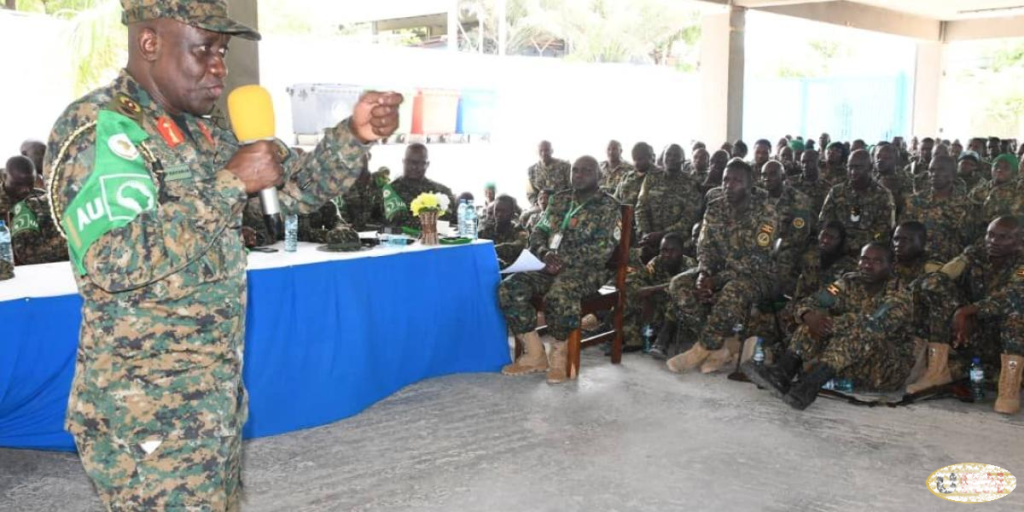
Gen Jackson Kayanja During the Address to the Soldiers in Somalia
Uganda’s military commander in Somalia has ordered troops to tighten discipline and professionalism amid growing uncertainty over the future of the African Union peacekeeping mission after the United States signalled it will stop funding the UN logistical support system that keeps the force running.
Brig. Gen. Jackson Kayanja, who commands Uganda’s contingent serving under the African Union Support and Stabilization Mission in Somalia (AUSSOM), told soldiers that discipline is not simply about obeying orders but is the foundation of survival, operational success and career progression.
Addressing UPDF troops at the Sector One Headquarters in Mogadishu on Saturday, Brig. Gen. Kayanja urged the soldiers to remain focused despite the difficult security environment.
“Discipline is the key to our lives, our success and our career progression. You, the young people, still have a bright future ahead of you. Therefore, desist from habits that undermine your values,” he said.
The commander reminded the troops that every soldier deployed in Somalia represents Uganda and that their conduct directly shapes the country’s international image.
He stressed that maintaining discipline, respecting the chain of command and observing the rules of engagement remain critical to the mission’s success.
According to Kayanja, professionalism strengthens cooperation with the Somali National Army (SNA) and earns the confidence of local communities.
“Maintaining order, respecting the chain of command and adhering to the rules of engagement builds trust with the Somali National Army and local civilians. That trust is essential for intelligence sharing, joint operations and community support,” he added.
Deputy Contingent Commander Col. Jude Rukubya echoed the message, urging Ugandan troops to deepen cooperation with Somali forces while respecting Somali customs and traditions.
He said close coordination between the UPDF, Somali security forces and other AUSSOM contingents remains essential as Somalia gradually assumes responsibility for its own national security.
The commanders’ remarks come as AUSSOM continues supporting Somali security forces in military operations against the al-Qaeda-linked militant group Al-Shabaab, while also helping stabilize the Horn of Africa nation after decades of conflict.
LESSONS FROM BULO MARER
The renewed emphasis on discipline follows painful lessons learned from the devastating May 2023 attack on the UPDF Forward Operating Base at Bulo Marer, where 54 Ugandan soldiers lost their lives.
Following the attack, President Yoweri Museveni blamed the heavy casualties on operational weaknesses and inadequate preparedness.
The tragedy prompted sweeping reforms within the UPDF, including tougher pre-deployment training, enhanced operational planning and increased supervision of troops already serving in Somalia.
Senior UPDF commanders now regularly visit deployed soldiers to reinforce discipline, operational readiness, compliance with rules of engagement and respectful relations with local communities.
Uganda became the first country to deploy troops to Somalia in 2007 under the African Union Mission in Somalia (AMISOM).
Since then, Ugandan forces have played a leading role in helping the Somali National Army reclaim territory from Al-Shabaab, protect key government installations and restore stability.
In 2024, AMISOM officially transitioned into the African Union Support and Stabilization Mission in Somalia (AUSSOM), whose mandate focuses on strengthening Somali security institutions, protecting civilians and preparing Somali forces to eventually take full responsibility for the country’s security.
US THREATENS TO PULL THE PLUG
As Ugandan commanders rally their troops, a far bigger challenge is now looming over the entire mission.
The United States has informed the African Union that it will no longer support the United Nations Support Office in Somalia (UNSOS) beyond the end of this year—a decision that could cripple AUSSOM’s operations.
The nearly 12,000-strong African Union force depends heavily on UNSOS for critical logistical support, including food supplies, drinking water, fuel, medical services, engineering support and transportation of troops and equipment.
Without that backing, military officials fear the mission could struggle to survive.
Under President Donald Trump, Washington has grown increasingly frustrated with Somalia’s government, accusing it of failing to defeat Al-Shabaab despite years of international assistance.
In a diplomatic note dated July 1, reviewed by Reuters, the United States informed the African Union that while it would not oppose renewal of AUSSOM’s mandate by the UN Security Council, it would oppose any extension that included continued UN logistical or operational support through UNSOS.
The UN support office operates on an annual budget of approximately US$500 million, making it one of the mission’s most critical lifelines.
Last year, AUSSOM itself operated on a budget of about US$190 million, but funding shortages have continued to plague the mission.
Washington had already blocked proposals to allow the United Nations to finance three-quarters of AUSSOM’s costs.
‘HUGE IMPLICATIONS’
The African Union Commission has already warned member states that the American decision could have serious consequences.
In a letter circulated to members of the AU Peace and Security Council, the Commission warned that the decision carries:
“Significant implications for the logistical sustainment, operational posture and financing of the Mission.”
A spokesperson for the US State Department confirmed Washington’s position.
“The United States has provided nearly US$2 billion in assessed contributions to UNSOS and its predecessor,” the spokesperson said.
“Despite this investment, Somalia has been unable to independently sustain progress that AUSSOM and its predecessor missions have made to degrade and contain Al-Shabaab or take ownership of most of its own security functions.
“We should not continue to fund a mission that has not met core objectives and diverts resources away from security priorities with more immediate and direct implications for US interests.”
The Somalia Ministry of Defence, the US Department of Defense, the United Nations Transitional Assistance Mission in Somalia and the African Union Commission had not issued official responses by press time.
MISSION FACES UNCERTAIN FUTURE
Security analysts warn the funding decision could fundamentally alter the future of peacekeeping in Somalia.
Ahmed Koshin, a former Director General in Somalia’s Defence Ministry and now a Member of Parliament, described the American decision as a major setback.
“This will have huge ramifications for Somalia. The peacekeeping mission is in danger because ultimately you need to be able to support and sustain these forces,” he told Reuters.
Two diplomats familiar with the mission also warned that AUSSOM would struggle to continue operating unless another organisation steps in to replace the UN support system.
UN spokesperson Stephane Dujarric confirmed the world body is aware of Washington’s decision.
“At this stage, we are discussing this internally and engaging with the African Union, Federal Government of Somalia and other partners,” Dujarric said.
In its diplomatic communication, Washington also delivered a blunt assessment of Somalia’s internal politics.
According to the United States, persistent political rivalries and infighting within Somalia continue to undermine efforts to defeat both Al-Shabaab and ISIS.
“Internal rivalries and political infighting continue to undermine the fight against Al-Shabaab and ISIS, and the benefits of international support will remain limited until Somalia’s leaders unite to address the country’s security and governance challenges,” the US note stated.
With thousands of Ugandan troops still deployed on the frontlines, the future of Africa’s longest-running peacekeeping mission may now depend not only on the battlefield—but also on decisions being made in Washington, New York and Addis Ababa.
GOT A HOT STORY? LET US KNOW!
Got breaking news, explosive secrets, or hard evidence?
Email us: redpeppertips@gmail.com
We accept tips, documents, videos, photos, and recordings—the more evidence you have, the better.
CONFIDENTIALITY IS OUR TOP PRIORITY. SOURCES ARE ALWAYS PROTECTED!
About Post Author