DFCU BLEEDS! Sh15.8bn Loss Sparks Investor Panic As Crane Curse, Court Wars & Internal Turmoil Hit Bank

KAMPALA – For the first time in years, dfcu Bank has been thrown into the red, posting a shocking Shs15.8 billion half-year loss that has rattled shareholders, reignited questions about the never-ending Crane Bank saga and exposed deeper troubles simmering beneath one of Uganda’s biggest financial institutions.
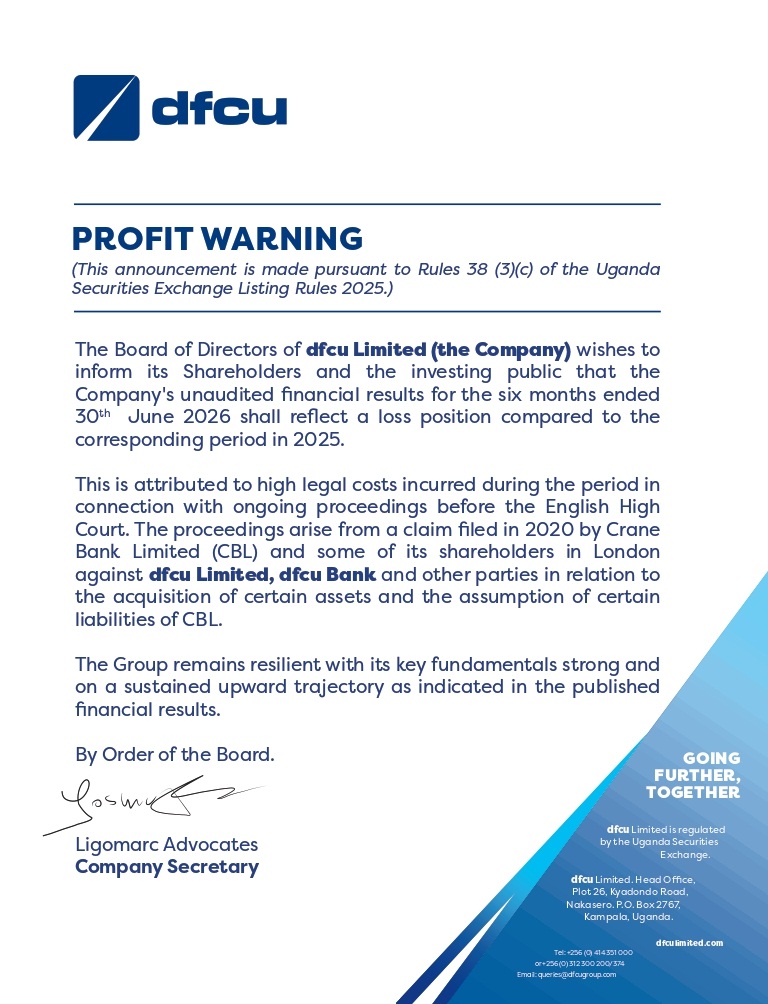
The Uganda Securities Exchange-listed lender, which made Shs34.5 billion profit during the same period last year, stunned the market after issuing a profit warning before unveiling its June 2026 financial results.
The turnaround is dramatic.
In just one year, the bank has swung by more than Shs50 billion, with earnings per share collapsing from Shs46.18 to negative Shs21.08, leaving investors nursing heavy paper losses, according to the bank’s Interim Condensed Consolidated Financial Statements (Unaudited) for the six-month period ended 30 June 2026.
In its official communication to shareholders, the Board squarely blamed the losses on massive legal bills arising from the ongoing case before the English High Court, where Crane Bank Limited (CBL) and some of its former shareholders continue fighting dfcu over the controversial 2017 acquisition of Crane Bank’s assets and liabilities.
The London suit, filed in 2020, has become one of the most expensive legal battles involving a Ugandan financial institution.
Yet, while management points at legal costs, analysts say the financial statements reveal a more complicated picture.
The bank’s core business actually continued growing.
Net interest income climbed from Shs150.4 billion to Shs158.9 billion, while fees and commissions rose to Shs35.3 billion. Trading income also jumped sharply from Shs15.5 billion to nearly Shs28 billion, showing that banking operations themselves remained healthy.
But all those gains were swallowed almost overnight.
Operating expenses ballooned from Shs150.4 billion last year to Shs230 billion this year—an astonishing increase of nearly Shs80 billion in just six months.
The result was devastating.
Instead of recording a Shs39.7 billion pre-tax profit like it did last year, dfcu ended the first half of 2026 with a Shs26.3 billion pre-tax loss, eventually closing with a Shs15.8 billion net loss after tax.
Adding salt to the wound, the bank also increased provisions for expected bad loans.
Credit impairment charges climbed to Shs11.8 billion, reflecting increased caution as the lender prepared for possible defaults among borrowers.
Despite the earnings collapse, dfcu continued attracting deposits.
Customer deposits surged by more than Shs416 billion to Shs2.87 trillion, while its loan book expanded to Shs1.44 trillion from Shs1.2 trillion a year earlier.
Total assets also grew from Shs3.53 trillion to Shs3.94 trillion, indicating customers have largely remained loyal despite the uncertainty.
However, insiders insist the legal case is only one of several fires management is trying to extinguish.
Sources familiar with operations claim the bank has in recent months grappled with internal operational challenges, cybersecurity incidents, employee dissatisfaction and increasing customer complaints.
Although the bank has not publicly linked these issues to its financial performance, sources allege management has been quietly handling several fraud-related incidents internally to avoid further unsettling investors.
dfcu has previously admitted suffering a major electronic fraud in a range of about Sh10bn after detecting unauthorized transactions that were later reported to CID. Investigations resulted in criminal proceedings against suspects accused of electronic fraud and theft.
This year, the State House Anti-Corruption Unit, working with CID and the Office of the Director of Public Prosecutions, announced it had foiled an alleged Shs689 million fraud attempt targeting funds held in a dfcu account using allegedly forged court documents before any money could be withdrawn.
The lender has also found itself battling customers in court over frozen bank accounts.
In one of the latest rulings, the High Court ordered dfcu to unfreeze businessman Bob Ainebyoona’s account after finding that the bank had continued restricting access even after criminal proceedings against him had ended in acquittal.
Justice Joyce Kavuma ruled that banks cannot freeze customer accounts arbitrarily and must act within the law while balancing anti-money laundering obligations with customers’ constitutional property rights.
Another court also ordered the bank to release accounts belonging to businessman Dr Dennis Daniel Ssemugenyi, adding to a growing list of legal disputes involving customers.
Inside the bank, sources further allege that staff morale has deteriorated amid complaints of tough performance targets, disagreements over management decisions and fears of possible restructuring. These claims remain unverified, and dfcu has not publicly commented on them.
Questions are also beginning to emerge over whether CEO Charles Mudiwa, who returned from Zambia can steer the institution through its most turbulent period since the Crane Bank takeover.
For now, the Board insists there is no cause for panic.
It says the Group’s fundamentals remain strong and that the underlying banking business continues on an upward trajectory despite the exceptional legal costs.
“The Group remains resilient with its key fundamentals strong and on a sustained upward trajectory,” the board said in its profit warning.
Whether investors buy that explanation remains to be seen.
With billions already spent on legal fees, customer confidence under pressure, fresh court battles emerging and the London Crane Bank case still far from conclusion, many shareholders fear the worst may not yet be over.
The coming months could determine whether dfcu stages a comeback—or whether Uganda’s most expensive banking acquisition continues to haunt the lender nearly a decade later.
GOT A HOT STORY? LET US KNOW!
Got breaking news, explosive secrets, or hard evidence?
Email us: redpeppertips@gmail.com
We accept tips, documents, videos, photos, and recordings—the more evidence you have, the better.
CONFIDENTIALITY IS OUR TOP PRIORITY. SOURCES ARE ALWAYS PROTECTED!
About Post Author