BUSEGA EXPRESSWAY TRUTH! How Sh6Trn Compensation War, A Blacklisted Contractor, Ex-UNRA Bosses’ Secret Role & Consultants’ (DOHWA, IDCG & TD3) Web Triggered Questions
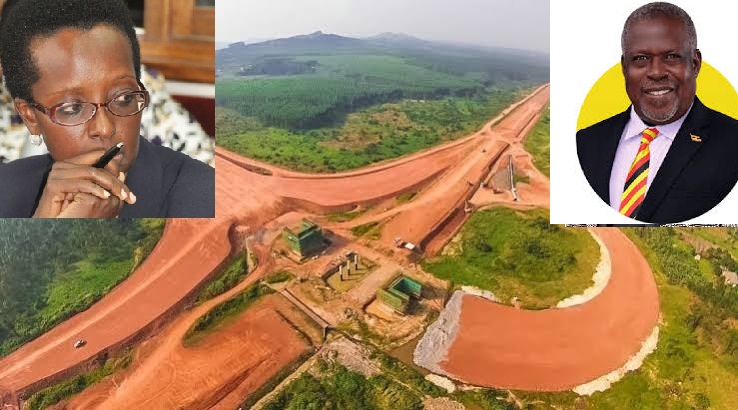
KAMPALA – The suspension of two junior engineers over the troubled Busega–Mpigi Expressway may only be the tip of a much bigger scandal that has haunted one of Uganda’s most expensive road projects.
With the Inspectorate of Government (IGG) now investigating alleged corruption surrounding the project, fresh questions are emerging about how a highway initially estimated to cost hundreds of billions of shillings allegedly ballooned into a compensation nightmare running into trillions.
The controversy now stretches beyond junior engineers to former officials of the defunct Uganda National Roads Authority (UNRA), consultants, contractors and decisions made during the planning and implementation of the project.
If investigators widen the scope of their probe, insiders believe the investigation could expose years of questionable decisions that transformed what was supposed to be a flagship infrastructure project into one of Uganda’s most controversial road developments.
FROM SHS547BN TO A TRILLION-SHILLING HEADACHE
The 27.3-kilometre Busega–Mpigi Expressway was conceived as a strategic route to ease traffic congestion between Kampala and Mpigi.
When the contract was awarded in June 2019 to a joint venture comprising China Civil Engineering Construction Corporation (CCECC) and China Railway 19th Bureau Company Limited, the project was expected to cost about Shs547 billion and be completed within roughly three years.
Years later, however, the project remains far from completion.
Government recently disclosed that construction stands at about 47 percent, with hundreds of billions of additional shillings reportedly required to finish the project.
What has attracted the greatest attention, however, is not merely the delay but allegations that compensation costs for Project Affected Persons (PAPs) spiralled dramatically during the project’s evolution.
Investigators are now expected to establish how these figures were generated and whether public funds were exposed to irregular payments.
THE OLD UNRA CONNECTION
The controversy dates back to the era of the former UNRA administration.
Attention has been drawn to decisions taken during the tenure of former Executive Director Berunado Ssebbuga Kimeze, former Finance Director Joe Semugooma, former Legal Director Marvin Baryaruha, and former Planning Director Eng. David Luyimbazi.
According to project insiders, the original alignment attracted enormous compensation obligations because it passed through densely occupied areas requiring government to acquire large amounts of private land.
Sources familiar with the project allege that earlier designs carried compensation estimates running into nearly Shs6 trillion.
Before implementation progressed significantly, allegations emerged that some individuals reportedly benefited from compensation payments.
Those claims have never been fully tested in court, but investigators are now expected to examine whether the compensation process was manipulated for personal gain.
No sooner had UNRA started compensating people following the old design than another mindboggling scandal erupted on Mukono – Katosi – Nyenga road leading to arrest of some UNRA staff and interdiction.
ENTER ALLEN KAGINA
When Allen Kagina assumed leadership at UNRA alongside legal director Mary Kutesa Kamuli, officials reportedly became concerned by the escalating compensation bill.
Sources claim Kagina team whistle-blew the Sh6trn cost of compensation to the powers-that-be and they were advised to come up with a new and cheaper design.
The project alignment was reportedly redesigned, shifting sections of the expressway through swampy terrain in an effort to reduce compensation costs.
The new UNRA administration reportedly lowered the value to Shs1.3 trillion but insiders reveal that not even a half of this was sunk in the road project, the very reason why the IGG should not leave any stone unturned while investigating the matter.
It was at this point that the road was diverted to pass through the swamp. Instead of ending the controversy, critics argue the redesign created fresh technical and financial challenges.
Questions are now being asked whether adequate environmental assessments were undertaken before the changes and whether all relevant approvals were secured before implementation.
THE SWAMP CONTROVERSY
Perhaps the most controversial aspect of the redesign involves allegations surrounding land ownership within swamp areas.
Insiders allege that after learning about the new alignment, some individuals (names withheld for now) quickly acquired land titles in areas earmarked for the project.
Those claims have fuelled speculation that government may have ended up compensating landowners who acquired titles after learning of the proposed route.
If confirmed, investigators will have to determine who benefited and whether public officials played any role in facilitating the transactions.
WHEN DESIGNS KEPT CHANGING
Engineers familiar with the project say the expressway suffered from repeated design changes long after construction had commenced.
Normally, road designs are expected to be substantially completed before contractors mobilise equipment.
However, insiders allege the contractor repeatedly rejected designs presented by supervising consultants, forcing revisions even after works had begun.
Among the reported concerns were bridge locations, drainage structures, pavement specifications and quantities of construction materials.
Each redesign reportedly altered the bills of quantities, increasing costs and delaying implementation.
Technical experts say continuous design alterations inevitably generate additional claims by contractors for time extensions, idle equipment, staff costs and revised construction quantities.
CONTRACTOR, CONSULTANTS UNDER SCRUTINY
UNRA awarded the contract to the two Chinese firms that formed the joint venture of China Civil Engineering Construction Corporation (CCECC) and China Railway 19th Bureau Company Limited in June 2019.
The contractors were reportedly influenced to reject the designs that were presented by the supervisor, UNRA right away. And the supervisor had to commission for the new designs that came with a lot of challenges. For about a year, the passengers on that road could be witnesses to some activities that included drilling the swamp, bush clearing and grubbing. At Mpigi intersection the main road was closed and a diversion onto the 3.7 km route through Mpigi Town was opted with no Ugandan or authorities coming up to question why the road was closed up-to-date.
Insiders are aware that the delays were brought by the contractor rejecting the first and the updated designs that were availed by UNRA.
When the contractor rejected the first design, UNRA reverted to the consultants for update but the contractor again rejected the second batch of the designs leaving the roads body with no other option warranting legal redress that may result in the termination of the contract.
It was the first time in the history of road construction where a contractor was given a chance to advise the consultants on the changes in the design.
The consultants for Busega – Mpigi expressway are three; DOHWA Engineering Co. Ltd (for Koreans), IDCG Engineering Services (Kenyan company that does consultancy services to DOHWA Engineering Co. Ltd and TD3 Engineering group.
DOHWA Engineering Company Limited is a privately owned engineering, construction company in South Korea. DOHWA is one of the largest engineering design firms in South Korea and in the Busega – Mpigi expressway; it provided the resident engineer and the Highway engineer who at some point abandoned their roles for unclear reasons.
IDCG Engineering Services provided materials engineer and the deputy resident engineer who was in charge of drainage.
TD3’s role was to provide an environmentalist, sociologist and safety agent.
These consultants made the designs way back before the contactor was on the ground. However, on reaching the site, the contractor reportedly found loopholes. While addressing the contractors’ comments, the consultants redesigned to include some details that were left out in the initial design. However, CCECC engineers were not content to feel more changes should be made.
The designs required for road construction include width of the road, cross and box culverts, pavement structures (top of the road – asphalt, base and sub-base), Terrain (climbing lanes), road signs, guard rails and road markings.
The bills of quantities are normally based on the designs and once the designs keep changing even the cost shoots up. A case in point was on the number of bridges; Busega-Mpigi expressway was expected to have 9 – 13 bridges but the contractor discovered that the exact number and locations were not included in the design.
The general design in this case included four major interchanges at Nabbingo, Nsangi, Maya and Lugala. These interchanges were designed to allow connection with the Kampala Northern Bypass Highway and the Entebbe–Kampala Expressway.
The Construction which was expected to last 36 months is far behind the schedule due to excuses that included endless changes in the designs.
The contractor encroached on the taxpayers’ money by putting in claims for extension of time based on lack of all design drawings by the supervisor, delayed instructions, idle road equipment and site staff payments.
CONTRACTOR ISSUES
It should be mentioned that the two Chinese firms that won the tender to construct Busega-Mpigi Expressway were at that time blacklisted by the World Bank.
The Uganda National Roads Authority (UNRA) announced the award of the contract on July 11, 2019 two months after the World Bank announced that it had blacklisted the two firms.
Given that both the World Bank and the African Development Bank (ADB) have cross-debarment agreements, which means when a firm is blacklisted by any one of them, it has to be blacklisted by the other, and the firms would be ineligible for the award of the contract, which was meant to be executed with funding from ADB. This was however ignored by UNRA and the firms took the contract. With the then status quo of rejecting designs, UNRA was legally expected to terminate their contract. Owing to the rapport between some individual top honchos and the contractor, the latter remained in charge despite the mess.
This was not the first time China Civil Engineering Construction Corporation (CCECC) was having issues with contracts in Uganda. In 2014, the firm was named in the deal where the Ministry of Defence was supposed to award USD8.5bn (Sh22tn) tender for the construction of the standard gauge railway.
However, the deal to construct the railway line hit a snag after the then Works State Minister John Byabagambi cancelled an understanding with China Civil Engineering Construction Corporation (CCECC) to construct the eastern route of the line and handed the project to another China Harbour Engineering Corporation (CHEC) that was later kicked out.
THE BIG QUESTIONS
As the IGG investigation gathers momentum, several questions remain unanswered.
Who approved repeated design changes?
Were compensation values properly verified?
Why did costs escalate so dramatically?
Were procurement and contract management procedures followed?
Did any public officials or private actors improperly benefit from compensation or contract variations?
THE ROAD AHEAD
For now, the suspension of two junior engineers appears to be only the beginning.
Should investigators pursue the entire chain of decisions—from project design and land acquisition to compensation, supervision and contract management—the Busega–Mpigi Expressway could become one of Uganda’s biggest infrastructure corruption investigations.
The Ministry of Works and Transport, the former UNRA leadership, consultants and contractors are all likely to come under increasing public scrutiny as investigators piece together what happened on a road that has consumed billions of taxpayers’ money while remaining unfinished.
The allegations referred to above remain subject to investigation, and no findings of criminal liability have been made against the individuals or organisations mentioned.
Watch this space for more details!
GOT A HOT STORY? LET US KNOW!
Got breaking news, explosive secrets, or hard evidence?
Email us: redpeppertips@gmail.com
We accept tips, documents, videos, photos, and recordings—the more evidence you have, the better.
CONFIDENTIALITY IS OUR TOP PRIORITY. SOURCES ARE ALWAYS PROTECTED!
About Post Author