SH34BN PENALTY, DELAYED ROADS & SAFETY DEFECTS! Investigation Expose Mwondha’s World Bank Funded Multi-Billion North Eastern Road Corridor NERAMP Project Failures

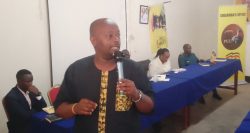
Ivan Emmanuel Mwondha, the Senior Transport Specialist at the World Bank Uganda, served as the project's focal person and team leader
KAMPALA – The Auditor General has exposed major implementation failures, delayed road works, safety defects, unspent millions of dollars and costly financing penalties under the North Eastern Road Corridor Asset Management Project (NERAMP), piling pressure on officials who supervised one of Uganda’s biggest World Bank-funded road projects.
The project, which was initially supervised by the Uganda National Roads Authority (UNRA) before oversight shifted to the Ministry of Works and Transport following the merger of UNRA into the ministry, was implemented with technical support from the World Bank. Ivan Emmanuel Mwondha, the Senior Transport Specialist at the World Bank Uganda, served as the project’s focal person and team leader.
Approved by the World Bank Board in April 2014 at a cost of USD243.8 million (about Shs890 billion), the project was intended to rehabilitate and maintain the 340-kilometre Tororo–Mbale–Soroti–Lira–Kamdini road corridor, reduce transport costs, improve road safety and preserve road assets through performance-based contracts.
However, according to the Auditor General’s report for the year ended 30 June 2025, implementation lagged badly despite billions of shillings being committed to the project.
The audit shows that out of the approved IDA financing of USD243.8 million, only USD207.3 million had been disbursed, leaving an undisbursed balance of USD36.5 million.
To make matters worse, depreciation of the Special Drawing Rights (SDR) against the US dollar reduced the value of the remaining financing, leaving only USD5.3 million available for withdrawal by 29 September 2025.
Government counterpart funding also fell short.
Out of the expected USD11.2 million contribution from the Government of Uganda, only USD5.5 million had been released by 30 June 2025, leaving USD5.7 million outstanding.
The delays proved costly.
The Auditor General found that implementation delays attracted commitment charges amounting to USD9.5 million (SDR5.9 million) on the undisbursed credit.
At prevailing exchange rates, the commitment charges translate to approximately Shs34.7 billion, money paid because project funds remained undisbursed while implementation stalled.
Despite project receipts of USD48.3 million during the 2024/25 financial year against an approved budget of USD46.1 million, representing 105 percent budget performance, spending remained low.
Out of total available funds of USD71.9 million, only USD44.8 million was spent, leaving USD27.1 million unutilised.
The Auditor General also found that the project continued to experience significant implementation delays.
On the 150.8-kilometre Tororo–Mbale–Soroti section, only minimal rehabilitation works had been completed.
Although the 189.4-kilometre Soroti–Lira–Kamdini road recorded better progress, with asphalt, base and sub-base layers reaching 99 percent, 99.7 percent and 99.7 percent respectively on Lot 2B, several planned improvement works remained incomplete.
For Lot 1A and Lot 1B, revised work programmes showed that several activities would extend beyond the IDA credit expiry date of 31 December 2025.
On Lot 2, only Lot 2B pavement works had been completed by September 2025, while several improvement works still stood at zero percent progress as of 30 June 2025.
The audit further exposed serious deficiencies in completed works.
Auditors found blocked drainage channels, missing road signs, worn-out road markings, unsafe overtaking lane applications on sharp bends, inadequate speed calming measures in high-risk areas, damaged inlet kerbs, damaged inspection chambers and inadequate environmental, social, health and safety conditions at Ngetta Quarry.
The project’s objective was to reduce transport costs, improve road safety and sustainably preserve road infrastructure along the Tororo–Kamdini corridor through cost-effective asset management contracts.
World Bank records indicate the project officially closed on 31 December 2025, with Ivan Emmanuel Mwondha serving as the World Bank’s Senior Transport Specialist and project focal person during its implementation.
The Auditor General’s findings now raise difficult questions over why a flagship infrastructure project backed by nearly USD244 million accumulated Shs34.7 billion in delay penalties, left USD27.1 million unspent, failed to complete critical road works before the financing deadline and continued to exhibit safety and construction defects despite years of implementation under the supervision of UNRA, the Ministry of Works and Transport and the World Bank project team.
GOT A HOT STORY? LET US KNOW!
Got breaking news, explosive secrets, or hard evidence?
Email us: redpeppertips@gmail.com
We accept tips, documents, videos, photos, and recordings—the more evidence you have, the better.
CONFIDENTIALITY IS OUR TOP PRIORITY. SOURCES ARE ALWAYS PROTECTED!
About Post Author