GEN. SALEH BIDS FAREWELL TO GEN. OTEMA! ‘One of Uganda’s Greatest Soldiers’ Honoured After 47 Years in Uniform
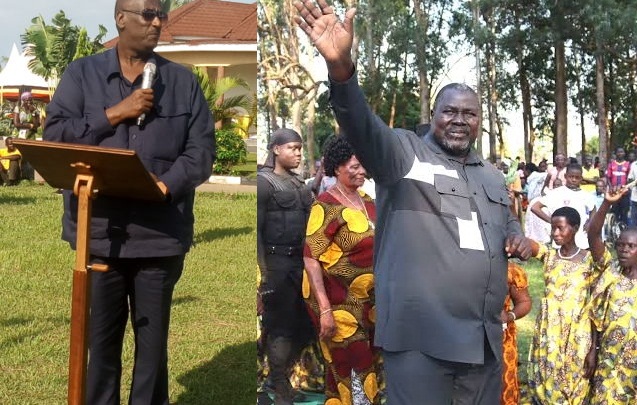
In a moment that underscores the enduring bonds forged in Uganda’s military and the transition of a generation of commanders, Gen. (Rtd) Salim Saleh (Caleb Akandwanaho) has paid tribute to Lt. Gen. (Rtd) Charles Awany Otema as one of the country’s greatest soldiers. Saleh thanked Otema for decades of service protecting the nation and contributing to its progress.
The remarks come as Otema formally retired from the Uganda People’s Defence Forces (UPDF) on 20 August 2026 after 47 years in uniform, part of a larger send-off of 19 general officers.
Otema, often addressed as Afande, rose from a young recruit to senior command through consistent performance across varied roles. Born in what is now Nwoya District in northern Uganda, he joined the military shortly after completing his Primary Leaving Examinations around 1979, when family circumstances limited further formal schooling. He served during the Uganda National Liberation Front period before integrating into the National Resistance Army, which later became the UPDF.
His career included critical staff and operational assignments: Chief of Logistics and Engineering, and later General Officer Commanding the Reserve Force. He contributed to counter-insurgency efforts against the Lord’s Resistance Army in northern Uganda, including operations such as Iron Fist and Lightning Thunder, as well as related efforts in the Democratic Republic of Congo’s Garamba region. Colleagues, including Lt. Gen. James Mugira, have highlighted his role in strengthening institutions and leaving the Reserve Force better positioned than he found it.
Saleh’s recognition carries particular weight. As President Yoweri Museveni’s younger brother and a veteran of the liberation struggle, Saleh joined the Front for National Salvation in 1976 at age 16. He trained in Mozambique, fought in key battles, and commanded the NRA’s final assault on Kampala in January 1986.
He later served as Army Commander (1987–1989) and has long acted as Senior Presidential Adviser on Defence and Security while coordinating Operation Wealth Creation, a major civil-military programme focused on household incomes, agriculture, and socio-economic transformation. Saleh has repeatedly emphasised practical approaches to security that link defence with development, peace-building in the north, and adaptation to modern challenges such as information warfare.
The two officers’ paths have intersected in the shared work of stabilising and developing northern Uganda. After retirement, Otema returned to his ancestral home in Tangi village, Purongo Sub-county, Nwoya District, where elders performed traditional cleansing rituals to reintegrate him into community life.
He has spoken of shifting focus to economic transformation—farming, hospitality, animal husbandry, and wealth creation in Acholi. Notably, Otema has publicly noted discussions with Saleh about a possible role as a provincial governor overseeing government programmes in northern Uganda, and he received documentation from Saleh outlining investment opportunities under an Acholi Investment Plan.
These exchanges illustrate a continuity of purpose: military experience channeled into civilian development goals that Saleh has long championed through Operation Wealth Creation.
Otema’s retirement forms part of a broader generational shift. President Museveni, as Commander-in-Chief, presided over the formal send-off and praised the outgoing generals for advancing peace, security, patriotism, and the integration of military capability with national economic goals. Otema handed over command of the Reserve Force to Maj. Gen. Joseph Ssemwanga, with senior officers stressing the importance of mentoring successors to ensure institutional continuity.
Both men exemplify different yet complementary strands of Uganda’s post-1986 security and development story. Saleh, the strategist and long-time adviser who moved from battlefield command to wealth-creation coordination, represents institutional memory and quiet influence. Otema, the logistics specialist, reserve force leader, and northern son who spent nearly half a century in uniform, embodies operational reliability and regional roots.
Their mutual regard—Saleh’s public description of Otema as among Uganda’s greatest soldiers, and Otema’s engagement with Saleh’s development vision—highlights respect across ranks and regions.
As Otema steps into civilian life and Saleh continues his advisory and coordination work, the farewell underscores a simple truth of Uganda’s military tradition: service measured not only in years or ranks, but in the protection of the country and the quiet promotion of its greater heights. The nation marks the end of one chapter while recognising the foundations both officers helped build.
GOT A HOT STORY? LET US KNOW!
Got breaking news, explosive secrets, or hard evidence?
Email us: redpeppertips@gmail.com
We accept tips, documents, videos, photos, and recordings—the more evidence you have, the better.
CONFIDENTIALITY IS OUR TOP PRIORITY. SOURCES ARE ALWAYS PROTECTED!
About Post Author