ENTEBBE AIRPORT MESS (PART 3): SHOCKING REPORT WARNS CRIMINALS CAN SHOOT DOWN PLANES…Says Aircraft Are Extremely Low When Approaching Vandalised Runway 17, Making Them Vulnerable To Enemy Attacks As Cattle Keepers, Fishermen, Farmers & UNVETTED Workers Roam Critical Airport Installations
KAMPALA — Criminals targeting electrical installations at Entebbe International Airport could do more than steal copper cables. They could potentially bring down an aircraft during landing, a chilling warning contained in an internal Uganda Civil Aviation Authority (UCAA) report that exposes serious security vulnerabilities around the airport’s approach lighting infrastructure.
The shocking assessment warns that the location of the Approach 17 lighting installation leaves aircraft particularly vulnerable because planes are flying at very low altitude as they approach the runway.
The report specifically cautions that criminals could exploit the vulnerability to attack aircraft during landing, including through an enemy attack.
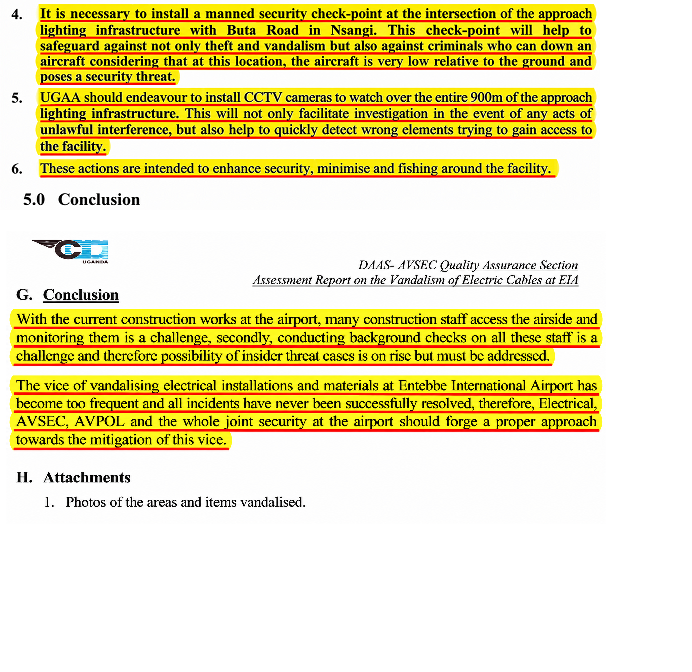
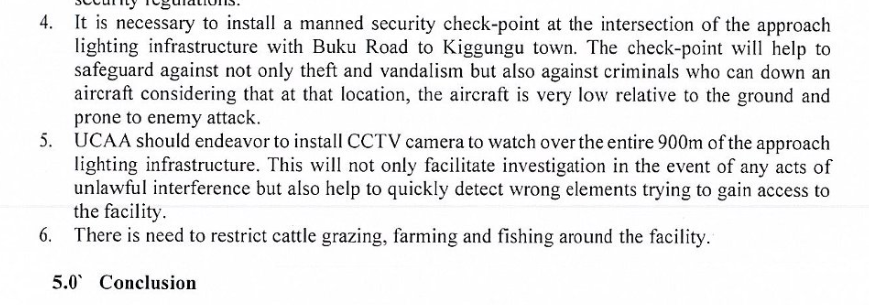
In a recommendation that should send shivers down the aviation security establishment, the Chief Electrical Engineer, Eng. Patrick Ojok, calls for a manned security checkpoint at the intersection of the approach lighting road and Buku Road, Kigungu, to protect against criminals who could bring down an aircraft.
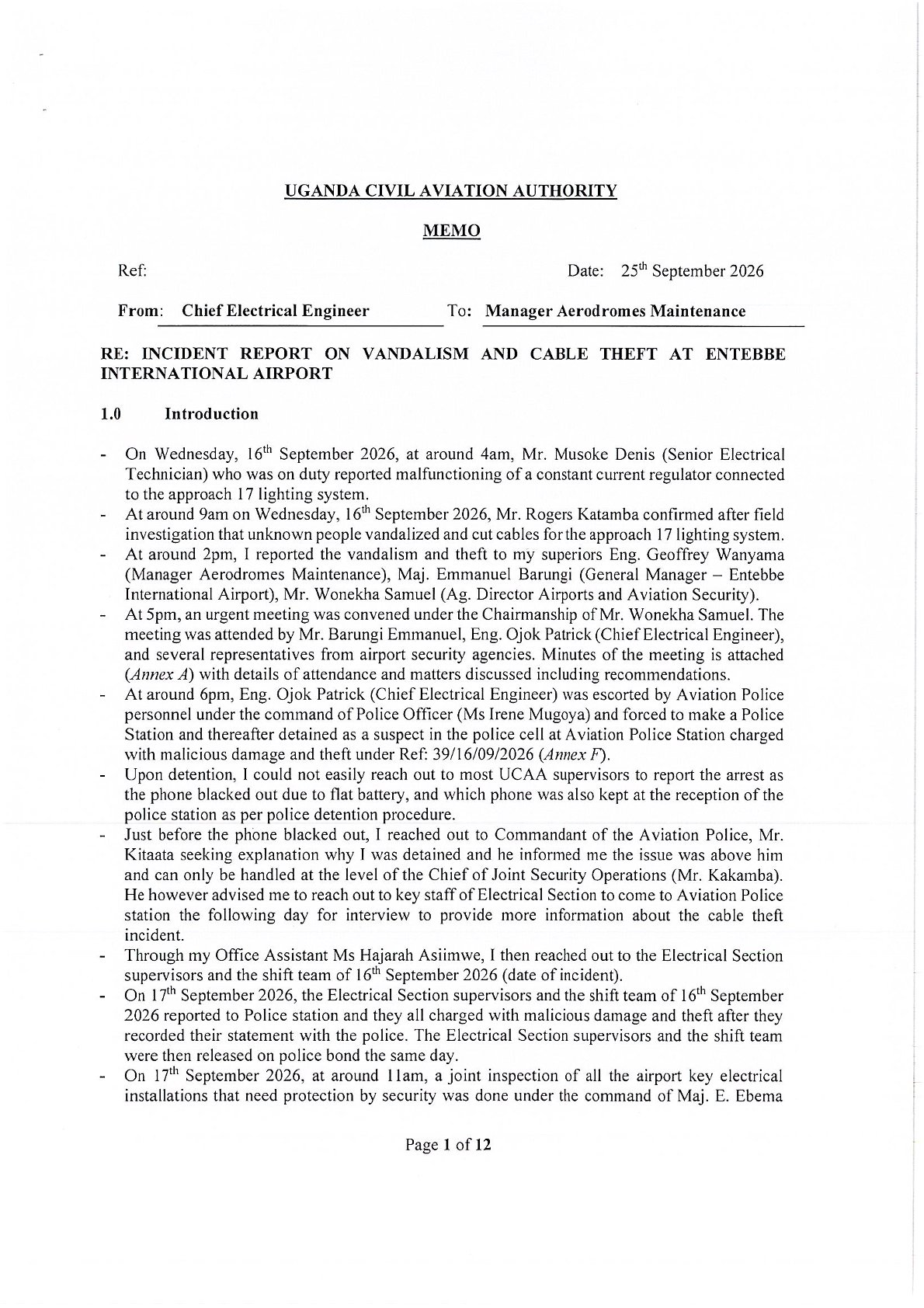
The warning is contained in an incident report on vandalism and cable theft at Entebbe International Airport dated September 25, 2026.
The shocking incident, which exposed vulnerabilities in the management and protection of critical airport infrastructure, occurred in the early morning hours of September 16, 2026, when the crew of a Kenya Airways aircraft noticed that the Approach 17 lighting system was not operational while landing.
The report, titled Outage of Approach 17 Airfield Ground Lighting System, reveals that the electrical installation had been knocked out after unknown individuals vandalised and cut the primary power cable supplying the lights.
The incident raises serious questions about how thieves accessed and tampered with such a critical aviation safety installation, leaving pilots without an important visual aid during landing operations.
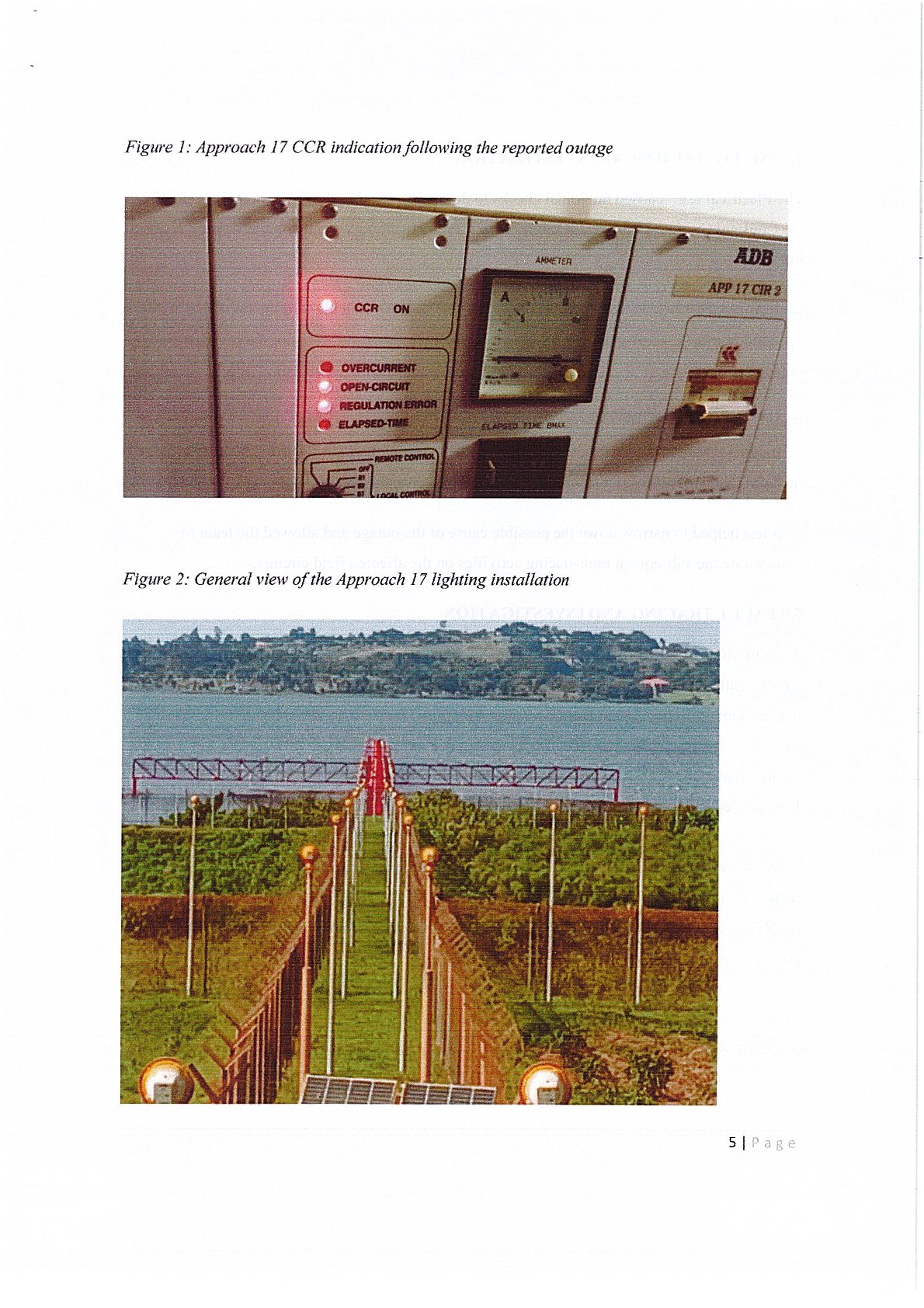
The Approach 17 lighting system is not ordinary airport lighting. It is a critical aviation safety installation designed to guide pilots during the final stages of landing.
According to the UCAA report, the installation consists of 120 lights extending approximately 900 metres before the beginning of Runway 17.
The lights form part of the Airfield Ground Lighting (AGL) system and serve aircraft operating under Category I (CAT I) precision approach landing criteria.
Their purpose is to provide pilots with visual guidance as an aircraft approaches the runway, helping them align the aircraft with the runway centreline and maintain the correct wing-level position.
In simple terms, the lights help pilots establish the correct direction and orientation as they prepare to touch down.
They also provide visual information about the remaining distance to the runway threshold, while confirming to the pilots that the runway is ahead.
Without these lights, pilots lose an important visual reference during the approach and landing phase, making an already critical stage of flight more challenging.
It was this vital installation that went dark at Entebbe, with the Kenya Airways crew being the first to alert airport authorities to the problem.
The internal report indicates that the electrical team initially received information from the Control Tower at approximately 04:20am that the Approach 17 lights were not operational.
The team initially had to establish whether the problem was caused by faulty regulators or damage to the electrical cables supplying the lights.
They tested both regulators using a dummy load and established that they were functioning normally.
This pointed to a problem outside the regulators, prompting the engineers to investigate the underground electrical cables, manholes and connections along the approach lighting route.
At approximately 6:05am, additional Airfield Ground Lighting (AGL) personnel, including Joseph Wasswa and John Wasswa, joined the investigation.
The team inspected the manholes within the Runway 17 Runway End Safety Area (RESA) before extending the search towards Approach Pier 17.
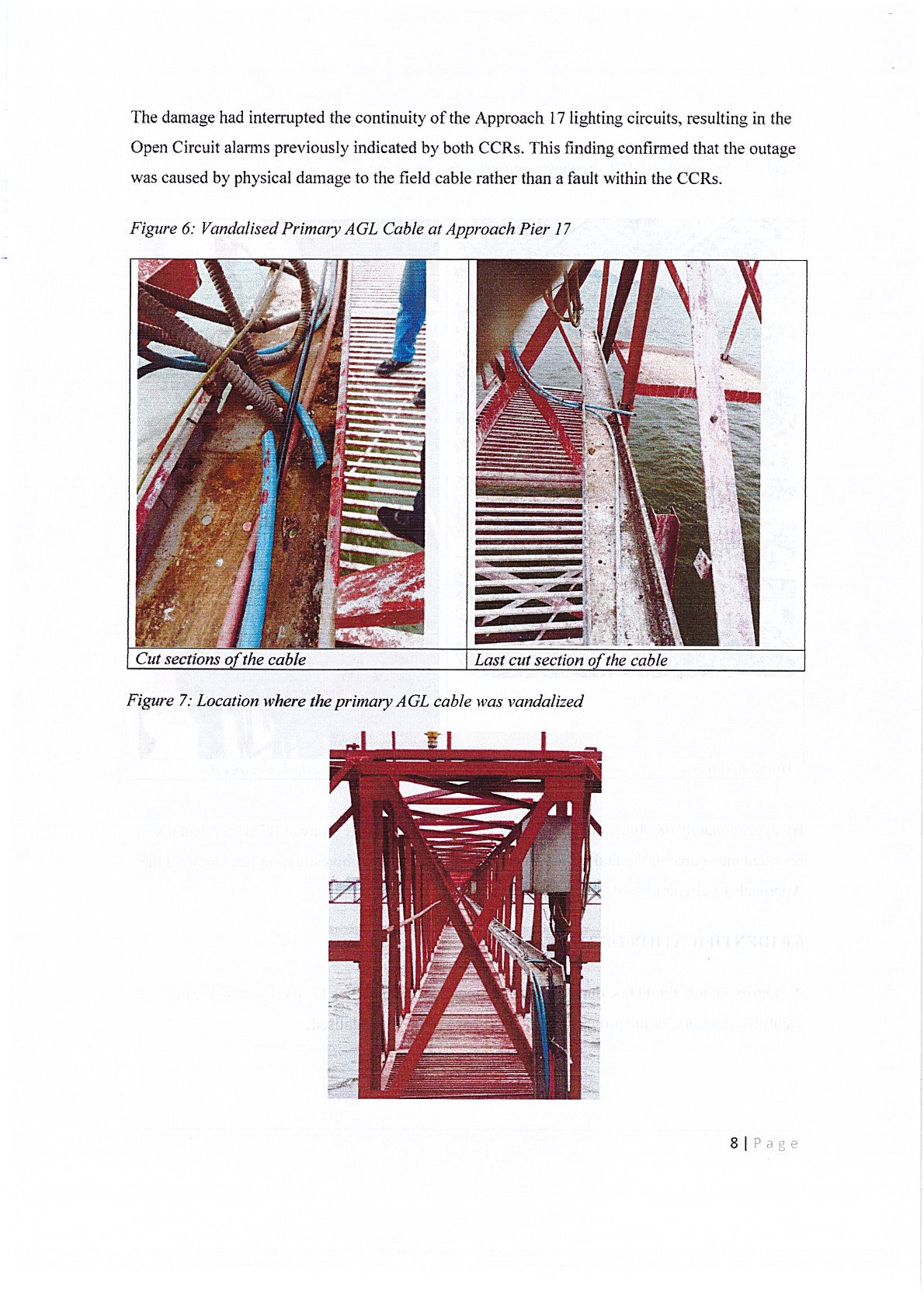
At approximately 9:00am, the engineers discovered a section of the primary AGL cable that had been vandalised at Approach Pier 17.
The damage had interrupted electrical continuity, causing the two regulators to trip and consequently knocking out the entire Approach 17 lighting system.
Minutes of a joint security meeting held at UCAA headquarters on September 16 indicate that the stolen cable was estimated at approximately 470 metres, comprising two sections measuring 250 metres and 220 metres.
The cable theft was confirmed by the electrical team during its investigation.
SECURITY THREAT
Ojok writes that the proposed checkpoint would help safeguard the installation against theft and vandalism, but also protect aircraft from criminals who could target them when they are at low altitude and vulnerable to enemy attack.
The revelation raises a bigger question: How did a facility whose security is directly connected to the safety of aircraft approaching Uganda’s main international airport end up so exposed?
CATTLE KEEPERS, FARMERS, FISHERMEN ROAM!
The report’s findings paint a disturbing picture of an installation that is accessible to virtually anyone from surrounding areas.
Following inspections conducted on September 16 and 17, 2026, investigators established that there was no CCTV coverage at the Approach 17 lighting installation.
Even more alarming, the report states that anyone could access the installation, with cattle grazing and crop-farming activities taking place immediately next to the critical airport facility.
The installation’s vulnerability is further compounded by its geographical location.
According to the report, the Approach 17 facility can be accessed from surrounding areas through both land and water.
There is no fencing around the critical portion of the installation extending into the lake, meaning fishermen, cattle keepers and farmers can access the area.
The report warns that this makes it difficult to control who enters the facility and creates opportunities for unauthorised interference with critical airport infrastructure.
In other words, while the airport has elaborate security arrangements around its main operational areas, an installation guiding aircraft during landing was left exposed to surrounding human activity.
NO GUARDS, NO CCTV, WATCHTOWERS TOO FAR!
The report identifies several other security shortcomings.
First, there are no dedicated guard house at Approach Pier 17 to support continuous security presence and access monitoring.
Second, the nearby Aviation Police watchtower iss too far away to provide a full view of the installation.
Third, the watchtowers are not continuously manned, limiting the ability to detect intruders.
Fourth, the critical installation has no dedicated security personnel to protect it against vandalism and theft.
The September 16 joint security meeting further revealed that although Aviation Police deployed personnel daily, night patrols concentrated mainly on the airport perimeter fence.
When officials were asked whether Approach 17 was under CCTV surveillance, the response was that it had no CCTV coverage.
The meeting also established that the existing watchtowers are too far apart to provide effective assistance.
Worse still, the police patrol vehicle reportedly broke down on the night of September 16, affecting patrol operations when the cable vandalism was discovered.
These findings raise serious questions about whether airport security had been designed around protecting the perimeter fence at the expense of isolated but equally critical aviation installations.
AIRCRAFT VULNERABLE TO ENEMY ATTACK!
The Chief Electrical Engineer’s report does not treat the theft as an ordinary property crime.
In its recommendations, it explicitly links the security of Approach Pier 17 to the physical safety of aircraft.
Ojok writes that the facility must be guarded by uniformed personnel both day and night because of its remote location.
He further recommends a permanent presence of armed guards who can take responsibility for protecting the installation.
The report also calls for appropriate watchtowers that do not have their view obstructed by obstacles.
But the most striking warning appears in the recommendation for a manned security checkpoint at the intersection of the approach lighting road and Buku Road, Kigungu.
The report says the checkpoint would help prevent not only theft and vandalism but also protect against criminals capable of bringing down an aircraft because of its low altitude during approach and vulnerability to enemy attack.
The report’s conclusion stresses that security measures around critical airport installations must prioritise prevention rather than waiting for incidents to occur before taking action.
KISAME, AVIATION POLICE BOSSES ON THE SPOT!
The findings put the Directorate of Airports and Aviation Security, particularly the Aviation Security Department, under intense scrutiny.
Brig Gen Mike Samuel Kisame, UCAA’s Aviation Security Manager, now faces questions about how such a critical facility could remain without adequate surveillance, continuous guarding and controlled access.
The Aviation Security Department is expected to safeguard airport infrastructure, yet the internal assessment documents a facility accessible through land and water, without comprehensive fencing or CCTV coverage.
Aviation Police (AVPOL) bosses are equally under pressure to explain why watchtowers were not continuously manned, why patrols concentrated on the perimeter fence and why isolated critical installations did not have adequate security deployment.
Airport management has also been tasked to explain why the security of Approach 17 was not treated with the urgency its aviation safety function demanded.
The September 16 joint meeting had already expressed concern about the lack of a security regime around critical infrastructure.
The Chief Legal Officer reportedly questioned why attention had largely concentrated on the integrity of the airport perimeter fence, including crash gates and grills, while remote critical installations remained vulnerable.
The question now is whether the security bosses had fully assessed the risks posed by the location of the approach lighting system and whether their deployment arrangements adequately addressed those risks.
CONSTRUCTION WORKERS: ANOTHER SECURITY NIGHTMARE!
As if the vulnerability around Approach 17 was not enough, a separate Aviation Security Department assessment dated September 18, 2026, raises another worrying concern involving construction workers accessing the airport’s airside.
The report, compiled by Airport Security Inspector Collins Aritua Aleni, warns that ongoing construction activities at Entebbe have created additional security challenges because many construction workers access the airside.
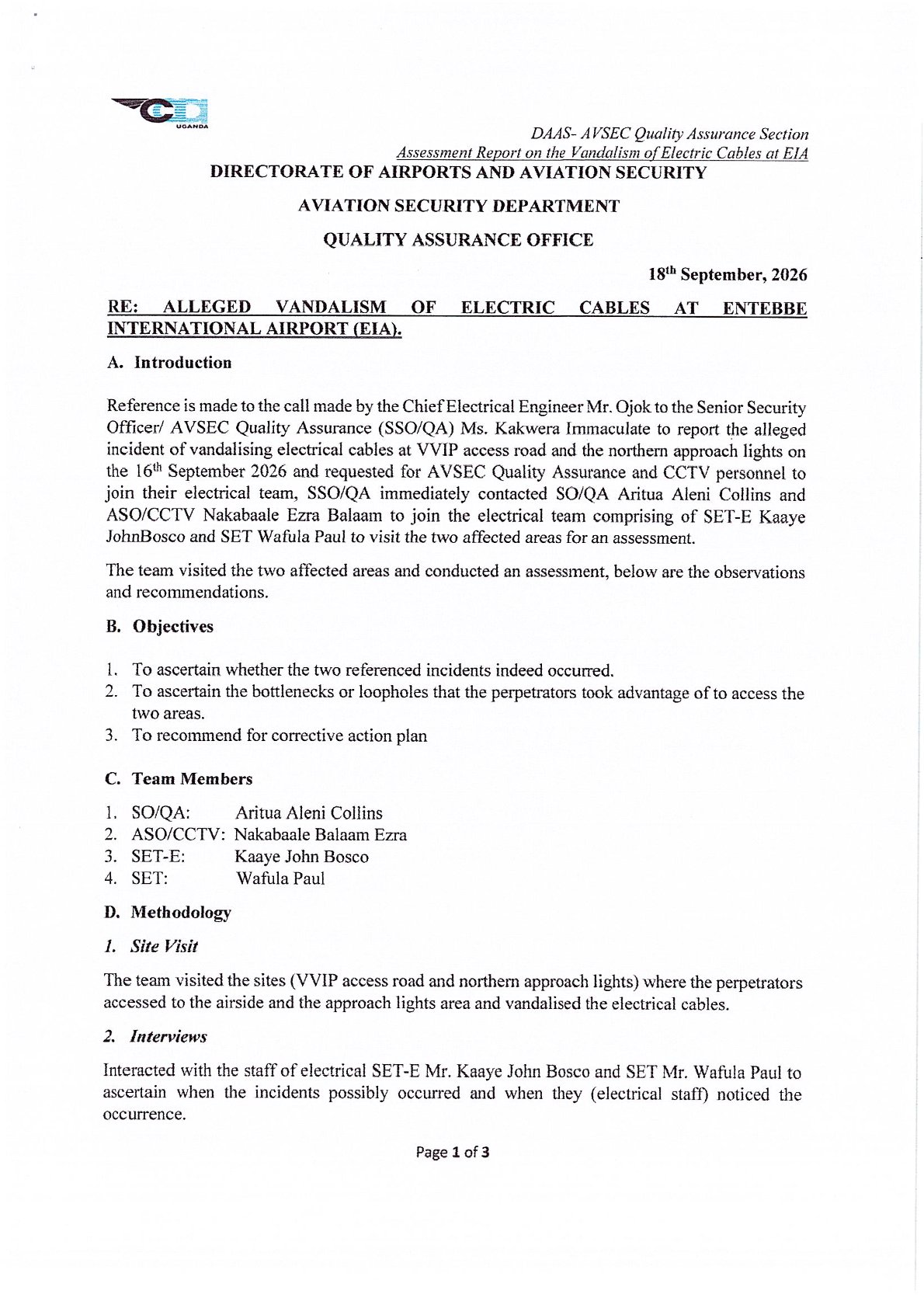
According to the report, monitoring these workers is difficult, while conducting background checks on all of them is also a challenge.
The security team warns that the possibility of insider-threat cases is therefore on the rise and must be addressed.
This is a serious concern because individuals working on airport construction projects may have access to sensitive operational areas and installations that ordinary members of the public cannot easily reach.
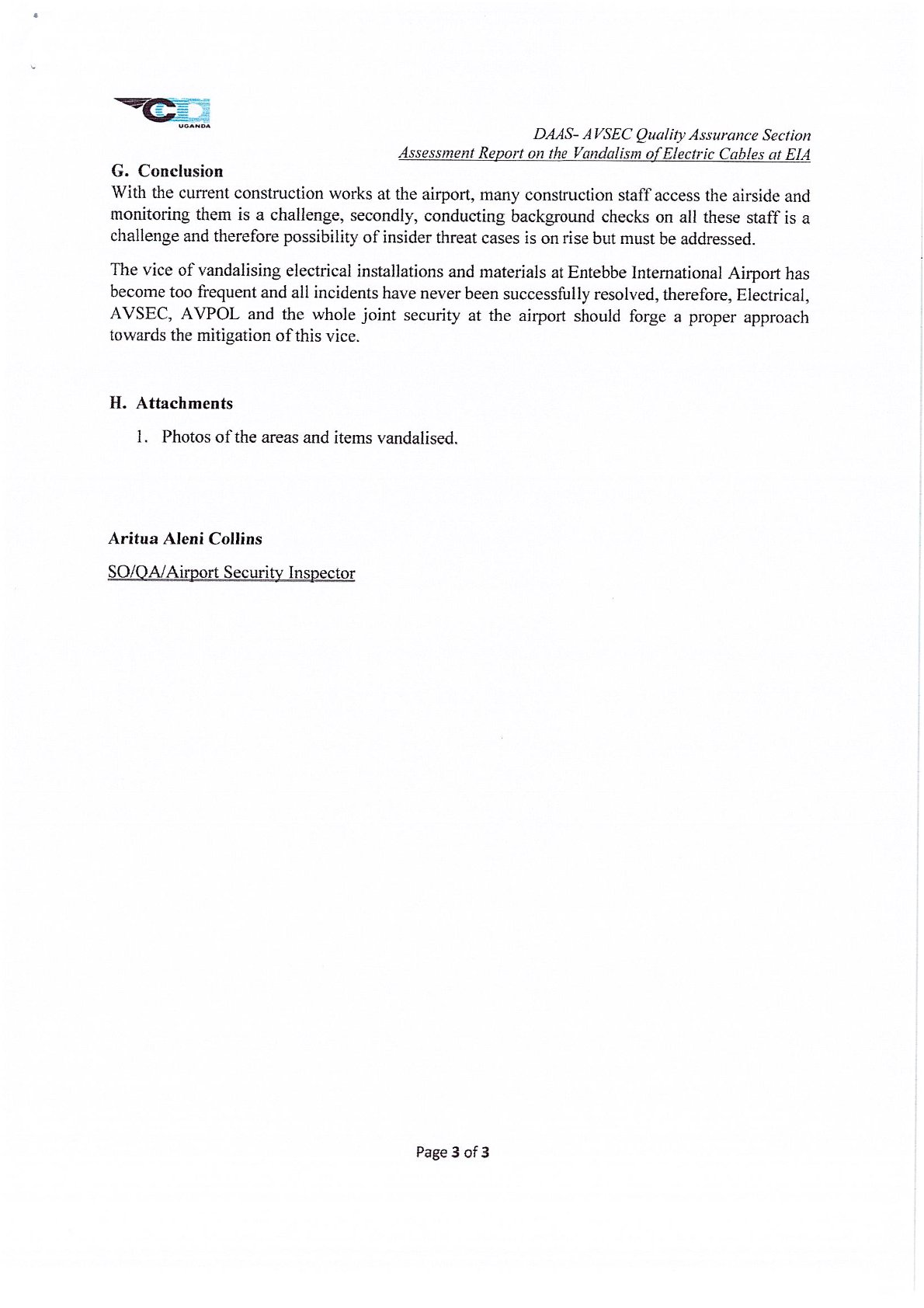
The report does not establish that any construction worker participated in the cable theft. However, it warns that inadequate monitoring and difficulties conducting background checks increase the risk of insider threats.
The assessment therefore calls for a coordinated response involving the Electrical Department, Aviation Security, Aviation Police and the entire airport joint security establishment.
PREVIOUS WARNINGS, REPEATED VANDALISM!
The reports also suggest that the security problems are not isolated.
The September 25 incident report documents several previous cases of cable theft and vandalism at Entebbe, including thefts at the Electrical Centre, passenger terminal, old 3.3KV ring and vandalism of earth copper plates at the electrical substation near the new cargo terminal.
The Chief Electrical Engineer had also requested CCTV installation at the Electrical Centre and other remote power centres in May 2022, warning that inadequate surveillance compromised both electrical installations and airport security.
Yet the September 2026 investigation still found critical gaps.
WHAT NEEDS TO BE DONE?
The internal report recommends urgent security interventions, including:
- Permanent deployment of armed uniformed guards at Approach Pier 17, both day and night.
- Construction of appropriate watchtowers positioned to provide a clear view of the installation.
- A manned security checkpoint at the intersection of the approach lighting road and Buku Road, Kigungu.
- Extending security fencing to cover the entire approach lighting facility, including the section extending into the lake.
- Installing CCTV cameras to monitor the entire 900-metre approach lighting infrastructure.
- Restricting cattle grazing, farming and fishing around the facility.
- Improving patrols and ensuring isolated airport installations receive adequate protection.
The separate Aviation Security assessment also recommends better monitoring of construction workers, strengthening security around construction areas and addressing the challenges associated with conducting background checks.
The reports now place the entire airport security establishment under scrutiny, with questions extending beyond the stolen cables to the possibility of a much bigger aviation security threat.
For an international airport handling aircraft movements every day, the warning that criminals could exploit vulnerabilities around a landing approach to attack aircraft is too serious to ignore.
The question is no longer simply who stole the 470 metres of cable. It is how an installation so critical to aircraft safety was left exposed to criminals, unauthorised access and possible hostile activity in the first place.
GOT A HOT STORY? BLOW THE WHISTLE!
Have breaking news, explosive revelations, juicy leads or evidence of wrongdoing?
WE WANT TO HEAR FROM YOU!
Send your tips, documents, videos, photos and audio recordings to:
redpeppertips@gmail.com
Whether it’s corruption, scandals, abuse of office, injustice or stories others are afraid to tell, help us bring the truth to light.
SOURCES ARE PROTECTED.
CONFIDENTIALITY IS OUR NO.1 PRIORITY!
About Post Author