AFRICA CDC TO U.S.: Lift Uganda Ebola Travel Restrictions!

The Africa Centres for Disease Control and Prevention (Africa CDC) has called on the United States to lift travel restrictions imposed on Uganda following its recent Ebola outbreak, saying the country has demonstrated transparency and made significant progress in containing the disease.
Africa CDC Director General Dr Jean Kaseya said the continental health agency had formally written to U.S. Health Secretary Robert F. Kennedy Jr. requesting the removal of the restrictions.
“For the past three weeks, Uganda didn’t record a new case, and the last case was discharged on the 16th of July. Uganda is doing a great job. There is no reason for the U.S. to continue with this travel restriction,” Kaseya said.
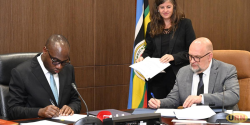
He was speaking at the opening of the ministerial segment of the African Union Extraordinary Session on Ending AIDS by 2030 and Strengthening Africa’s Health Systems in Accra on Tuesday.
Kaseya’s appeal follows public health measures introduced by the U.S. Centers for Disease Control and Prevention (CDC) after Uganda declared an Ebola outbreak earlier this year.
The measures included enhanced health screening for travelers arriving from Uganda, rerouting eligible passengers through designated U.S. airports for public health screening, and temporary entry restrictions for certain categories of travelers with recent travel history to Uganda.
Although the measures did not amount to a blanket travel ban, Ugandan officials have argued that they have affected tourism, business travel, investment, and the country’s international image.
Kaseya urged African governments to support Africa CDC’s appeal, arguing that countries that promptly declare disease outbreaks should not be penalized.
“Being transparent cannot lead to countries to be punished. It’s time today to lift the status and then we’ll continue to support DRC on the challenge they are facing,” he said.
The Africa CDC chief made the remarks as the continent battles what he described as the worst Ebola outbreak ever recorded in Africa, centred in the Democratic Republic of Congo (DRC).
According to Kaseya, the outbreak has already claimed about 1,000 lives and continues to spread at an unprecedented pace.
“Already 52 Ebola outbreaks. This is the worst one. After 65 days, we already have more than 2,400 confirmed cases. If we don’t stop this outbreak today, it will be the worst one that the world will be documenting,” he warned.
Kaseya said more than 70 percent of new infections are now being detected through community transmission, indicating that many infected people are not being identified early enough.
He explained that health authorities should ideally trace about 40 contacts for every confirmed Ebola case, but current surveillance is reaching less than 10 percent of the expected contacts.
He attributed the deteriorating situation partly to insecurity in eastern DRC, where attacks by armed groups have disrupted response operations and forced health workers to withdraw from some affected areas.
He added that the presence of more than one million internally displaced people has further complicated contact tracing and disease surveillance.
To contain the outbreak, Africa CDC estimates that US$1.4 billion is required. African countries have so far pledged about US$110 million, surpassing an initial target of US$100 million but falling far short of the resources needed.
Kaseya said Africa CDC and the World Health Organization (WHO) had jointly developed a continental response plan while accelerating clinical trials for Ebola vaccines and therapeutics.
He reiterated that Africa CDC does not support travel bans or restrictions on international meetings during disease outbreaks, arguing that such measures discourage countries from reporting outbreaks promptly and undermine continental and global health security.
The 25th Extraordinary Session of the African Union Executive Council, which is considering strategies to end AIDS by 2030, reduce preventable maternal deaths, strengthen health systems and improve Africa’s preparedness for disease outbreaks.
Opening the meeting, Ghana’s Minister of Health, Kwabena Mintah Akandoh, urged African governments to increase domestic financing for health and invest in local production of medicines, vaccines and medical technologies to reduce dependence on external suppliers.
He said recent global health emergencies had underscored the need for resilient health systems capable of responding effectively to future pandemics without relying heavily on foreign assistance.
GOT A HOT STORY? LET US KNOW!
Got breaking news, explosive secrets, or hard evidence?
Email us: redpeppertips@gmail.com
We accept tips, documents, videos, photos, and recordings—the more evidence you have, the better.
CONFIDENTIALITY IS OUR TOP PRIORITY. SOURCES ARE ALWAYS PROTECTED!
About Post Author