CHARCOAL BILL SLASHED! How Polland Food Centre Cut Fuel Costs by 60% and Boosted Profits with Ecostoves
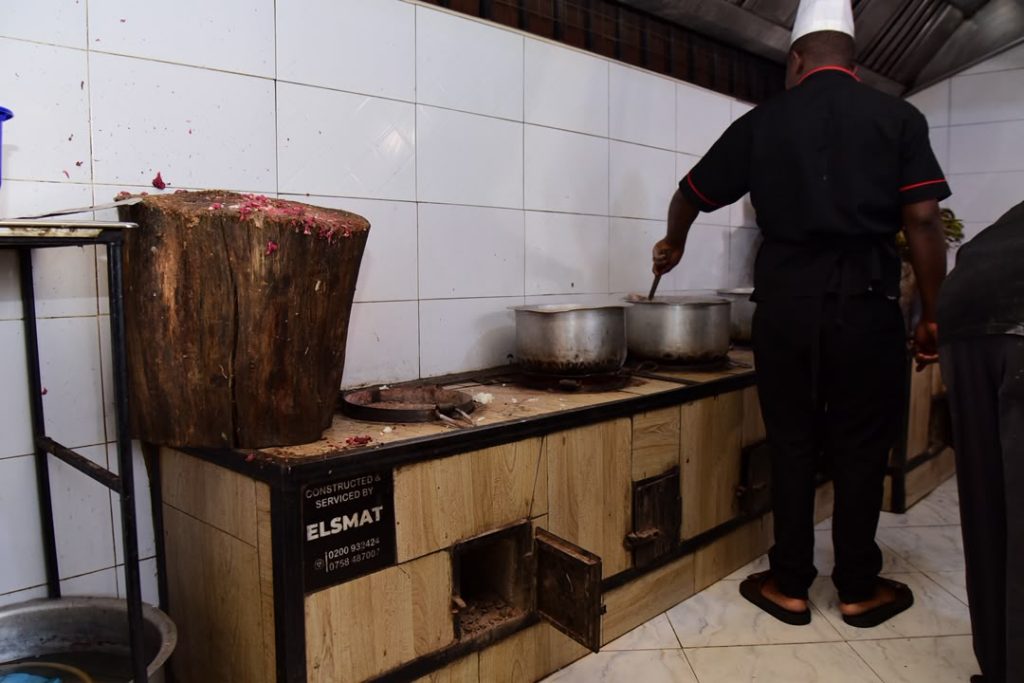
Muhuza John Bosco, Head Chef at Polland Food Centre, preparing food from the restaurants smart kitchen
By our Reporter
When Polland Food Centre opened its doors in 2025, the aroma of sizzling delicacies filled the air. But behind the scenes, another scent lingered stubborn smoke from traditional charcoal stoves that were quietly burning through profits.
Like many fast-growing restaurants, Polland found itself caught in what industry insiders call the charcoal trap. Rising fuel prices, inefficient traditional stoves, and unsafe kitchen conditions were turning daily operations into an expensive grind.
Despite offering a diverse menu ranging from traditional local dishes to continental cuisine, the restaurant’s kitchen was struggling to keep pace with demand while managing soaring energy costs.
“We were spending between Shs 40,000 to 50,000 daily on five to seven basins of charcoal,” explains Muhuza John Bosco, Head Chef at Polland Food Centre.
The numbers told only part of the story. Heat escaped easily from the open stoves, forcing constant refueling. Thick smoke clung to walls, uniforms, and lungs. Staff ended shifts exhausted, eyes stinging, bodies drained by unmanaged heat. The risk of burns and kitchen accidents hovered daily over the busy cooking stations.

It was clear something had to change. In search of a smarter solution, Polland partnered with Elsmart Conservation Technologies to install built in Ecostoves designed specifically for high volume commercial kitchens.
Unlike traditional charcoal burners, the Ecostoves use high density honeycomb briquettes that burn longer and cleaner. The stoves are insulated to conserve heat, dramatically reducing fuel waste and maintaining consistent cooking temperatures.
The impact was immediate. Daily fuel expenditure dropped from Shs 50,000 to just Shs 20,000, a 60 percent reduction in energy costs. For a restaurant operating seven days a week, the savings quickly translated into stronger margins and breathing room for expansion.
“Previously, we spent 40,000 to Shs 50,000 on charcoal every day. Now we spend only Shs 20,000 on briquettes to prepare a variety of foods for the entire day,” says Muhuza John Bosco. “The stoves are cost effective. We cook faster, and the insulation preserves heat, keeping food warm all day without additional fuel. Since we started using them, we have not recorded a single accident.”
The transformation has gone beyond numbers. The reduction in smoke has created a healthier working environment. Cooking times have shortened. The insulated system maintains steady heat, allowing food to stay warm during peak service hours without constant reheating. Operational efficiency has improved, and staff morale has risen in a cleaner, safer kitchen.

With lower overhead and faster production, Polland Food Centre is now serving more customers than ever before. The fuel savings have freed up capital that can be reinvested into menu innovation, staffing, and customer experience.
Encouraged by the results, the restaurant’s management is already planning to acquire additional Ecostoves to expand kitchen capacity. Plans are also underway to open a second branch that will be fully equipped with sustainable cooking technology from day one.
“The impact has been significant. Through our partnership with GIZ, we helped expand access to clean cooking systems and solar technologies across different communities,” says Virginia Semakula, Equity Bank Uganda Manager-Energy, Environment and Climate Change Pillar Head. Businesses have reduced dependence on charcoal, firewood, and kerosene by adopting cleaner cooking solutions. Businesses such as salons, households, retail shops, and farms adopted solar-powered systems, enabling them to operate longer hours and reduce energy costs.
For Polland Food Centre, the shift to energy efficient cooking was not just an environmental choice. It was a business strategy that turned a daily expense into a competitive advantage.
In a sector where margins are often thin and fuel prices unpredictable, Polland’s experience offers a compelling example of how smart energy solutions can transform not just kitchens, but entire business models.
GOT A HOT STORY? EMAIL: redpeppertips@gmail.
SOURCE PROTECTION/CONFIDENTIALITY IS OUR NO.1 PRIORITY.
About Post Author