DENTAL CARE IN QUACKS’ HANDS! 1,330 Practitioners, Only Half Licensed as Oral Disease Crisis Deepens with Medical and Dental Council Rocked By Systemic Failures, Poor Oversight & Procurement Mess
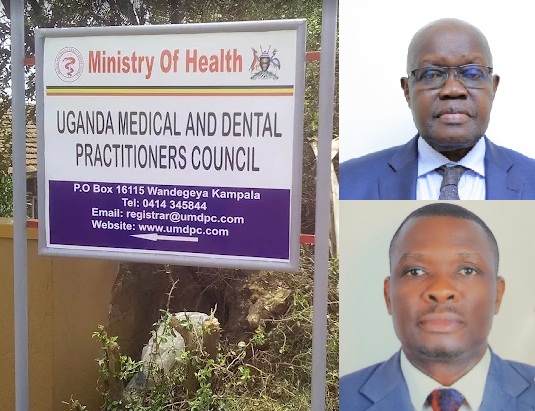
The findings have raised serious questions about leadership under Council Chairperson Prof. Joel Okullo and Registrar Dr. Charles Tusiime.
Uganda’s struggle to provide safe and accessible dental care is being compounded by a shortage of licensed practitioners, with the Ministry of Health revealing that only about half of the 1,330 registered dental practitioners have active licences to practice.
The Ministry warns that the gap is leaving unsuspecting members of the public vulnerable to quacks and underqualified practitioners, some of whom operate from facilities that do not meet the required standards.
Dr Stavia Turyahabwe, the Commissioner for Communicable Disease Prevention and Control at the Ministry of Health, said the situation is particularly worrying given the high burden of oral diseases in the country.
She said 37.2 per cent of Uganda’s population lives with oral health problems, ranging from common conditions such as bad breath and dental caries to serious complications requiring specialised treatment.
The burden is even more pronounced among children aged between six and 12 years. A 2021 survey found that 35 per cent of children in this age group suffer from severe dental caries, many of which remain untreated. Yet, only about four per cent of them have access to proper dental care.
Dr Gilvas Mubangizi, a dental surgeon who heads the Ministry of Health’s oral health services section, said the problem persists into adulthood, with 52 per cent of adults aged between 35 and 44 years experiencing oral health problems.
He said many adults, however, do not seek timely treatment, allowing relatively manageable dental conditions to progress into more complex problems.
Mubangizi also revealed that only 16 per cent of registered oral health practitioners are employed by the government, further limiting access to affordable and regulated dental services. He, like Turyahabwe, raised concern over complex oral procedures being performed by underqualified practitioners, particularly in some private facilities.
Asked what the government is doing to address the problem, Mubangizi acknowledged that supervision remains a major challenge. He said regulatory bodies are now reviewing guidelines governing private practice to clearly define the roles and scope of practice for each category of oral health professional.
Mubangizi said the public is largely unaware of the different roles and responsibilities of oral health practitioners, with providers licensed under both the Allied Health Practitioners Council and the Uganda Medical and Dental Practitioners Council.
He cited orthodontic treatment, commonly associated with braces, as an example of an increasingly popular service that is being offered by different dental clinics in Kampala.
According to Mubangizi, orthodontic treatment should be prescribed and managed by appropriately qualified dental specialists, including dental surgeons with the requisite training and orthodontists.
However, Uganda has a very limited number of specialists in these fields. Data from the Uganda Medical and Dental Practitioners Register shows that the country has only 26 dental surgeons and nine oral and maxillofacial surgeons.
The Ministry says the shortage of qualified personnel, inadequate access to services and weak supervision are among the major gaps it hopes to address through a new oral health strategy currently in its final stages of development.
Ministry officials say they require an estimated Shs131 billion to comprehensively improve oral health services, including addressing gaps in human resources, regulation, access to care and specialised treatment.
AUDITOR GENERAL’S DAMNING FINDINGS
The Uganda Medical and Dental Practitioners Council (UMDPC), the very institution mandated to protect Ugandans from unqualified medical practitioners and enforce professional standards in the country’s health sector, has itself come under heavy scrutiny after the Auditor General exposed glaring weaknesses in its operations, raising serious questions about leadership under Council Chairperson Prof Joel Okullo and Registrar Dr Charles Tusiime.
Successive Auditor General reports covering the financial years ending June 30, 2024 and June 30, 2025 paint the picture of a regulator struggling to regulate itself despite its statutory responsibility to supervise medical and dental practice, enforce ethics, discipline practitioners and safeguard the public from abuse and malpractice.
The 2024 audit found that although UMDPC received an unqualified audit opinion on its financial statements, numerous operational weaknesses remained unresolved.
The Auditor General established that the Council’s financial management systems were riddled with deficiencies. Account codes used to categorize transactions were not attached to the financial manual, while the accounting policies failed to specify expense codes.
The Council continued relying on an off-the-shelf QuickBooks accounting system that is not linked to the bank, forcing staff to manually post payment transactions and carry out reconciliations.
The audit further revealed weak information management, with monthly data backups not being conducted.
Auditors also found that the accounts team failed to capture detailed payment descriptions when posting transactions into the accounting system, contrary to information contained on payment vouchers.
Even more worrying was the state of the Council’s online registration system.
According to the Auditor General, the platform lacked critical features such as the ability to capture Continuing Professional Development (CPD) hours, lacked a feedback mechanism and did not support batch uploads.
Although management had reportedly been informed about these weaknesses, no corrective action had been taken by the time auditors concluded their work.
The Council was also found to be operating using a fee structure prescribed by the Minister of Health in 2011, which had never been reviewed despite changing economic conditions.
As a result, UMDPC’s fees remain the lowest within the East African Community.
Financial management weaknesses extended to debt collection.
Auditors found that the Council had debtors totaling Shs292 million, including advances worth Shs200 million that had remained outstanding for more than 90 days without settlement.
There was no evidence that the accounts department had pursued the debtors or that Council had initiated any recovery procedures.
The Auditor General also questioned the Council’s legal management.
Although one court case was ongoing, the legal officer failed to produce updated records of court proceedings.
Auditors further established that the Council had not submitted reports on ongoing litigation to either the Ministry of Justice and Constitutional Affairs or the Ministry of Finance as required for proper management of contingent liabilities.
Despite having Shs2.671 billion available during the year, UMDPC utilized only Shs2.319 billion, leaving Shs352 million unspent by year-end.
Ironically, the same audit also found that several activities had either never been budgeted for or exceeded approved allocations by Shs185 million.
Implementation of Council programmes also fell far below expectations.
Out of fifteen outputs comprising 153 activities funded with Shs2.319 billion, only one output containing two activities was fully implemented.
Thirteen outputs with 110 activities had only 65 activities fully completed, fourteen partially implemented and thirty-one never implemented at all.
Auditors further noted that although Parliament had approved expenditure of Shs2.302 billion, the Council spent Shs2.319 billion, overshooting the approved budget by Shs17 million without obtaining supplementary approval.
Perhaps most alarming was the finding that monitoring and supervision of medical schools and training institutions remained inadequate, exposing the public to the risk of poor-quality education and ultimately unqualified medical practitioners entering Uganda’s health system.
COMPLAINTS LOST, CASES DRAG ON
The Council’s complaints management system also came under fire after auditors discovered numerous complaints had never been entered into the official complaints register, making it impossible for management to properly track them.
Even where complaints had been received, formal feedback was only provided for cases that had already been concluded, leaving complainants with unresolved matters in the dark.
Instead of showing improvement, the 2025 Auditor General’s report indicates that many governance and operational weaknesses persisted.
Auditors established that UMDPC had operated the entire financial year without an approved Strategic Plan after its previous plan expired in the 2021/22 financial year and was never renewed.
This raised concerns that the Council’s budgets and work plans were no longer aligned with national priorities.
Programme implementation also remained poor.
Of sixteen sampled activities worth Shs547.151 million, only ten were fully implemented while six remained partially implemented because of shortages in transport, manpower and funding.
Revenue collection also missed target.
The Council collected Shs2.709 billion against a projected Shs3.032 billion, leaving an 11 per cent shortfall equivalent to Shs323 million.
The Auditor General also established that UMDPC lacked an annual Monitoring and Evaluation framework, limiting management’s ability to systematically track progress and enforce accountability across departments.
Core regulatory work, which lies at the heart of UMDPC’s mandate, remained seriously compromised.
Only 300 out of 1,872 health facilities were inspected during the year.
Out of thirteen regions earmarked for inspection, only seven were covered.
Auditors further observed that follow-up on weaknesses identified in private health facilities was poorly documented, weakening enforcement.
MEDICAL FACILITIES LEFT UNCHECKED
Inspection of medical schools was equally inadequate.
Out of eight Ugandan medical schools, only two were inspected, while ethics training was conducted in only one institution because of limited institutional capacity.
The Council also struggled to monitor licence renewals.
Many practitioners failed to renew their practising licences after relocating abroad, leaving practice or dying, yet the Council lacked a fully integrated system capable of tracking compliance in real time.
Delays were also recorded in implementing the Universal Exit Examination and reviewing medical curricula after several curricula were submitted too late to be concluded within the financial year.
Complaint handling remained another major weakness.
Out of forty-seven complaints received, only eleven were concluded while thirty-six remained pending, with some cases remaining unresolved for over five years.
Auditors also found outdated case files, incomplete documentation and delayed communication with complainants.
Asset management weaknesses surfaced as well.
UMDPC lacked an asset safeguarding policy and had no structured maintenance plans for its assets.
The Auditor General further exposed procurement irregularities involving failure to use framework contracts, repeated splitting of procurements into low-value Local Purchase Orders, implementation of unplanned procurements, inadequate staffing in the Procurement and Disposal Unit, poor segregation of duties, limited internal audit coverage and failure to consistently prepare procurement performance reports.
PRIVATE HEALTHCARE REGULATION UNDER FIRE
The Council’s own weaknesses become even more significant when viewed alongside the Auditor General’s broader audit on regulation of private healthcare in Uganda, where UMDPC features among the regulatory bodies responsible for protecting millions of Ugandans.
According to the audit, an estimated 54 per cent of Ugandans seek treatment from private health facilities, making effective regulation essential.
However, auditors found incomplete databases for practitioners and facilities, inconsistencies involving more than 10,458 private health facilities missing from the National Health Facility Registry, failure by regulatory councils including UMDPC to gazette licensed facilities and practitioners, inadequate inspection and supervision, weak follow-up of inspection recommendations and poor enforcement against facilities that failed to meet health standards.
Even more disturbing, auditors found that all twenty-seven health facilities recommended for closure remained operational without evidence that they had been reassessed or formally cleared to reopen.
Complaint handling across the regulatory councils also remained sluggish.
A total of 204 disciplinary cases were pending, with UMDPC taking an average of twenty-four months to resolve complaints.
These findings place renewed pressure on the leadership of Prof Joel Okullo, as Chairperson of Council, and Dr Charles Tusiime, as Registrar and accounting officer, to explain why fundamental governance, financial management, inspection, licensing, complaint handling and enforcement weaknesses have persisted despite the Council’s statutory mandate to supervise medical practice, enforce ethics, discipline practitioners and protect Ugandans from unsafe healthcare.
The Auditor General’s reports suggest that unless these longstanding weaknesses are urgently addressed, the institution entrusted with safeguarding Uganda’s medical profession risks undermining public confidence in the country’s healthcare regulatory system itself.
GOT A HOT STORY? LET US KNOW!
Got breaking news, explosive secrets, or hard evidence?
Email us: redpeppertips@gmail.com
We accept tips, documents, videos, photos, and recordings—the more evidence you have, the better.
CONFIDENTIALITY IS OUR TOP PRIORITY. SOURCES ARE ALWAYS PROTECTED!
About Post Author