
DIPLOMATIC SHAKE-UP! Envoys in Panic Mode Over M7 Reshuffle Named
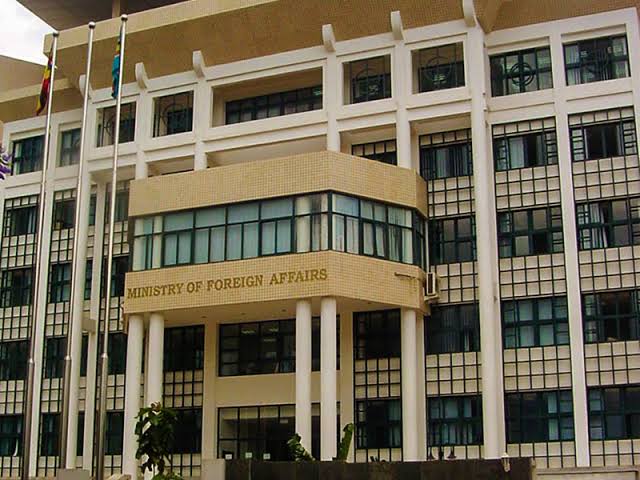
Ministry of Foreign Affairs Headquarters
By Pepper Intelligence Unit
KAMPALA — Uganda’s ambassadors, high commissioners and heads of foreign missions are bracing for a possible diplomatic shake-up as President Yoweri Museveni prepares to make changes to the country’s network of embassies, high commissions and consulates abroad.
Red Pepper understands that a list of envoys to be retained, redeployed, dropped, retired and arersted has been prepared, with an announcement expected soon.
Sources familiar with the developments say diplomatic performance, economic results, conduct, accountability and age are among the factors being considered.
The reported changes could extend beyond ambassadors to senior officials at the Ministry of Foreign Affairs, with some officers expected to face redeployment or retirement as the government reviews the effectiveness of its diplomatic machinery.
The shake-up could also have a generational dimension.
On April 2, 2026, Chief of Defence Forces Gen. Muhoozi Kainerugaba questioned the length of service of some Ugandan ambassadors and called for younger people to be appointed.
“I hear some have been Ambassadors since 1986? How is that possible? Their appointments are older than 80% of Ugandans? We want young people as Ambassadors,” Muhoozi posted on X.
His remarks have fuelled speculation that long-serving diplomats could be among those affected by the anticipated changes.
But age and length of service are only part of the story. The Auditor General’s December 2025 report has documented weaknesses across Uganda’s foreign missions, including incomplete strategic plans, missed performance targets, questionable expenditure, poor asset management, low revenue collection and inadequate implementation of earlier recommendations.
Some missions have struggled to demonstrate how their activities translate into tangible gains for Uganda, even where substantial public funds were released and spent.
The findings do not automatically establish personal wrongdoing by individual ambassadors, nor do they amount to recommendations that particular envoys be removed. They nevertheless provide a detailed record against which the performance of Uganda’s diplomatic network can be examined.
DAR ES SALAAM: TRADE, INVESTMENT AND EACOP TARGETS MISSED
According to sources, changes are expected at Uganda’s High Commission in Dar es Salaam, Tanzania, headed by H.E. Col. (Rtd) Fred Mwesigye, deputised by Ambassador Elizabeth M. Allimadi.
The mission occupies a strategic position in Uganda’s relations with Tanzania, particularly in trade, investment, regional integration and cooperation surrounding the East African Crude Oil Pipeline (EACOP).
The Auditor General’s findings, however, raise questions about whether the mission has been delivering the expected results from its economic-diplomacy activities.
The mission planned 32 investment forums and business matchmaking events but achieved only 12. It also set a target of 43 investment-promotion events aimed at attracting foreign direct investment and advancing public-private partnership opportunities, but managed only 13.
On EACOP cooperation, the mission targeted 26 meetings but achieved 11. Negotiation engagements stood at 12 against a target of 26, while progress reports numbered 14 against the same target of 26.
The figures point to a substantial gap between the mission’s planned engagement with Tanzanian counterparts and the activities actually delivered.
The shortfall is significant because Tanzania is a key partner in Uganda’s regional trade and oil-export infrastructure plans. Effective diplomatic engagement is expected to support cross-border business, investment partnerships and coordination on strategic projects.
The audit also exposed weaknesses in consular service delivery. The mission assisted 35 Ugandans abroad against a target of 1,700, while Uganda’s candidacies for positions in international institutions were advocated for in only three cases against a target of 24.
These findings raise questions about the mission’s ability to balance its political responsibilities with trade promotion, international representation and protection of Ugandans.
The challenge for the leadership is to demonstrate how the mission’s diplomatic presence is translating into measurable economic and consular gains.
MOMBASA: CONSUL REMANDED AS REVENUE AND PLANNING QUESTIONS PERSIST
Changes are also expected at Uganda’s Consulate in Mombasa, Kenya, according to sources.
The mission is headed by Consul General Ambassador Herbert Kiguli, who was recently remanded to Luzira Prison over corruption-related allegations. Questions have also been raised about his deployment to Kenya amid claims that he was under investigation at his former workplace, the Ministry of Agriculture. The audit paints a mixed picture of the consulate’s activities.
The mission undertook tourism and commercial-diplomacy initiatives, including Uganda-Kenya Tourism Conferences, cultural exhibitions, familiarisation trips and tourism-investment workshops.
It also reported helping Ugandan products such as pineapples, milk, hides and skins, and cereals to access markets along the Kenyan Coast.
These activities are important because the coastal region provides opportunities for Ugandan exporters seeking access to consumers, distributors and other commercial networks.
However, the mission’s planning and revenue-management arrangements raised concerns.
The Auditor General found that the consulate did not budget for non-tax revenue despite collecting money in successive financial years. The supplied audit figures show that the mission collected Shs28.3m in 2024/25 despite having no corresponding revenue budget.
The consular and document revenue target was Shs500,000, but collections amounted to only Shs40,500.
The report also recorded results-level compliance with National Planning Authority requirements of 8.8 per cent, against overall ministry, department and agency-level performance of 54.4 per cent.
The report further indicates that the mission continued paying rent on its old chancery after an anticipated move to new premises, raising questions about the management of its accommodation costs.
The issues call for a closer examination of revenue forecasting, the measurement of commercial-diplomacy results and the financial implications of maintaining diplomatic premises.
NAIROBI: SHS26BN UGANDA HOUSE FIRE LEAVES REVENUE GAP
Uganda’s High Commission in Nairobi, Kenya, under Acting High Commissioner H.E. Ambassador Eunice Kigenyi, faces one of the more prominent property-management challenges in the audit findings.
The mission had planned to collect approximately Shs2.02bn in non-tax revenue in the 2024/25 financial year but collected only about Shs81.8m.
The Auditor General attributed the shortfall largely to the loss of Uganda House, which had been the mission’s main source of non-tax revenue.
Uganda House had been refurbished at a cost of approximately Shs26bn and completed in June 2024. However, the building caught fire on June 25, 2024, during unrest in Kenya, before it could be officially commissioned.
The estimated restoration cost was Shs7.2bn, while the High Commission required additional capital funding for restoration and procurement of vehicles.
The audit found that the completed building had not been insured after being handed over to management. Although insurance had been provided during construction, the absence of cover for the completed structure left Uganda exposed when the fire occurred.
A physical inspection in September 2025 uncovered another troubling development: despite being considered unsuitable for human habitation, the damaged building was occupied by several business tenants. The report said they had illegally connected electricity and were not paying rent to the High Commission.
This raised questions about security, control of government property and the failure to generate revenue from an asset that had already consumed substantial public resources.
The audit also flagged outstanding staff advances and amounts recorded as receivables that had not been recovered. Some of the balances related to staff who had since left or retired, making recovery uncertain.
On strategic performance, the mission fully achieved six of 25 interventions, while the remaining 19 were only partially achieved. The report also recorded a funding shortfall of about Shs1.51bn against the five-year strategic plan.
Although the National Planning Authority gave the mission an 82.2 per cent compliance score for its 2024/25 budget against NDP III outputs, the incomplete implementation of its strategic interventions raises a separate question about actual delivery.
The Nairobi case is therefore not simply about a fire. It concerns the protection of a major government asset, the failure to insure it after completion, lost rental revenue, the occupation of damaged premises and the cost of restoring Uganda House.
ADDIS ABABA: INVESTMENT PROMOTION STALLS
Uganda’s mission in Addis Ababa, Ethiopia, is also under scrutiny over the implementation of its strategic plan and the resources available for investment promotion.
The audit identified a funding deficit of about 72 per cent against the mission’s strategic-plan requirements.
Investment promotion was among the key activities for which funding had not been allocated, raising questions about the mission’s capacity to attract investors and build commercial partnerships.
The Auditor General found that only eight of 12 sampled strategic interventions had been fully achieved.
The shortfall presents a challenge for a mission based in a city that hosts the headquarters of the African Union and provides opportunities for engagement with continental institutions, governments and development partners.
Uganda’s representation in Addis Ababa is expected to support both multilateral diplomacy and economic engagement. However, without adequate funding and measurable delivery targets, the mission risks concentrating on routine representation while investment-related opportunities remain underexploited.
The audit findings do not establish that the mission’s leadership caused the funding deficit. They do, however, raise questions about prioritisation, resource allocation and how effectively available funds were deployed.
NEW DELHI: INVESTMENT AND CONSULAR ACTIVITIES UNDER PRESSURE
At Uganda’s mission in New Delhi, India, the Auditor General identified a strategic-plan funding deficit of about 44 per cent.
Key activities, including investment promotion and consular services, lacked funding, limiting the resources available for work that should directly support Uganda’s economic and diplomatic interests.
Only four of six sampled interventions were fully achieved.
The audit also identified delays in the submission of some reports of up to 120 days, raising concerns about timely performance reporting and management oversight.
The shortcomings matter because Uganda’s engagement with India includes commercial relations, investment opportunities, education and consular services for Ugandans in the country.
A mission cannot adequately demonstrate its contribution to those objectives without clear work plans, realistic funding and timely reporting on what has been achieved.
The New Delhi findings therefore raise questions about whether the mission’s planning and reporting arrangements are sufficiently robust to support effective economic diplomacy.
ABUJA: FIGHTS, UNACCOUNTED CASH AND STALLED CHANCERY PROJECT
Uganda’s High Commission in Abuja, Nigeria, has faced a series of administrative and financial questions, with sources indicating that the mission could also be affected by the anticipated reshuffle.
The latest controversy involved physical altercations within the embassy premises that prompted local authorities to intervene.
The Ministry of Foreign Affairs even had to recall Accounting Officer Eriya Tusubira and First Secretary Stilson Muhwezi in August 2026.
Questions have also persisted over allegations of financial mismanagement, corruption and money laundering, as well as delays surrounding the construction of the embassy’s Shs19.7bn chancery complex. The Auditor General, documented specific financial-accountability weaknesses.
About US$11,100, equivalent to roughly Shs40m, had been advanced for diaspora mobilisation, consular services and commercial-diplomacy activities in Lagos and Port Harcourt. The planned activities were not undertaken, and the money had not been refunded by the time of the audit.
The failure raises questions about the authorisation of the advances, the supervision of planned activities and the recovery of public money when the intended work is not delivered.
The mission also had unsupported balances of about Shs13.99bn, mischarged expenditure of Shs507m and unexplained cash-flow variances of approximately Shs2.96bn.
Another US$4,140 withdrawn as per diem for a diplomatic assignment in Senegal remained unaccounted for.
These findings go beyond a missed target or a delayed report. They concern the documentation of public expenditure, the classification of costs and the ability of the mission to demonstrate that money released for official work was properly used.
The stalled chancery project adds another layer of concern because government investment in diplomatic infrastructure is expected to provide lasting value rather than leave Uganda exposed to prolonged construction delays and uncertainty.
The key questions are whether the outstanding amounts have since been reconciled, whether the uncompleted activities were eventually carried out, and what action has been taken to address the financial and project-management weaknesses.
BRUSSELS: TOURISM PROMOTION WITHOUT CLEAR RESULTS
Sources have told Red Pepper that changes are also expected at Uganda’s Embassy in Brussels, Belgium, headed by H.E. Ambassador Mirjam Blaak Sow, with Ambassador Franklin Katungwe serving as Deputy Head of Mission.
Ambassador Blaak Sow oversees Uganda’s diplomatic relations with Belgium, the Netherlands and Luxembourg, while the mission also engages with the European Union, the Organisation of African, Caribbean and Pacific States and other international organisations within its area of accreditation.
The mission’s responsibilities provide opportunities for tourism promotion, trade, development partnerships, education and wider engagement with European institutions.
However, the Auditor General identified shortcomings in tourism promotion, diaspora registration and education-related activities.
Tourism promotional materials had been distributed, but the audit found no demonstrable outcomes to show what the activity had achieved. Distribution of brochures and other publicity materials does not, on its own, establish that more tourists were attracted to Uganda or that the country generated additional tourism business.
The findings raise the question of whether the mission was measuring the results of its promotional activities, including potential tourist enquiries, partnerships with travel operators and other indicators of market response.
Diaspora registration was also incomplete, limiting the information available for planning consular services and engaging Ugandans living in the mission’s area of responsibility.
The audit further noted that education opportunities had not been advanced and that scholarships had been suspended without adequate public engagement.
This raises questions about communication with prospective beneficiaries and the mission’s efforts to maintain educational links and opportunities for Ugandans.
Brussels is an important diplomatic centre because of its concentration of European and international institutions. The performance question is whether the mission is converting that presence into measurable benefits for Uganda through tourism, education, trade and diplomatic partnerships.
PARIS: EURO287,265 ALLOWANCES AND EURO15,000 TRAINING PAYMENT QUESTIONED
Whispers say changes are also expected at Uganda’s Embassy in Paris, France, headed by H.E. Ambassador Amule Doreen, deputised by Ambassador Otiti Catherine.
The mission came under scrutiny in the Auditor General’s December 2025 report, which issued an unqualified audit opinion but identified financial, administrative and strategic-planning weaknesses.
One of the findings concerned Foreign Service Allowances paid to home-based staff in advance on a quarterly basis.
The payments amounted to EUR287,265.59, a practice the Auditor General said was contrary to the applicable Circular Standing Instructions.
The issue was not simply the size of the payments. It concerned whether the timing and manner of disbursement complied with the rules governing the allowances.
The report also questioned a EUR15,000 payment towards a PhD programme for the Head of Mission.
According to the Auditor General, the expenditure was contrary to provisions of the Public Service Standing Orders and the Staff Training Policy, which require evidence demonstrating how the course will improve job performance.
The finding raises questions about the approval process for the sponsorship, the connection between the programme and the officer’s official duties, and whether the applicable training requirements were satisfied.
The audit also identified shortcomings in the embassy’s strategic plan. The plan was inadequately aligned with the mission’s strategic objectives, omitted the governance and security programme and had not received the required approval.
The mission had not obtained National Planning Authority approval for its draft strategic plan covering 2025/26 to 2029/30, despite the commencement of the Fourth National Development Plan on July 1, 2025.
Without an approved plan aligned with national priorities, it becomes more difficult to establish clear performance indicators, assess progress and link expenditure to intended outcomes.
The Auditor General also reviewed Treasury Memoranda covering several earlier financial years, including 2022/23, 2021/22, 2015/16, 2014/15 and 2013/14.
Those reviews brought historical management issues back into focus and underline the importance of following up earlier recommendations rather than allowing unresolved matters to persist across successive audit cycles.
The Paris findings therefore raise separate questions about allowance administration, staff-training expenditure, strategic planning and implementation of previous accountability recommendations.
ROME: NO STRATEGIC INTERVENTION FULLY IMPLEMENTED
Uganda’s Embassy in Rome, Italy, is another mission facing questions over performance and the management of public resources.
The mission is headed by H.E. Ambassador Elizabeth Paula Napeyok, who also serves as Uganda’s Permanent Representative to the Food and Agriculture Organization, the World Food Programme and the International Fund for Agricultural Development.
She is deputised by Kemerwa Alinemary Kenyangi.
The mission’s position gives Uganda an important platform for engagement on food security, agriculture, rural development and international assistance.
However, the audit findings indicate that none of nine planned strategic interventions had been fully implemented.
The report also identified a payment of EUR7,800 in rent for accommodation belonging to a deceased staff member, covering months after the staff member’s death.
The expenditure raises questions about the timeliness of administrative updates, the management of rental obligations and the controls used to ensure that payments cease when they are no longer justified.
The Auditor General further found that some official travel claims lacked clear descriptions of the objectives of the trips, the expected outputs and the anticipated outcomes.
Travel expenditure is an ordinary part of diplomatic work, but the absence of clearly documented objectives makes it difficult to determine whether the trips delivered value to Uganda.
The mission’s performance-management arrangements also came under scrutiny, with staff appraisals reportedly not conducted for several years.
Appraisals are intended to establish individual responsibilities, identify performance gaps and provide a basis for professional development. Their absence weakens the ability of management to measure staff performance and address shortcomings.
Taken together, the findings raise questions about strategic-plan execution, expenditure controls, travel accountability and staff supervision at a mission whose responsibilities include representing Uganda in major international food and agriculture institutions.
WASHINGTON: DIVERTED BUDGETS, UNACCOUNTED FUNDS
Changes are also being considered at Uganda’s Embassy in Washington, United States, headed by Ambassador Robbie Kakonge, according to sources.
The mission occupies a strategically important position because of the United States’ influence in international diplomacy, development cooperation, trade and security.
The Auditor General’s December 2025 report identified several financial-control weaknesses.
The report found that US$87,794 had been diverted from budgeted activities without the required approvals.
Another US$68,735.75 had not been accounted for by staff at the time of reporting.
The audit also identified unplanned procurements worth US$108,500 and expenditure of Shs561m above the planned rental budget.
The issues raise questions about compliance with approved budgets, the authorisation of expenditure and the documentation required to show how public money was used.
The mission’s record of implementing earlier oversight recommendations was also weak. Of 26 recommendations arising from previous Parliamentary Accounts Committee findings, only eight had been fully implemented. Fifteen were partially implemented, while three remained unimplemented.
The figures suggest that some accountability issues were still awaiting complete resolution.
The Washington findings therefore present three distinct management tests: accounting for funds advanced to staff, obtaining approval before changing budget allocations and ensuring that previous recommendations result in corrective action.
Given the mission’s diplomatic importance, the question is whether financial-management weaknesses are being addressed with the urgency expected of a major foreign mission.
COPENHAGEN: SHS297M VEHICLE PAYMENT WITHOUT GUARANTEE
Sources say Uganda’s Embassy in Copenhagen, Denmark, could also be affected by the anticipated reshuffle.
The mission is headed by H.E. Margaret Mutembeya Otteskov, Ambassador Extraordinary and Plenipotentiary of the Republic of Uganda to Denmark and the Nordic and Baltic States.
Its diplomatic jurisdiction covers Denmark, Sweden, Norway, Finland, Iceland, Latvia and Lithuania. The Deputy Head of Mission is Ambassador Simon P.A. Ajiku.
The Auditor General identified a vehicle-procurement concern involving Shs297m paid as a prepayment for a representation vehicle.
The payment was not backed by a bank or performance guarantee, while the vehicle had not been delivered when auditors inspected the mission.
The absence of a guarantee exposes the government to additional risk because such instruments provide a form of protection when a supplier fails to fulfil contractual obligations.
The non-delivery also raises questions about the status of the procurement contract, the recovery mechanisms available to the mission and whether the supplier had met the agreed delivery conditions.
The key issue is not merely whether the embassy required a representation vehicle. It is whether the procurement was adequately protected and whether the government had sufficient safeguards before releasing a substantial sum of public money.
The mission’s leadership and accounting authorities would need to demonstrate what happened after the audit, including whether the vehicle was delivered, the money recovered or the necessary contractual remedies pursued.
LONDON: GOVERNMENT PROPERTY LEFT IN DILAPIDATED CONDITION
At Uganda’s Embassy in London, United Kingdom, headed by Ambassador Nimisha Madhvani, the Auditor General identified both expenditure and property-management concerns.
The audit flagged Shs83.65m in mischarged expenditure and a 36 per cent funding shortfall against the mission’s strategic plan.
The mission’s commercial property at 89 Wardour Street was also found to be in a dilapidated condition despite its potential to generate revenue for Uganda.
The property raises questions about the management of government-owned real estate abroad and whether adequate maintenance has been undertaken to preserve its value.
The Shs83.65m in mischarged expenditure adds a separate financial-control concern that requires clarification and appropriate accounting treatment.
KHARTOUM: SHS34.46BN STRATEGIC-PLAN FUNDING GAP
Uganda’s Embassy in Khartoum, Sudan, headed by Ambassador Dr Rashid Yahya Ssemuddu, recorded one of the more pronounced gaps between planned and implemented activities.
According to the Auditor General’s 2025 report, the mission’s five-year strategic plan for 2020/21 to 2024/25 had a budget of Shs55.39bn.
However, only Shs20.93bn, equivalent to 37.8 per cent of the planned amount, was realised, leaving a funding gap of Shs34.46bn, or 62.2 per cent.
The funding shortfall had a direct bearing on implementation. Of 80 planned activities, only 17 were fully implemented, 40 were partially implemented and 23 were not implemented at all.
The findings show a mission operating with substantially fewer resources than envisaged in its strategic plan while leaving a significant portion of planned work incomplete.
The Auditor General also found that the embassy had not developed a client charter tailored to its diplomatic and consular services.
A client charter sets out the standards of service that members of the public can expect. Without one, it becomes more difficult to communicate service commitments and assess whether they are being met.
The mission also spent Shs27.11m on maintenance of transport equipment and other fixed assets without a system to track maintenance logs, costs and personnel involved.
Such records are important for establishing whether maintenance expenditure is reasonable, which assets received attention and whether repairs were properly supervised.
The embassy had also not finalised a new strategic plan aligned with NDP IV, raising concerns about the alignment of its 2025/26 budget with Uganda’s current development priorities.
The findings raise questions about funding, service standards, asset maintenance and the transition from one strategic-planning cycle to another.
JUBA: MOST STRATEGIC ACTIVITIES NOT FULLY DELIVERED
At Uganda’s mission in Juba, South Sudan, the supplied audit findings indicate that only two strategic activities were fully achieved.
Another 11 were partially achieved, while 13 were not implemented.
The pattern points to a considerable gap between planned activities and delivery.
The performance questions are especially important for a neighbouring country with which Uganda has significant diplomatic, commercial and people-to-people relations.
A foreign mission is expected to support official engagement, assist citizens, facilitate trade and maintain the working relationships required for cross-border cooperation.
When a substantial number of planned activities are either partially delivered or not undertaken, the mission needs to explain the reasons, identify the affected objectives and demonstrate what corrective action has followed.
The available findings establish the implementation gap but do not, by themselves, show that every missed activity resulted from management failure. Funding, operating conditions and other constraints must be examined before assigning responsibility.
The issue for the diplomatic review is whether the mission has a credible plan to improve implementation and measure results more consistently.
GENEVA: ONLY TWO OF 17 INTERVENTIONS FULLY ACHIEVED
Uganda’s mission in Geneva, Switzerland, also recorded a substantial implementation gap.
The supplied audit findings show that only two of 17 sampled strategic interventions were fully achieved, while the mission’s National Planning Authority performance stood at 52 per cent.
Geneva provides a platform for Uganda’s engagement with international organisations and multilateral institutions. Effective representation requires more than attending meetings: missions must also follow up negotiations, pursue national priorities and report measurable outcomes.
The audit figures raise questions about the extent to which planned interventions were delivered and whether performance monitoring adequately captured progress.
The 52 per cent performance score also raises questions about alignment between annual plans, budget allocations and the outputs expected under Uganda’s national development priorities.
MOSCOW: STAFFING GAPS AND MISSING STRATEGIC PLAN
At Uganda’s Embassy in Moscow, Russia, the Auditor General identified a staffing gap and shortcomings in strategic planning.
Only two of five approved Foreign Service Officer positions were filled.
A mission operating with less than half of its approved Foreign Service Officer establishment may face difficulties distributing responsibilities across political engagement, consular work, reporting and other diplomatic functions.
The audit also found that several outputs had been only partially implemented and that the mission did not have an approved strategic plan for 2025–2030.
An approved strategic plan is important because it establishes priorities, targets and a framework for assessing performance. Without one, it becomes more difficult to assess whether the mission’s activities are aligned with Uganda’s diplomatic and economic objectives.
KUALA LUMPUR: ACTIVITIES LEFT UNIMPLEMENTED OR UNMEASURED
Uganda’s mission in Kuala Lumpur, Malaysia, also faces questions over implementation and performance measurement.
According to audit findings, only four of 32 activities were fully implemented, while five were partially implemented.
A further 13 activities could not be assessed because targets were missing.
The mission also recorded a strategic-plan funding deficit of approximately 44.5 per cent.
The missing targets are a particular concern because performance cannot be properly assessed when the intended results have not been clearly defined.
Without measurable targets, management cannot reliably determine whether an activity has succeeded, whether resources have been used effectively or what adjustments are required.
TEHRAN: FULL FUNDING, BUT ONLY 14 OF 26 INTERVENTIONS ACHIEVED
Uganda’s Embassy in Tehran, Iran, provides another example of the distinction between funding and results.
The Auditor General reported that the mission received Shs19.98bn, representing full funding of its strategic plan, but fully achieved only 14 of 26 sampled interventions or outcomes.
The finding raises questions about how the available resources were translated into planned outputs and why the remaining interventions were not fully achieved.
The audit also found that the mission had not developed, published or displayed a client charter tailored to its diplomatic and consular services.
Several assets had exceeded their normal service life but continued to be recorded at their original historical cost. The asset register also contained missing, inconsistent or illogical purchase dates and dates on which assets were placed into service.
These weaknesses can complicate asset management because records may not accurately reflect the age, condition or value of government property.
The National Planning Authority gave the mission an overall performance score of 60 per cent, with the report attributing weaknesses partly to the omission of relevant NDP III output indicators and inconsistencies in the indicators used.
The audit also recorded 19 fully implemented recommendations out of 23 contained in Treasury Memoranda covering several earlier financial years. Two recommendations were partially implemented and two had not been implemented.
The central question is why full funding did not translate into full implementation of the activities sampled by auditors.
ALGIERS: SHS193.66M DIVERTED FROM BUDGETED ACTIVITIES
At Uganda’s mission in Algiers, Algeria, the Auditor General identified Shs193.66m diverted from budgeted activities without the required approvals.
The finding raises questions about compliance with financial procedures and the controls used to ensure that expenditure remains within approved allocations.
OTHER MISSIONS: MORE QUESTIONS OVER ASSETS, FUNDING AND SERVICE DELIVERY
The audit findings extend beyond the missions discussed above, with additional weaknesses identified in several other diplomatic posts.
At Uganda’s High Commission in Bujumbura, Burundi, the government had received 3.5 hectares of land for construction of its chancery but had not reciprocated by providing land in Kampala for Burundi’s chancery, as required under the arrangement described in the audit.
The Ugandan chancery, opened in March 2022, was reported to be in good condition, but the mission had no annual maintenance budget. Its Land Cruiser Prado TX-L was in faulty mechanical condition and had been recommended for disposal, even though a replacement vehicle was available.
The mission’s strategic plan was underfunded by about 42 per cent, and a new plan aligned with NDP IV had not been finalised by July 1, 2025. Some activities could not be assessed because targets and indicators were missing.
The findings raise questions about maintenance planning, asset disposal, strategic-plan funding and the use of measurable performance indicators.
At Uganda’s mission in Tokyo, Japan, the Auditor General found that the embassy lacked a retooling budget for information and communications technology equipment, including desktop computers, printers, laptops, a server and a projector.
The mission operated three vehicles, including a 2013 Toyota Mark X that had exceeded ten years of useful life and incurred high maintenance costs. Other equipment and household assets had also been recommended for disposal.
The strategic plan had a funding shortfall of about 62.52 per cent.
These findings raise questions about whether the mission has adequate resources to maintain its operational equipment and whether asset-replacement decisions are being planned in line with the demands of diplomatic work.
At Uganda’s High Commission in Kigali, Rwanda, the Auditor General flagged high rental costs, including US$8,000 per month for the Ambassador’s official residence, in addition to accommodation costs for other mission staff.
The audit concern centres on the overall cost of maintaining official residences and whether the accommodation arrangements represent value for public money.
At Uganda’s Embassy in Beijing, China, annual rental expenditure stood at Shs1.83bn, equivalent to about 20 per cent of the mission’s total funding of Shs9.015bn.
The embassy did undertake consular work, including ten visits to Ugandans held in detention in different locations and the repatriation of 33 Ugandans detained over illegal employment. However, the Auditor General found that non-tax revenue projections were not captured in the financial statements and that some planned programme outputs had not been fully implemented.
The mission had also not finalised its new strategic plan for 2025/26 to 2029/30 by the start of the financial year.
The Beijing findings raise questions about the cost of diplomatic accommodation, revenue reporting and the implementation of planned activities, while also showing that the mission undertook specific consular interventions.
At Uganda’s Embassy in Havana, Cuba, the Auditor General identified weaknesses in the recruitment and management of locally contracted staff. Some employees had been recruited without written approval from the responsible officer and without following recruitment procedures.
The audit also found that appointment letters lacked disciplinary procedures, some contract dates were inconsistent with the stated contract periods, and renewals were delayed. Social-security provisions in the contracts were also reported to be inconsistent with the applicable arrangements in Cuba.
The findings raise questions about recruitment controls, contract administration and the potential legal and financial risks associated with employment practices that do not comply with local requirements.
At Uganda’s Embassy in Doha, Qatar, the Auditor General found that three vehicles purchased during the year were not recorded in either the financial-management information system’s asset module or the manual asset register.
Although physical verification confirmed that the vehicles were in good working condition and in use, the incomplete records created a risk that government assets could be lost or inadequately tracked.
The issue highlights the importance of recording assets promptly and maintaining consistent records across the embassy’s financial and administrative systems.
Sources say changes are also expected in Canada, Kigali in Rwanda, Bujumbura in Burundi, Qatar, the United Arab Emirates, Japan, Saudi Arabia and Turkey. The precise extent of the reported reshuffle at each post remains subject to the final decisions of the appointing authority.
The audit findings should not be interpreted as proof that every mission listed is facing removal of its head, or that every weakness identified was caused by an ambassador. The responsibility for particular failures depends on the circumstances, the officers involved and the applicable management arrangements.
THE BIG DIPLOMATIC TEST
The Auditor General’s findings raise a broader question about what Uganda expects from its diplomatic network and how it measures the return on public resources invested in foreign missions.
An embassy is expected to do more than organise receptions, issue travel documents and attend official functions. It is also expected to attract investors, open export markets, promote tourism, protect Ugandans abroad, mobilise development partnerships and advance Uganda’s strategic interests.
That work requires clear priorities, adequate resources, disciplined expenditure, effective supervision and measurable results.
The audit trail shows that some missions have struggled to meet those expectations. Others have faced funding gaps, staffing shortages or property-management problems that may have constrained their performance.
As Museveni prepares to make changes to Uganda’s diplomatic team, the test will not simply be who stays and who goes.
It will be whether the government uses the review to address persistent weaknesses, strengthen financial accountability, protect public assets and set clear performance expectations for every mission.
The ultimate measure of a successful reshuffle will be whether Uganda’s embassies, high commissions and consulates deliver stronger results in trade, investment, tourism, consular protection and the pursuit of national interests.
GOT A HOT STORY? BLOW THE WHISTLE!
Have breaking news, explosive revelations, juicy leads or evidence of wrongdoing?
WE WANT TO HEAR FROM YOU!
Send your tips, documents, videos, photos and audio recordings to:
redpeppertips@gmail.com
Whether it’s corruption, scandals, abuse of office, injustice or stories others are afraid to tell, help us bring the truth to light.
SOURCES ARE PROTECTED.
CONFIDENTIALITY IS OUR NO.1 PRIORITY!
About Post Author


