ENTEBBE AIRPORT MESS REPORT (PART 5)! Inside How Cable Thieves Have Been Feasting For 11 Years… Kenya Airways Incident Exposes Deadly Security Gaps As Billions-Worth Of Infrastructure Disappears While CAA Bosses Sleep On The Job
KAMPALA – The shocking theft of 470 metres of electrical cable that plunged critical approach lights at Entebbe International Airport into darkness, triggering a warning from a Kenya Airways aircraft crew, could be just the tip of a much bigger scandal involving years of alleged thefts and vandalism at Uganda’s main international airport.
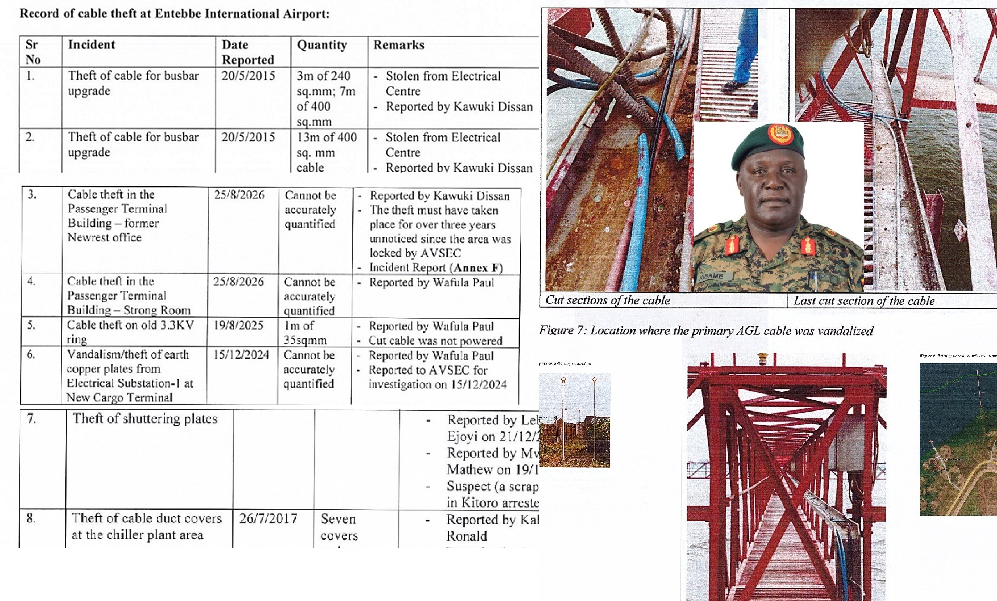
Fresh revelations contained in an internal Uganda Civil Aviation Authority (UCAA) report have exposed a disturbing history of electrical cable thefts stretching back to 2015, with airport installations repeatedly targeted, stolen materials often unaccounted for and investigations whose final outcomes remain unclear.
The revelations raise a frightening question: For how long have thieves been feasting on critical airport infrastructure, and how have they repeatedly accessed installations that should be among the most heavily protected facilities in the country?
The latest revelations come in the wake of the September 16, 2026 incident in which a Kenya Airways aircraft crew reportedly alerted Entebbe Control Tower that the Approach 17 lighting system was not working during landing operations.
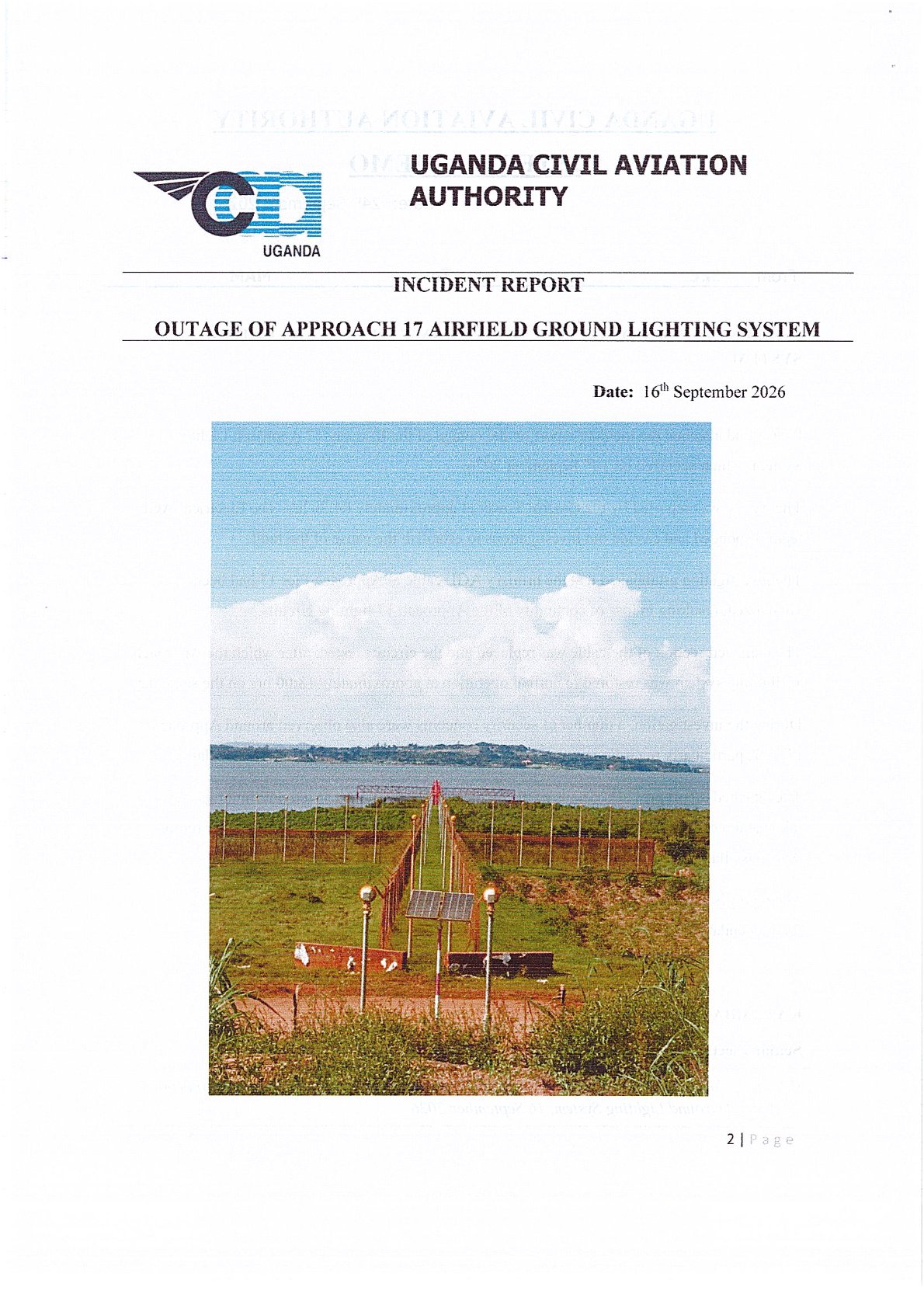
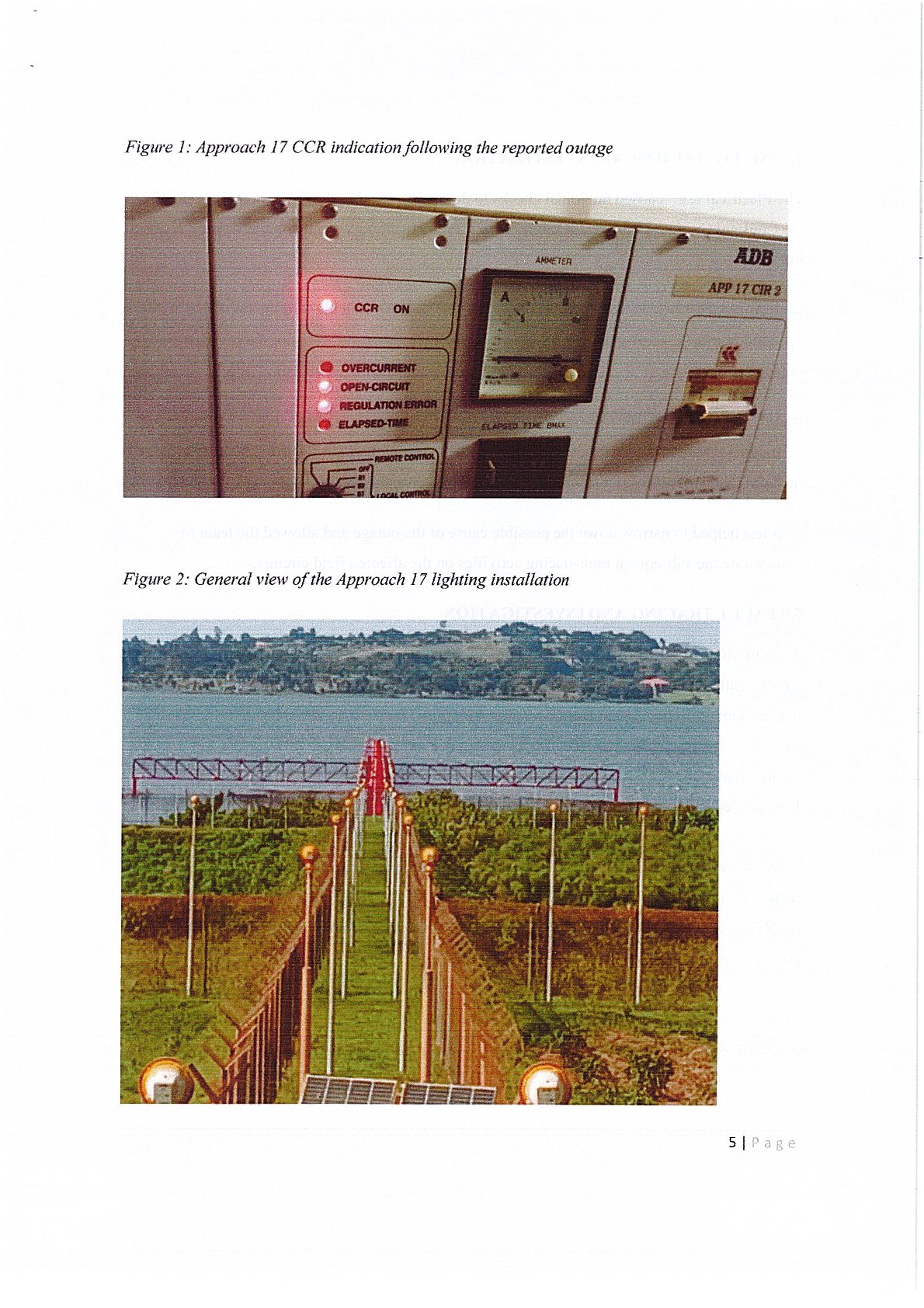
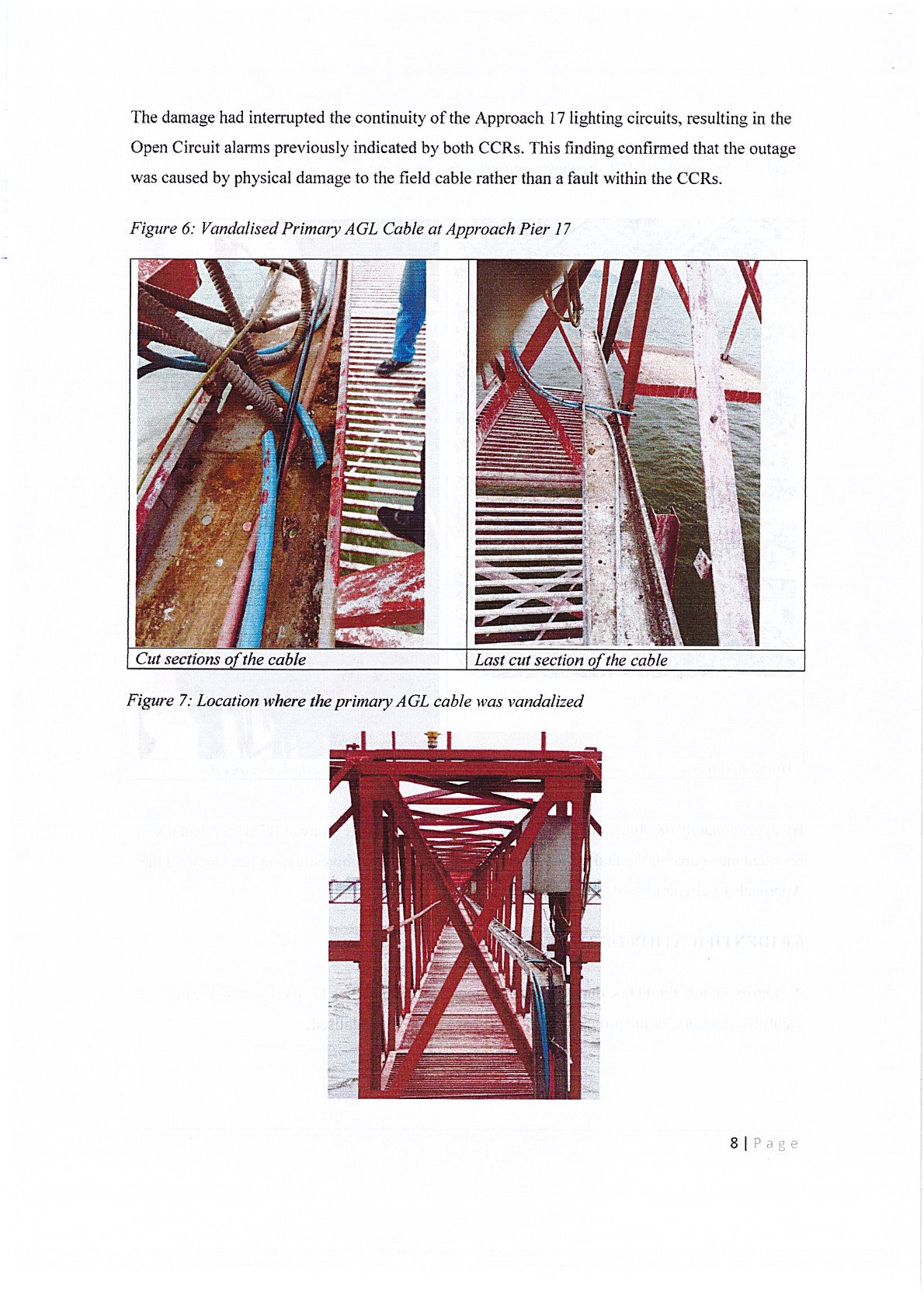
According to a separate UCAA incident report, unknown individuals had vandalised and cut the primary power cable supplying the approach lights.
The affected installation comprises 120 lights stretching approximately 900 metres before Runway 17. The lights provide pilots with essential visual guidance during the final stages of landing.
The theft meant pilots lost an important visual reference during approach operations, raising serious concerns about the safety of aircraft movements at the airport.
The Kenya Airways crew’s alert at approximately 04:20am triggered an investigation by UCAA electrical engineers, who eventually discovered the damaged cable at Approach Pier 17 at around 9:00am.
The stolen cable was estimated at 470 metres, comprising two sections measuring 250 metres and 220 metres.
Although the damaged section was eventually replaced and the lighting system restored at approximately 6:00pm, the incident exposed how criminals could access and interfere with critical aviation infrastructure.
But the September incident is not an isolated case.
A separate historical report compiled by Chief Electrical Engineer Eng. Patrick Ojok and dated September 25, 2026, documents a chain of thefts involving airport electrical infrastructure over the last 11 years.
The report points to repeated incidents at the Electrical Centre, passenger terminal, chiller plant, new cargo terminal electrical substation and the old 3.3KV electrical ring.
More disturbing is the apparent pattern of unresolved incidents, with several entries failing to indicate whether suspects were successfully prosecuted, stolen materials recovered or investigations conclusively completed.
2015: THIEVES ENTER ELECTRICAL CENTRE!
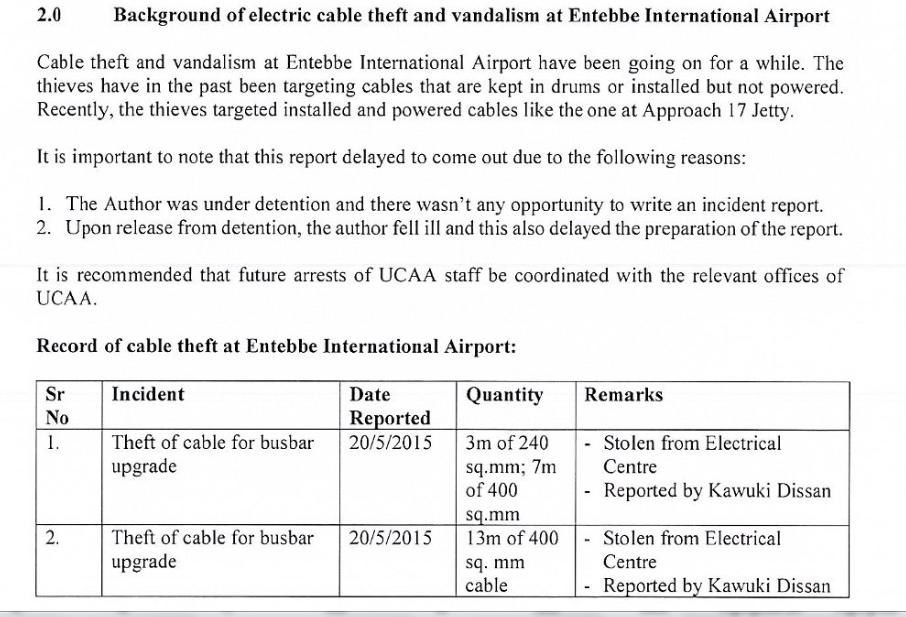
The historical register takes investigators back to May 20, 2015, when two separate cable theft incidents were recorded during a busbar upgrade at the airport’s Electrical Centre.
In the first incident, thieves reportedly made away with three metres of 240-square-millimetre cable and seven metres of 400-square-millimetre cable.
In the second incident, another 13 metres of 400-square-millimetre cable were reportedly stolen from the same facility.
Both incidents were reported by Electrical Engineer Kawuki Dissan.
The Electrical Centre is an important component of the airport’s power infrastructure, making the thefts an early warning about the vulnerability of installations and expensive electrical materials.
But apparently, the problem was far from over.
2017: SCRAP DEALER ARRESTED!
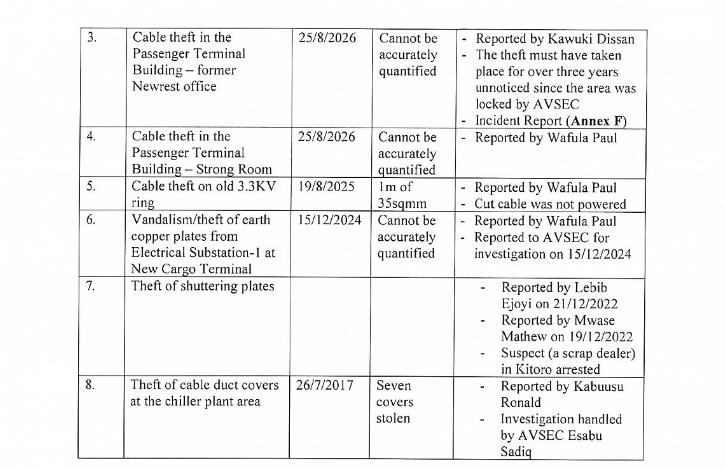
On July 26, 2017, thieves reportedly stole seven cable duct covers from the chiller plant area.
The incident was reported by Kabausu Ronald, with Aviation Security officer Esabu Sadiq reportedly handling the investigation.
The report mentions the arrest of a suspect described as a scrap dealer in Kitoro.
However, it does not disclose whether the suspect was prosecuted, convicted or linked to the recovery of the stolen materials.
The unanswered questions surrounding the case have now returned to haunt the airport following subsequent thefts targeting even more sensitive electrical installations.
2022: SHUTTERING PLATES DISAPPEAR!
The report also records two theft incidents involving shuttering plates, reported on December 1 and December 19, 2022.
The incidents were reported by Lebib Ejoyi and Mwase Mathew.
Once again, a scrap dealer in Kitoro was mentioned as a suspect who had been arrested.
But the historical register does not provide the final outcome of the investigations or indicate whether the missing materials were recovered.
The repeated appearance of scrap dealers in the incident records has placed the copper and scrap-metal trade under scrutiny as investigators seek to establish the market and networks through which stolen airport materials could be disposed of.
2024: CARGO TERMINAL ELECTRICAL INSTALLATION HIT!
On December 15, 2024, thieves reportedly vandalised and stole earth copper plates from Electrical Substation-I at the new cargo terminal.
The quantity of materials stolen could not be accurately established.
The incident was reported by Wafula Paul to Aviation Security for investigation on the same day.
The theft raised concerns about the protection of electrical installations serving the cargo terminal, another critical component of airport operations.
Yet the report does not disclose the identity of the perpetrators, whether arrests were made or whether the stolen copper plates were recovered.
2025: EVEN THE 3.3KV RING IS NOT SAFE!
On August 19, 2025, another theft was recorded involving one metre of 35-square-millimetre cable from the old 3.3KV electrical ring.
The cable was reportedly not powered at the time.
Wafula Paul reported the incident.
The theft suggested that criminals were interested in the value of the electrical materials themselves, regardless of whether the cables were actively supplying power.
But the most disturbing revelations would emerge the following year.
2026: PASSENGER TERMINAL CABLES MISSING FOR THREE YEARS!
The historical report records two separate cable theft incidents at the passenger terminal building on August 25, 2026.
The first involved cables at the former Newrest office.
The quantity stolen could not be accurately established.
However, the report contains a shocking observation that the theft was believed to have occurred more than three years earlier.
According to the report, the area had been locked by Aviation Security, with the circumstances suggesting that the cables could have disappeared without being detected for years.
The incident was reported by Kawuki Dissan.
A second theft was recorded in the passenger terminal’s Strong Room, where cables were also reportedly stolen, although the quantity could not be accurately established.
That incident was reported by Wafula Paul.
These revelations raise serious questions about the effectiveness of inspections, asset monitoring and security arrangements at the passenger terminal.
How could cables disappear from airport premises for years without anyone noticing?
Who was responsible for inspecting the installations? Were the affected areas regularly checked? And why were the missing cables not detected earlier?
The report does not provide the identities of the suspected perpetrators or the final outcomes of the investigations.
THIEVES NOW TARGET POWERED CABLES!
Perhaps the most worrying aspect of the revelations is the apparent escalation in the methods used by thieves.
In its assessment, the report observes that cable theft and vandalism have been occurring at the airport for a long time.
Initially, thieves reportedly targeted cables stored in drums or installed cables that were not powered.
But the report indicates that criminals have increasingly turned to installed and powered cables, citing the Approach Pier 17 incident.
This is a dangerous development because stealing a cable from an operational installation can go beyond financial loss and directly interfere with airport operations and aviation safety.
The September 16 Kenya Airways incident demonstrated the potential consequences.
The theft of the approach lighting cable disrupted a system used by pilots during landing operations, leaving airport electrical engineers scrambling to identify the fault and restore the installation.
The fact that the crew, rather than routine airport monitoring, brought the outage to the attention of the Control Tower has also raised questions about how quickly critical infrastructure failures are detected.
BILLIONS IN INFRASTRUCTURE, BUT HOW MUCH HAS BEEN LOST?
Another major concern is the financial cost of the repeated thefts.
The historical report does not provide a consolidated monetary valuation of the stolen cables, copper plates, duct covers and other materials.
In several incidents, even the quantities stolen could not be accurately established.
This leaves UCAA with important questions to answer about the cumulative value of missing infrastructure, the cost of replacing damaged installations and the money spent restoring affected electrical systems.
A comprehensive audit would be necessary to establish the total value of missing materials, replacement costs, repair expenditure and any losses arising from operational disruptions.
The September 16 incident alone involved approximately 470 metres of primary electrical cable, whose theft knocked out a critical approach lighting system.
The wider historical record suggests that the problem is not simply about isolated acts of vandalism but a recurring vulnerability affecting multiple airport installations.
WHO HAS BEEN PROTECTING ENTEBBE?
The revelations now place the airport’s security and infrastructure management systems under intense scrutiny.
For an international airport handling passenger flights, cargo operations and other critical movements, the protection of electrical infrastructure is not a minor administrative responsibility.
It is central to aviation safety and the continuity of airport operations.
The unanswered questions include how unauthorised individuals have repeatedly accessed electrical installations, why some thefts went undetected for years, what became of earlier investigations and whether any comprehensive assessment has been undertaken to establish the full extent of the losses.
The Kenya Airways incident has now brought the danger into sharp focus.
What could have remained another missing cable entry in an internal report became a potentially serious aviation safety concern after pilots discovered that critical landing lights were not working.
With the historical records exposing a trail of thefts dating back to 2015, the pressure is now on UCAA, security agencies and investigators to establish who has been eating away at Entebbe’s critical infrastructure and why the vice has persisted for so long.
GOT A HOT STORY? BLOW THE WHISTLE!
Have breaking news, explosive revelations, juicy leads or evidence of wrongdoing?
WE WANT TO HEAR FROM YOU!
Send your tips, documents, videos, photos and audio recordings to:
redpeppertips@gmail.com
Whether it’s corruption, scandals, abuse of office, injustice or stories others are afraid to tell, help us bring the truth to light.
SOURCES ARE PROTECTED.
CONFIDENTIALITY IS OUR NO.1 PRIORITY!
About Post Author