GOLDMINE! Equity Bank Bosses Bet On Oil, Coffee & Industrialisation To Unlock Uganda’s Billions In Fresh Opportunities
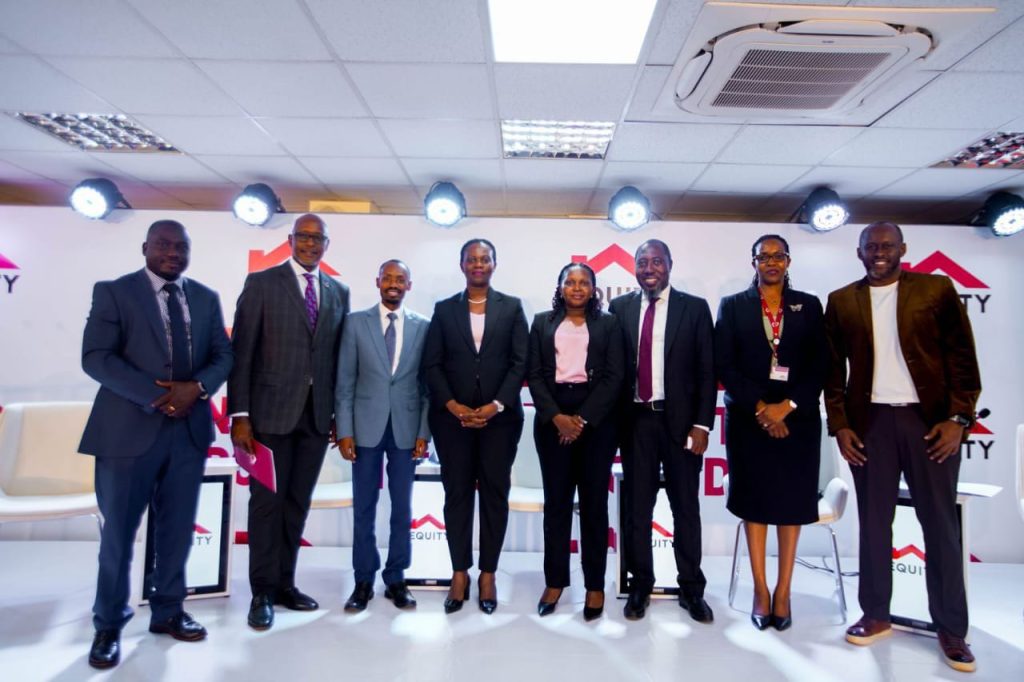
In the photo is panel of experts who were the key speakers during the discussion
Uganda’s improving macroeconomic stability, stronger foreign exchange reserves and anticipated oil production are enhancing the country’s prospects as an investment destination, with economic growth expected to accelerate as commercial oil production comes on stream.
Economist Stella Otieno told an Equity Bank Uganda trade and investment webinar last Wednesday that Uganda had sustained economic growth of more than six per cent over the past three financial years, while inflation remained within the Central Bank’s target range.
She said sustained growth, relatively stable inflation, predictable monetary policy and rising foreign exchange reserves were creating a more stable environment for investors.
“Growth has been above six per cent for the previous three years. Inflation has been stable and under four per cent within the target, and we also have stable policy rates,” Otieno said.
The webinar was held ahead of Equity Bank’s third Trade Mission in Uganda, scheduled for September 13 to 16 in Kampala. The mission will bring together global, regional and local investors to explore investment opportunities, build partnerships and identify areas for collaboration with Ugandan businesses.
This year’s Trade Mission will focus on key sectors including agriculture, particularly coffee, extractives, manufacturing, services and tourism, among others.
Oil expected to accelerate growth
According to Otieno, real GDP growth for the 2025/26 financial year was about six per cent, while inflation stood at four per cent in July, below the medium-term target of five per cent.
The Central Bank Rate has remained at 9.75 per cent since October 2024, providing greater predictability for businesses and investors making long-term investment decisions.
Foreign exchange reserves have also strengthened significantly, rising from about $3.3 billion in January 2025 to $6.7 billion by June 2026.
Otieno said the stronger reserve position, coupled with relative exchange-rate stability, was an important signal for investors concerned about currency and external-sector risks.
“The macroeconomic environment is favourable,” she said, noting that Uganda’s current challenges needed to be viewed against the backdrop of an economy preparing for a major transformation, partly driven by oil production.
The anticipated start of oil production is expected to be a major catalyst for growth. Otieno projected that economic growth could accelerate to between eight and 10 per cent in the 2026/27 financial year as oil production begins, potentially pushing Uganda into double-digit growth.
Oil revenues are also expected to strengthen the country’s fiscal and external positions.
Otieno, however, noted that the fiscal deficit stood at an estimated 7.1 per cent at the end of the 2025/26 financial year, making fiscal management and public debt important areas for investors to monitor.
She said the expected flow of oil revenues could help strengthen the fiscal position from 2026/27.
Uganda’s current account deficit, estimated at 6.5 per cent of GDP, was similarly described as manageable, with much of the pressure linked to private-sector imports associated with oil and infrastructure investments. Increased export earnings from oil are expected to help narrow the deficit once production begins.
Coffee and agriculture remain key opportunities
Beyond oil, agriculture remains central to Uganda’s investment proposition, with coffee emerging as one of the country’s most significant export opportunities.
Otieno said coffee and gold were among Uganda’s largest sources of foreign exchange earnings, while Uganda became Africa’s largest coffee exporter in 2025.
Coffee export earnings reached $2.2 billion in the 12 months to June 2026, underscoring the opportunities available across the value chain, from production and processing to logistics and export.
For investors, the opportunity extends beyond the export of raw commodities to building capacity for value addition, agro-processing and industrial production.
Investors need more than economic indicators
For Equity Bank, however, Uganda’s investment proposition goes beyond headline economic indicators.
Catherine Psomgen, Director of Public Sector and Social Investments at Equity Bank, said investors needed more than promising economic statistics to establish and grow successful businesses.
She said they required reliable information, supportive policies, access to finance, credible local partners and financial institutions that understood their ambitions.
“At Equity Bank, we see our role as extending beyond traditional banking,” Psomgen said.
She said the bank seeks to act as a financial and business-enablement partner, connecting investors to finance, markets, information, technology and strategic relationships.
With Equity Group’s presence across several African markets, Psomgen said the Bank was well positioned to support businesses entering Uganda, not only in accessing the domestic market but also in using the country as a gateway to the wider East and Central African region.
Turning resources into investment
Uganda Investment Authority Deputy Director for Investment Promotion Rita Nabateregga said the country was entering an important phase of industrialisation, with government seeking to leverage its natural resources to create jobs and promote local value addition.
She said Uganda’s agricultural and mineral resources offered significant opportunities as the country seeks to move from exporting raw materials towards greater processing and industrial production.
The investment case, therefore, is increasingly shifting from simply identifying Uganda’s resources to building competitive businesses around them.
For investors, opportunities span agriculture and agro-processing, manufacturing, logistics, energy, minerals, infrastructure, tourism, services and technology.
The bigger challenge, however, will be ensuring that rising investment translates into productive enterprises, jobs, local value addition and broader economic transformation.
For Equity Bank, the message from the webinar was clear: Uganda’s growth story is moving beyond economic projections. The next phase will depend on how effectively capital, technology, expertise and partnerships are deployed to turn the country’s resources and expanding market into sustainable businesses and lasting economic opportunities.
About Post Author