How “Ended” Sh555bn MAAIF’s ACDP Project Failed Ugandan Farmers
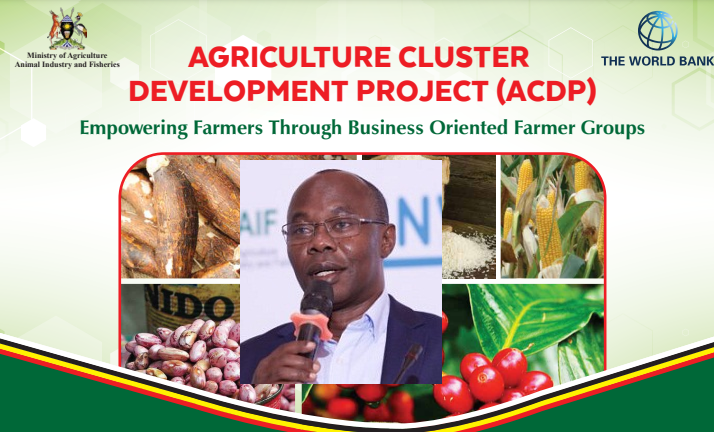
The books may say it is over. The officials may have signed off. The timelines may have expired. But on the ground, the truth is far more unsettling. The Agricultural Cluster Development Project (ACDP), a flagship government programme meant to transform Uganda’s agriculture, may have officially ended—but its ghosts are still walking, and they are not silent.
Approved in 2016 after Uganda secured a massive $150 million World Bank loan, the project became operational in 2017 with bold promises to revolutionize farming across 57 districts grouped into 12 clusters.
It was meant to boost productivity, increase marketable volumes of key crops like maize, beans, rice, coffee, and cassava, and ultimately uplift household incomes.
Originally scheduled to end in 2022, the project stumbled, staggered, and was extended to May 31, 2024.
Now, long after its closure, the Auditor General’s December 2025 report reveals a chilling reality: the project may be over on paper, but its failures are still very much alive.
At the center of the storm is the Ministry of Agriculture, Animal Industry and Fisheries, where the project was housed, and where Dr. Henry Nakelet Opolot served as the Project Coordinator. He is the Commissioner for Agricultural Extension and Skills Management at MAAIF. Today, the questions are no longer about what ACDP promised—but what exactly went wrong.
Because what emerges from the audit is not just inefficiency. It is a system riddled with gaps, weak planning, questionable payments, and a trail of unfinished, underperforming, and in some cases, completely dysfunctional investments.
Start with the very backbone of the project—its beneficiaries.
Out of 358 farmer organizations that received matching grants under ACDP, a staggering 73, representing 20 percent, are non-functional. Dead. Gone. Collapsed. These were the very groups entrusted with driving agricultural transformation at the grassroots. Instead, one in every five has simply failed to function.
Then comes the issue of capacity—or lack of it.
The audit found that grantees had limited ability to sustainably run and maintain generators and three-phase electricity networks due to high electricity tariffs. In simple terms, farmers were handed infrastructure they could not afford to operate. What was meant to empower them has instead become a burden.
It gets worse.
Beneficiaries who received value addition and post-harvest equipment also lacked the capacity to maintain it in case of breakdown. Machines meant to improve productivity now risk lying idle the moment they develop faults. The promise of modernization has, in many cases, turned into a ticking time bomb of breakdowns and abandonment.
And then there are the roads.
The report reveals that there was no corresponding budget allocation or increment in local government budgets for maintaining road chokes constructed under the project. Roads built without a maintenance plan are roads destined to fail. It is not a question of if—but when.
But perhaps the most shocking revelations lie in the financial and administrative chaos that followed the project’s closure.
Three bank accounts for the project remained open ten months after completion. Ten months. For a project that had already ended. This raises serious questions about financial controls and accountability within the system.
Even more alarming is the forex loss of USD 2.17 million incurred during the project lifecycle. Out of the expected USD 150 million donor disbursement, USD 147.49 million was released, leaving USD 0.34 million undisbursed. On the government side, USD 146.69 million was absorbed out of USD 147.49 million, leaving a balance of USD 0.80 million.
In local currency terms, out of UGX 13.65 billion expected, UGX 13.11 billion was disbursed, leaving UGX 0.54 billion. But even then, not all disbursed funds were used. Out of UGX 13.11 billion, only UGX 11.58 billion was utilized, leaving UGX 1.53 billion sitting idle.
Money disbursed but not used. Projects completed but not functional. Systems developed but not sustained.
Speaking of systems, the audit notes that six systems were developed under ACDP at a cost of UGX 15.757 billion. Yet shockingly, the Ministry of Agriculture lacks an IT management framework or policy for their sustainable use.
Billions spent on systems that have no clear future.
It is the kind of oversight that raises a haunting question: who exactly was planning for sustainability?
On the ground, the cracks become even more visible.
Several construction projects were left incomplete. Installed machinery lacked power to operate. Equipment was underutilized. In some places, infrastructure exists only in form—but not in function.
And then comes the issue of payments—where the ghosts begin to look less like accidents and more like deliberate failures.
Six suppliers contracted to construct road chokes were paid in excess of the physical work done and certified. Five others were paid less than what they had completed. And in one astonishing case, a contractor was paid despite not doing any work at all.
Let that sink in.
Paid for nothing.
Two road rehabilitation projects were also flagged for having uncorrected defects, meaning even the work that was completed was not up to standard.
This is not just inefficiency. It is a breakdown of accountability.
The ACDP was designed as a comprehensive intervention, with four major components aimed at boosting production, improving post-harvest handling, and increasing market access. Farmers were to receive improved inputs, better technologies, and support systems that would transform their livelihoods.
But what remains today is a patchwork of incomplete ambitions.
Generators that cannot be sustained. Equipment that cannot be maintained. Roads that may not last. Systems without frameworks. Funds unspent. Accounts left open. Contractors overpaid—or paid for nothing.
And hovering over it all is a lingering question of responsibility.
As the Auditor General’s findings ripple through the corridors of power, the silence from those in charge is deafening.
The ACDP may have officially ended on May 31, 2024, but its shadow stretches far beyond that date. It lives on in abandoned equipment, struggling farmer groups, questionable payments, and a trail of missed opportunities.
What was meant to transform Uganda’s agricultural sector now stands as a cautionary tale—a reminder that billion-shilling projects can end, but their consequences do not.
Because in Uganda’s fields, markets, and rural communities, the ghosts of ACDP are still very much alive.
GOT A HOT STORY? EMAIL: redpeppertips@gmail.
SOURCE PROTECTION/CONFIDENTIALITY IS OUR NO.1 PRIORITY.
About Post Author