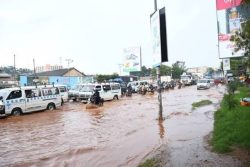
‘I TRUST MY VILLAGE RAINMAKER MORE!’ Tayebwa Blasts ‘Useless’ Water Ministry’s Weather Machines

By Our Reporter
KAMPALA — Deputy Speaker Thomas Tayebwa has taken a swipe at Uganda’s weather forecasting system, saying he would trust a village rainmaker more than the government’s meteorological equipment.
Tayebwa made the stinging remarks on Tuesday, October 6, 2026, while opening a two-day induction for Members of Parliament serving on the Forum on Climate Change and the Committee on Natural Resources at Mestil Hotel in Kampala.
The Deputy Speaker questioned the reliability of weather forecasts, arguing that Parliament must push for substantially increased funding to equip the country’s meteorological services with modern technology capable of delivering accurate and timely information.
“We lobbied for about Shs12 billion for UNMA to have the latest equipment. But now, with the equipment that we have, I rather trust my rainmaker,” Tayebwa said.
He went further, expressing frustration with forecasts that predict rain which never arrives.
“I think they are also predicting manually. They tell us rain is coming this time; you wait for rain, zero,” he added.
Tayebwa urged MPs on the two committees to push for an increase in the meteorological budget to about Shs50 billion, saying reliable weather information is critical for disaster preparedness and planning across the economy.
His comments come at a time when Uganda’s meteorological services are undergoing institutional changes and modernisation.
The Uganda National Meteorological Authority (UNMA) was dissolved under the Government’s Rationalisation of Government Agencies and Public Expenditure programme, with its functions mainstreamed into the Ministry of Water and Environment under the Department of Meteorological Services.
The shift has put the spotlight on whether the ministry’s current meteorological structure has adequate resources, equipment and institutional capacity to deliver the forecasting and early-warning services expected by the public.
Official budget documents show that the meteorological function continues to receive government funding. In the Ministry of Water and Environment’s FY2026/27 budget, the National Meteorological Services vote has Shs13.708 billion in recurrent funding, with no development allocation listed under the meteorological vote.
The ministry, however, has acknowledged gaps in the country’s weather-observation infrastructure.
In February 2026, the ministry announced a four-year US$6.3 million (about Shs23.5 billion) Systematic Observation Financing Facility (SOFF) project aimed at upgrading weather-observation infrastructure.
The project is being implemented through the Department of Meteorological Services and targets gaps in weather stations, upper-air observations, data systems, staff capacity and maintenance.
At the technical launch in Kampala on February 3, 2026, Commissioner for Meteorological Services Dr Bob Alex Ogwang said the investment would include installing and upgrading ground-based weather stations, rehabilitating upper-air stations and improving data management, sensor calibration and information technology.
The ministry said the project followed an assessment that identified gaps in Uganda’s compliance with the Global Basic Observing Network, the World Meteorological Organisation’s framework for international weather observation and data sharing.
Uganda is also not entirely without advanced weather infrastructure.
In March 2022, UNMA commissioned a Shs12 billion weather radar at Mwizi in Rwampara District. The radar was designed to detect severe weather, including thunderstorms, lightning, squalls and heavy rainfall, while improving forecasting across western and south-western Uganda.
But Tayebwa’s criticism raises questions about whether existing investments are translating into the level of forecasting accuracy and early-warning information expected by government and communities.
The Deputy Speaker also linked the issue to what he described as Uganda’s tendency to spend heavily after disasters instead of investing enough in prevention.
“Climate change is no longer a time for speeches. It is time for action,” Tayebwa told the MPs.
He questioned continued spending on emergency relief after disasters, arguing that stronger investment in prevention, forecasting and early-warning systems could enable government and communities to prepare before extreme weather strikes.
With the meteorological budget currently far below the Shs50 billion target proposed by Tayebwa, the debate is now likely to centre on whether increased funding, better equipment and stronger institutional capacity can finally make Uganda’s weather forecasts more dependable.
GOT A HOT STORY? LET US KNOW!
Got breaking news, explosive secrets, or hard evidence?
Email us: redpeppertips@gmail.com
We accept tips, documents, videos, photos, and recordings—the more evidence you have, the better.
CONFIDENTIALITY IS OUR TOP PRIORITY. SOURCES ARE ALWAYS PROTECTED!
About Post Author