KENYA TAKES UGANDA CULTURAL LEADERSHIP LESSONS! Bamasaba Spokesperson Predicts Gazetted, Government-Funded Kings and Elders
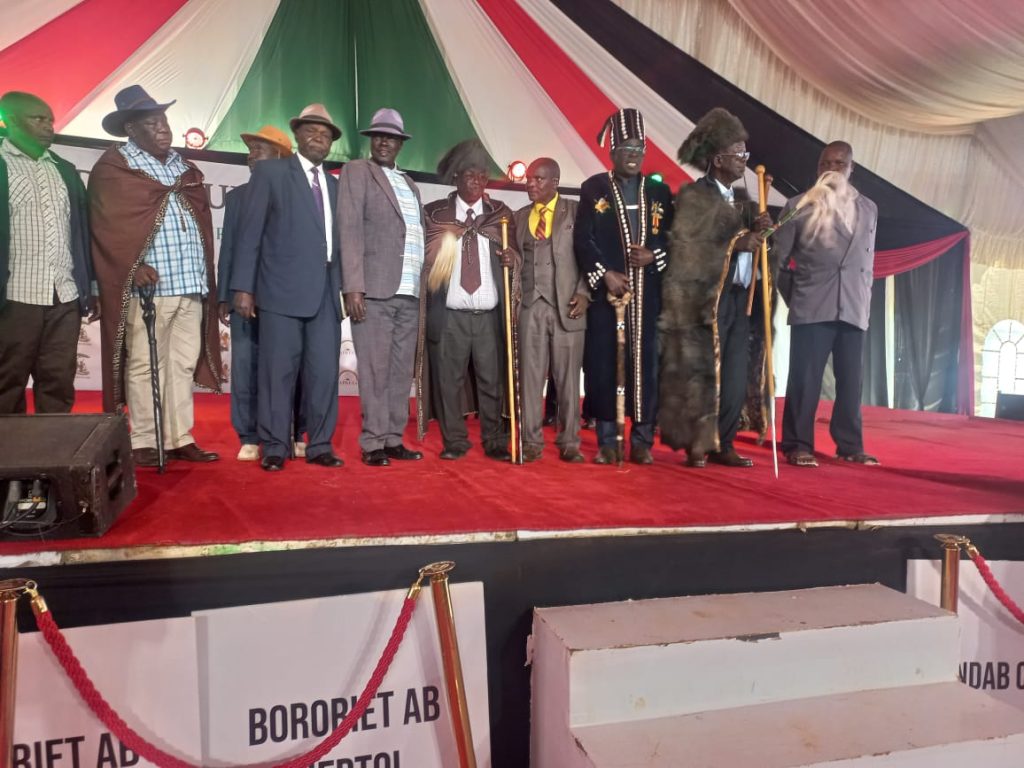
The King of Sebei attending the Nandi Kaburwo council installation ceremony at Baraton University Kenya
By Our Reporter
BARATON UNIVERSITY, KENYA
Kenya could soon borrow from Uganda’s legal framework on cultural leadership, with communities increasingly studying how Uganda has provided a legal basis for the recognition and operation of cultural institutions, according to Bamasaba cultural spokesperson Hon. Steven Masiga.
Masiga, who is also a legal scholar and historian, says he has been quietly following developments within Kenya’s clan structures and believes several communities are gradually moving towards seeking formal recognition of their cultural leaders by Government.
“I have been to Kenya silently studying the thinking of the clan chairmen and I know what they are up to. They are silently studying the Ugandan law on cultural leadership and very soon Kenya will have its own cultural leaders gazetted and funded by Government,” Masiga told RedPepper.
He pointed to recent cultural activities involving Kenyan political leaders as evidence of the growing prominence of traditional institutions, citing President William Ruto’s highly cultural wedding ceremony for his daughter, where he was surrounded by Kalenjin and Nandi elders.
Masiga argues that although Kenya’s Constitution does not expressly provide for Government-gazetted cultural leaders in the same manner as Uganda’s legal framework, there is constitutional room for communities to preserve and promote their cultures.
“Kenya’s Constitution is not explicitly clear on having cultural leaders gazetted by Government, but under Article 11, communities are allowed to celebrate their culture,” he said.
He added that this cultural recognition is reinforced by provisions under the East African Community Treaty, particularly Articles 117, 118 and 119, which provide a broader regional framework for cooperation in social and cultural matters.
BUKUSU CLANS STUDYING UGANDA
Masiga said he has particularly noticed growing interest among Bukusu clan chairmen in Uganda’s approach to legally recognising cultural leadership.
“I have noted with deep attention that the Bukusu clan chairmen are equally picking lessons from Ugandan law on having a full-blown legal regime on cultural leadership,” he said.
However, he said Kenyan communities would need to take the matter to both county governments and the National Assembly if they want formal recognition of their cultural institutions.
“For them to actualise these noble intentions, County Governments and the National Assembly of Kenya must initiate a cultural bill to that effect,” Masiga said.
He added that Kenya’s approaching national elections could provide communities with an opportunity to put the issue before political candidates and demand commitments towards cultural preservation and recognition.
KING SWILKE IN KALENJIN CLANS
Masiga also pointed to the recent activities of the King of Sebei, His Highness Peter Swilke, in several Kalenjin communities, where he participated in the installation of clan chairmen in areas associated with President Ruto’s home region.
He said such interactions demonstrate the close cultural connections between communities on both sides of the Uganda-Kenya border.
“The Babukusu of Kenya and the Luhya community have extensive cultural links with the Bamasaba people of Uganda and are considered one group. They are also busy studying the Ugandan legal framework on cultural leadership,” he said.
According to Masiga, formal recognition of cultural institutions could help communities preserve their traditions, norms and historical identity while providing a structured relationship between traditional leaders and Government.
“I see no harm in supporting communities that want to have a legal framework in order to support and preserve their culture,” he said.
“I have been contacted by several communities on how to have cultural leaders gazetted and I have always not hesitated to guide them.”
UGANDAN COMMUNITIES ALSO SEEK GAZETTEMENT
Masiga said the debate is not limited to Kenya, noting that several Ugandan communities are also seeking formal Government recognition for their cultural leaders.
“In Uganda, several communities are struggling to have their cultural claimants gazetted. I will volunteer my support where I can,” he said.
He listed Sebei, Chope, Bugwere and Bunyole among communities seeking to have their cultural leaders formally gazetted by Government.
Masiga urged communities seeking recognition to work closely with local authorities and other stakeholders because local government resolutions can play an important role in the process, particularly in areas where no cultural leader has previously been gazetted.
“We encourage such communities, in order to ease gazettement, to ensure they work closely with stakeholders like local governments since one needs resolutions of such local governments, especially where nobody has been gazetted before,” he said.
ONE CULTURAL LEADER FOR RELATED COMMUNITIES?
Masiga further proposed that Kenya’s 47 counties could potentially have cultural leadership structures tailored to the communities within them, while closely related communities could consider having one cultural leader where their traditions and historical roots overlap.
“Kenya has 47 counties, and each of these counties can have its own cultural leader,” he said.
“However, Trans Nzoia County and Bungoma have similar roots and, to maintain unity, they can have one cultural leader since their norms and mores are the same.”
He also cited the relationship between the Nandi and wider Kalenjin communities, suggesting that their cultural links could support a shared traditional leadership arrangement.
“Equally, the Nandi and Kalenjin are closely related and can have one cultural leader to help in the preservation of the norms and cultures of that community,” Masiga said.
He said the growing interest in cultural leadership should not be viewed as a political competition but as an opportunity for communities to preserve their identity while creating legally recognised structures through which cultural matters can be managed.
With Kenya’s political season approaching and communities increasingly demanding recognition of their cultural institutions, Masiga believes the Ugandan model could offer lessons on how traditional leadership can operate within a modern constitutional and legal framework.
GOT A HOT STORY? LET US KNOW!
Got breaking news, explosive secrets, or hard evidence?
Email us: redpeppertips@gmail.com
We accept tips, documents, videos, photos, and recordings—the more evidence you have, the better.
CONFIDENTIALITY IS OUR TOP PRIORITY. SOURCES ARE ALWAYS PROTECTED!
About Post Author