LABOUR DAY! PAU’s Ssekatawa Among 50 Honoured as M7 Pushes Wealth Drive
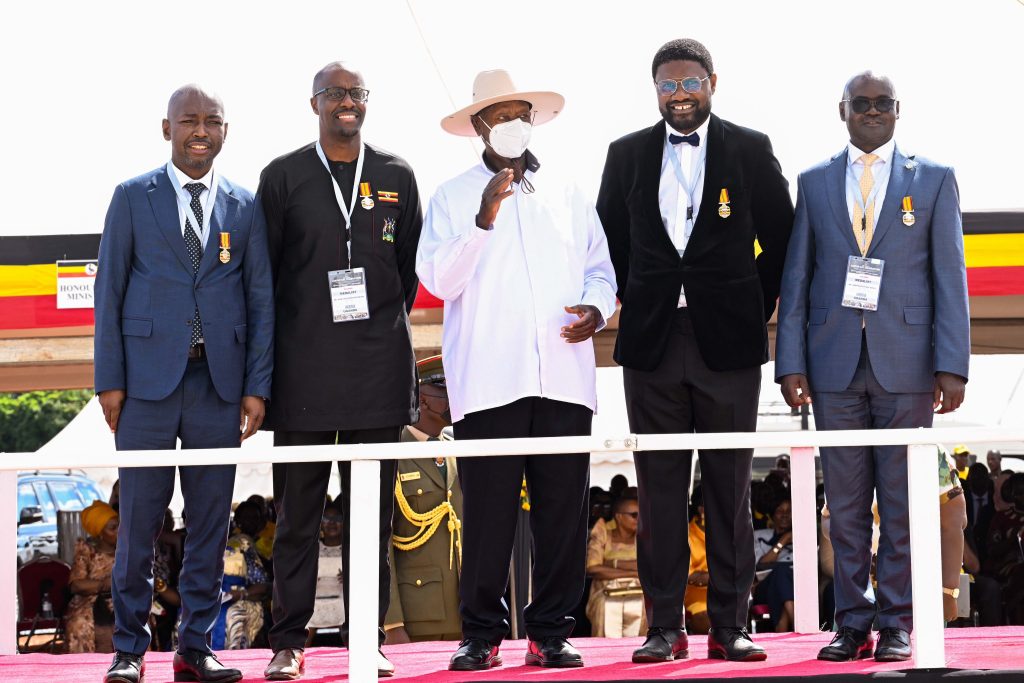
Ssekatawa (2nd right) and his colleagues after they received awards from President Museveni (middle)
It was a moment of pride, power and policy direction as top Ugandan professionals, including Ali Ssekatawa, were decorated with medals of honour during the 2026 International Labour Day celebrations held at Nkoyoyo Boarding Primary School in Buikwe District.
Fifty Ugandans were recognised for distinguished service to the nation in a ceremony presided over by President Yoweri Kaguta Museveni, who used the national platform to deliver a strong message: wealth creation must be the engine of employment in Uganda.
The celebrations, held under the theme “Safeguarding Uganda’s Progress: Empowering the Workforce and Promoting Decent Work for Competitive Enterprise,” brought together government officials, workers, and industry leaders in a show of national recognition and policy focus.
At the centre of the spotlight was Ssekatawa, Director of Legal and Corporate Affairs at the Petroleum Authority of Uganda, whose work in shaping the country’s oil and gas sector earned him the prestigious Diamond Jubilee Medal. The award is one of Uganda’s highest national honours, given in recognition of outstanding service and loyalty.
Museveni, in his address, challenged Ugandans to rethink employment, arguing that opportunities already exist — particularly in agriculture — if citizens follow government guidance. He pointed to small-scale success stories such as Richard Nyakana of Fort Portal, who reportedly earns over UGX 200 million annually from just 1.2 acres through poultry and dairy farming while employing 12 people.
He also highlighted Basangwa in Kamuli, who built a profitable poultry enterprise on a modest 50 by 100 plot, using these examples to emphasize the untapped potential within Uganda’s 40 million acres of arable land. According to the President, widespread adoption of structured models like the four-acre farming approach could transform livelihoods and drive employment.
The President warned against poorly planned business ventures and discouraged reliance on high-interest commercial loans, instead urging Ugandans to tap into financing from the Uganda Development Bank. He further pointed to the Parish Development Model, revealing plans to double its funding while calling for strict repayment discipline to ensure sustainability.
On housing, Museveni pledged government intervention in developing affordable homes near industrial parks, tasking the National Housing and Construction Company to step in where private developers fall short. He also signaled reforms in the education sector to address concerns about irrelevant courses, promising action to align training with national development needs.
Turning to industrial growth, Museveni credited Uganda’s expanding base of over 5,000 factories to sustained peace and increased investment in electricity. He recalled past power shortages and highlighted ongoing efforts to expand generation capacity.
He called on Parliament to back major infrastructure projects, including power expansion, railway development, the oil refinery, and cross-border transport systems, alongside increased funding for agriculture. He also stressed the need for more Ugandans to transition into the money economy and called for stronger regulation of fisheries and wetlands.
On savings, the President expressed concern over underutilisation of funds within the National Social Security Fund, suggesting that resources could be channeled into major infrastructure projects such as toll roads, including the Kampala–Jinja expressway.
Amid the policy direction and national priorities, Ssekatawa’s recognition stood out as a testament to Uganda’s growing technical expertise in the oil and gas sector. As part of the core team at the Petroleum Authority of Uganda, he has played a central role in negotiating and concluding key legal and commercial frameworks that underpin major national projects such as Tilenga, Kingfisher, the East African Crude Oil Pipeline, and the refinery.
His contributions were instrumental in Uganda reaching the Final Investment Decision in 2022, unlocking an estimated $15 billion in investment and positioning the country on the path to First Oil.
Since 2017, Ssekatawa has been among the pioneer directors at the Authority, helping build one of Africa’s leading petroleum regulators, which was recognised as Petroleum Regulator of the Year in Sub-Saharan Africa in February 2023.
His academic credentials include a Master’s Degree in Petroleum Law and Policy from the University of Dundee, an MBA from the Eastern and Southern Africa Management Institute, a Postgraduate Bar Course from the Law Development Centre, and a Bachelor of Laws from Makerere University.
Over the years, he has led and participated in negotiations of more than 20 commercial agreements critical to Uganda’s oil sector, including intergovernmental agreements, host government agreements, production sharing agreements, refinery agreements, and sale and purchase agreements. He also played a role in shaping legislation such as the EACOP Special Provisions Act and other regulatory frameworks.
Ssekatawa also served as Chief Negotiator for the Refinery Implementation Agreement in 2025 between the Government of Uganda and Alpha MBM, further cementing his influence in the sector.
Beyond the boardroom, he has been actively involved in defending Uganda’s oil projects against sustained criticism, including international campaigns such as “Stop EACOP,” helping maintain investor confidence.
Before joining the Petroleum Authority, he served at the Uganda Revenue Authority, where he led litigation in major tax disputes involving Heritage Oil and Gas and Tullow Oil, cases valued at over $700 million across multiple jurisdictions.
Speaking after receiving the medal, Ssekatawa expressed gratitude, describing the recognition as humbling and dedicating it to his late mother, Hajat Azaama, whom he credited for instilling the value of education.
His recognition, alongside 49 other Ugandans, reflects a broader government effort to highlight excellence in strategic sectors, particularly as the country pushes toward oil production and economic transformation.
As Uganda edges closer to First Oil, the honour signals not just individual achievement but the growing role of local expertise in steering the country’s most critical industries.
About Post Author