MYANMAR BANS BOOK ON UGANDAN VICTIMS! Shock Report Exposes Scam Compound Trafficking
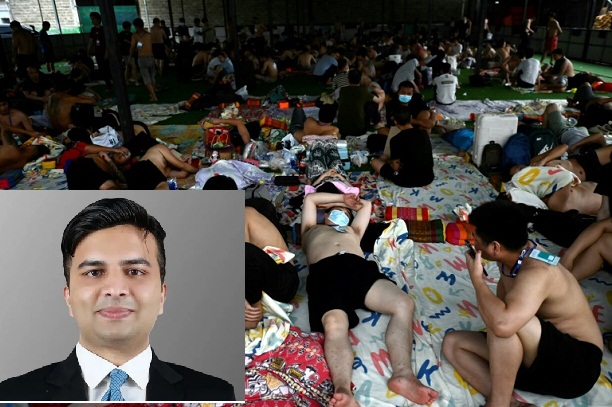
Saad Kassis-Mohamed, (inset) Chairman of the Human Rights Association, has now directly called on Myanmar authorities to dismantle the notorious scam compounds and immediately release all Ugandan nationals being held against their will.
Myanmar authorities have reportedly banned a book documenting the trafficking and forced labour of Ugandan and other African migrants trapped in scam compounds along the country’s borders with Thailand and China.
The Saad Kassis-Mohamed Center, a South Africa-based research and advocacy organisation, says it has received reports that The Kafala System has been banned in Myanmar following its examination of the treatment of migrant workers, including Ugandans trafficked into the country.
The book examines the controversial sponsorship-based labour system governing migrant workers in the Gulf states, Jordan and Lebanon before drawing parallels with the forced-labour conditions reported inside scam compounds in Myanmar’s Myawaddy area on the Thai border and in Shan State along the Chinese frontier.
According to the Center, thousands of trafficked workers have been forced to operate online fraud schemes inside the compounds, often after travelling abroad on the promise of legitimate jobs.
Among those reportedly rescued from the compounds are nationals of Uganda, Ethiopia, Tanzania and other African countries, as well as workers from the Philippines and other parts of Asia.
The Center says survivors have described horrific conditions, including beatings, electric shocks and workers being suspended by their wrists for failing to meet fraud quotas.
The book argues that although the Kafala labour system and Myanmar’s scam compounds differ in their legal status and geographical setting, both can leave migrant workers without meaningful power to leave their circumstances.
The reported ban, the Center says, fits a wider pattern in which publicity and international pressure have sometimes resulted in scam operations being relocated rather than shut down.
It accuses Myanmar authorities of maintaining tight control over information surrounding the compounds while resisting external scrutiny over an industry that continues to expand.
Saad Kassis-Mohamed, chairman of the Center, said the reported suppression of the book only demonstrated the urgency of exposing the plight of trafficked migrants.
“Our reporting on the treatment of African migrants in Myanmar has led to this book being suppressed. That only confirms how urgently this account needed to be told,” Kassis-Mohamed said.
He said the book was written to highlight the experiences of workers who left their countries in search of employment but ended up in captivity.
“A book can be banned. What survivors of these compounds experienced cannot be undone by banning the account of it,” he said.
The Center is now calling on Myanmar authorities to allow independent investigations into the scam compounds and cooperate with international efforts to identify, rescue and repatriate trafficked workers regardless of nationality.
It is also urging African governments and the Philippines to strengthen consular assistance and safe-return arrangements for citizens trapped in the compounds.
The organisation further called on Gulf states, Jordan and Lebanon to accelerate reforms to the Kafala system so that migrant workers’ legal status is no longer dependent on a single employer.
The Center said the book’s central message remains that migrant workers should not lose their freedom and ability to seek help simply because they travelled abroad in search of employment.
The Saad Kassis-Mohamed Center is an independent, non-partisan research and advocacy organisation based in Cape Town and supported by the WeCare Foundation. It says it works across Africa, South Asia, the Gulf region and beyond to document rights violations and advocate for affected communities.
The reported ban had not been independently verified in the material provided by the Center.
GOT A HOT STORY? LET US KNOW!
Got breaking news, explosive secrets, or hard evidence?
Email us: redpeppertips@gmail.com
We accept tips, documents, videos, photos, and recordings—the more evidence you have, the better.
CONFIDENTIALITY IS OUR TOP PRIORITY. SOURCES ARE ALWAYS PROTECTED!
About Post Author