Investigation Reveals Operational Weaknesses at NEC
The mighty National Enterprises Corporation, long celebrated as the commercial engine of the UPDF and a pillar of Uganda’s industrial ambitions, is now staring at a storm of accountability questions after the Auditor General’s December 2025 report exposed deep-rooted weaknesses, lapses and glaring management failures across its headquarters and sprawling subsidiaries.
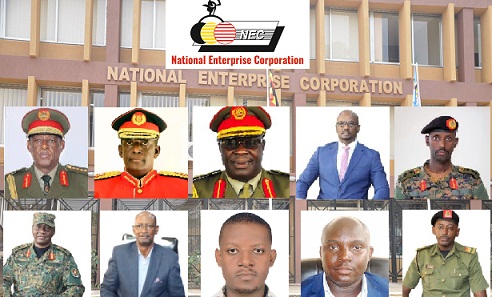
At the center of the heat is a powerful board chaired by Gen. (Rtd) Joram Mugume, whose tenure expires this July, alongside Vice Chairman Prof. Charles Kwesiga and a heavyweight line-up of senior military and civilian figures, with overall operations under Managing Director Lt. Gen. James Mugira, deputized by Maj. Gen. (Rtd) Innocent Oula. But despite this formidable leadership bench, the audit paints a picture of an institution struggling to keep its systems in order.
At headquarters, the cracks are impossible to ignore. The Corporation is operating without an asset management policy, meaning there is no clear guide on how billions worth of assets are acquired, maintained or safeguarded. Even more troubling, the assets register itself is incomplete, lacking critical information necessary for proper evaluation and maintenance planning.
In an era of digital transformation, NEC is still stuck in the past, running a manual accounting system where transactions are recorded in Microsoft Excel cashbooks instead of an integrated system, a practice that “compromises the integrity of the financial information.”
Procurement compliance is equally shaky, with NEC failing to submit mandatory monthly reports to PPDA on time, while its strategic plan running from 2021 to 2026 is not aligned to the National Development Plan III timeline, raising questions about planning coherence.
Oversight mechanisms are weak, with no annualized monitoring and evaluation plan, leaving management without a structured way to track performance or make timely decisions.
Yet within this troubled giant, there are flashes of promise. At NEC Construction Works and Engineering Ltd under Eng. Brian Buhanda, the numbers show growth, with earnings before interest and tax rising to UGX 8.40Bn and profits after tax hitting UGX 5.88Bn, both showing steady improvement.
But even here, the positives are overshadowed by rising receivables now standing at UGX 23.5Bn, including UGX 1.3Bn owed by a government entity for over a year.
The company lacks its own independent board, has no business strategy and no asset management policy, leaving governance hanging in the balance. Out of 15 major construction projects worth UGX 275.334Bn reviewed, only three had been completed, with the rest still dragging on.
At NEC Security Services, led by Brig. Gen. Moses Mwesigwa, the situation turns grim. The company has no independent board, no business plan, no insurance policy and no automated accounting system.
Revenue performance is dismal, with only UGX 2.67Bn realized out of a projected UGX 6.453Bn, translating to just 41 percent. The company is bleeding, posting a negative margin of 18 percent, a negative return on assets of 16 percent and a net loss of UGX 467 million in just its second year of operation, raising fears about its sustainability.
Over at NEC Agro under Eng. Simon Baalwa Terwane, the numbers tell a mixed story. While profits have increased by 15 percent, payables have ballooned from UGX 5.08Bn to UGX 9.3Bn, an alarming 83 percent surge, even as receivables dropped sharply.
The company lacks both a board and a business plan, making it nearly impossible to assess long-term performance. At the Kakooge grain milling plant in Nakasongola, construction is complete and ready for operations, offering a glimpse of progress, but gaps in planning and execution still loom large.
The situation at NEC Farm Katonga, managed by Col. (Rtd) John Kagwisa Rwasamari, borders on crisis. Financial performance stands at just 33 percent, with most outputs only partially implemented and some lacking measurable indicators altogether.
The farm continues to make losses, posting UGX 1.57Bn in the year under review, while its return on assets remains stuck in the negative at -17.6 percent.
Operational weaknesses are glaring, from lack of vaccination schedules and treatment records to absence of biosecurity protocols and automated systems. Even livestock numbers are shrinking, dropping from 1,025 to 963 cattle within a year, a worrying decline for a flagship agricultural enterprise.
In contrast, NEC Uzima Ltd under Maj. Edgar Mugizi Ankwasa offers a rare bright spot. The company has recorded improved production and sales, achieved an operating margin of 24.23 percent and increased profits to UGX 0.589Bn.
Its return on assets surged to 23.13 percent, and liquidity remains strong. Yet even here, governance gaps persist, with no asset management policy and board overlap with the parent company, contrary to corporate governance requirements.
NEC Luwero Industries Ltd, headed by Maj. Gen. Sabiiti Muzeeyi, stands out as a high performer, delivering profits of UGX 12.1Bn and a strong operating margin of 35 percent. The company boasts healthy returns and low debt levels, reinforcing its position as a key pillar of NEC’s industrial ambitions.
However, even this success story is not without flaws. The company lacks a documented business strategy and asset management policy, and its board structure raises governance concerns. Questions also linger over joint ventures, including missing financial statements and lack of reported performance results, while expected dividends failed to materialize in the year under review.
Across the entire NEC empire, a pattern emerges: strong potential weighed down by weak systems, poor coordination and gaps in governance. From manual accounting and missing policies at headquarters to loss-making subsidiaries and incomplete projects, the audit reveals an organization struggling to match its ambition with execution.
And yet, credit must be given where it is due. NEC remains a cornerstone of Uganda’s industrial and defence-linked economic vision, with profitable arms like Luwero Industries and NEC Uzima demonstrating that success is possible when systems work. The Corporation’s legacy of driving innovation, supporting the UPDF and contributing to national development remains intact.
But as the Auditor General’s findings ripple through the corridors of power, the pressure is mounting on Gen. Mugume, Lt. Gen. Mugira and their entire leadership team to urgently fix the glaring weaknesses threatening to derail this strategic institution.
With billions at stake, systems in disarray and performance uneven across subsidiaries, the message is loud and clear: NEC must get its house in order—or risk watching its hard-earned legacy crumble under the weight of its own inefficiencies.
GOT A HOT STORY? EMAIL: redpeppertips@gmail.
SOURCE PROTECTION/CONFIDENTIALITY IS OUR NO.1 PRIORITY.
About Post Author