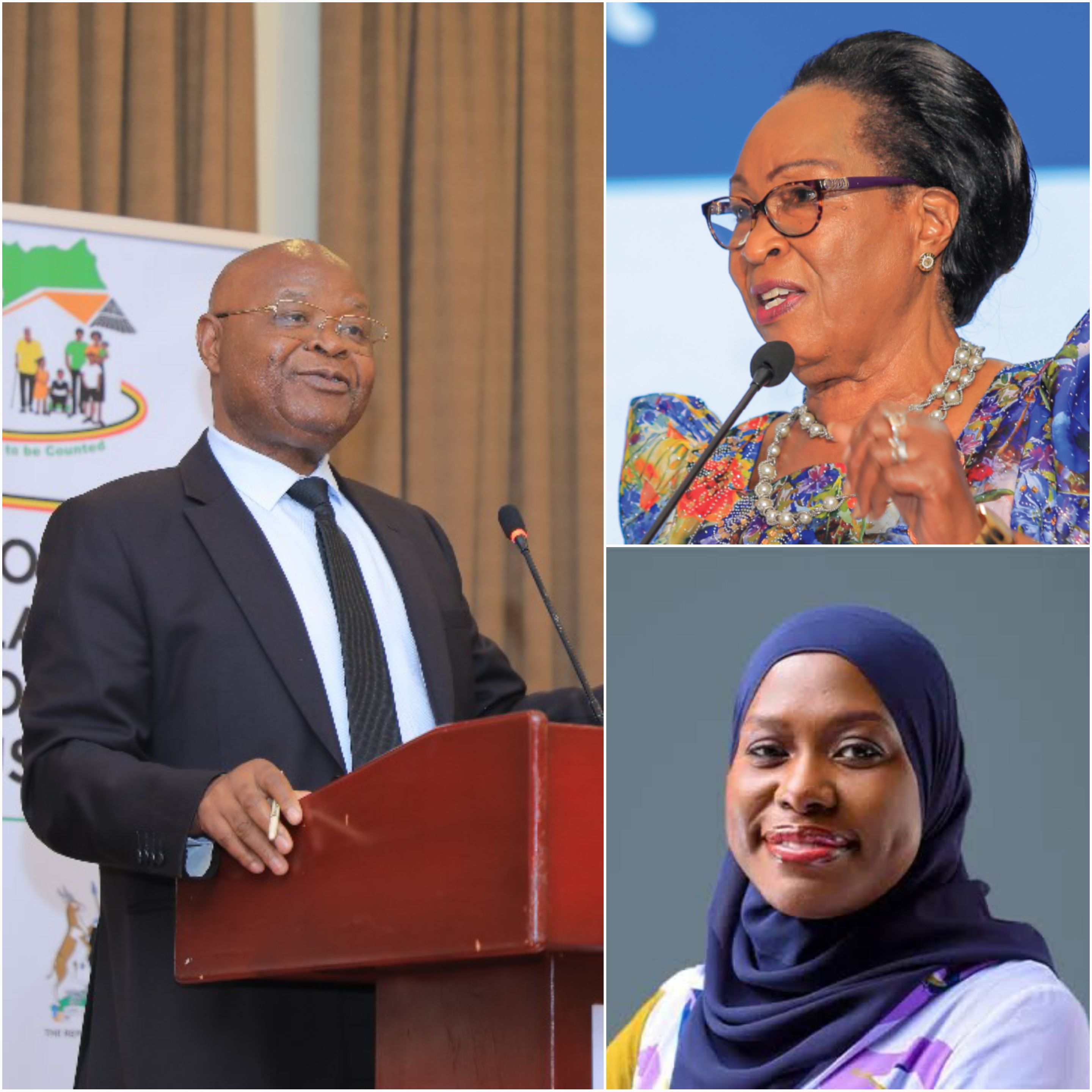
SCIENCE BODY IN MESS! Serruka, Wanyenze UNCST On Spot as Billions Stall, Machines Rust Amidst Procurement Chaos
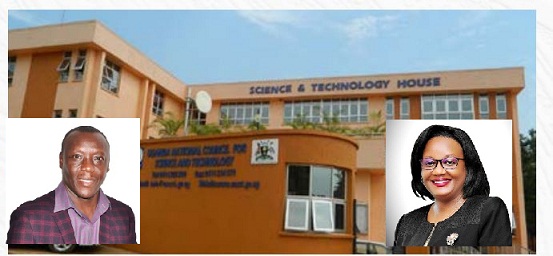
A storm is brewing at the Uganda National Council for Science and Technology as the Auditor General’s December 2025 report lays bare a trail of systemic failures, weak controls and shocking inefficiencies under the watch of Acting Executive Secretary Dr. David Serruka and the powerful Governing Council chaired by Prof. Rhoda Wanyenze.
The line ministry for the Uganda National Council for Science and Technology is the Ministry of Science, Technology and Innovation – Office of the President under Dr.Monica Musenero.
The Council, inaugurated in August 2024 and packed with some of the country’s top academic and technical minds, now finds itself under intense scrutiny as the audit exposes an institution struggling to deliver on its mandate despite heavy funding and strategic positioning at the heart of Uganda’s science and innovation agenda.
At the center of the unfolding drama is a pile of unpaid money, with the report revealing that “UNCST had outstanding receivables of UGX.2.11Bn at the end of the financial year,” raising immediate concerns about revenue collection and financial discipline. But this is just the tip of the iceberg.
Procurement, often a magnet for controversy, appears deeply compromised. The Auditor General found that the Council “did not indicate procurements reserved for registered Associations in its procurement plan as required by the PPDA guidelines,” effectively sidestepping established rules. Worse still, out of 26 planned procurements worth UGX.15.28Bn, two procurements worth UGX.12.98Bn were not implemented by the end of the financial year, a staggering gap that points to planning paralysis.
The irregularities deepen with revelations that five procurements conducted under the request for quotation method had shortlists below the required minimum, while seven bidders were shortlisted despite not being on the prequalified list. In six procurements worth UGX.1.12Bn, the Council outright failed to comply with evaluation criteria, raising red flags about fairness, transparency and value for money.
Even when contracts were awarded, execution dragged painfully. The report notes that “on average, there were contract performance delays of 98 days in two (2) procurements worth UGX.85.49Mn,” signaling inefficiencies that could derail critical projects.
Meanwhile, millions worth of equipment lies idle. In a revelation that has stunned observers, the Auditor General states that the Council had “112 engineering machinery/equipment that had not been effectively utilized during the year.” In a country pushing for industrialization and skills development, such underutilization is being viewed as a glaring waste of resources.
The chaos extends to asset management, with the Council operating without a formal policy and lacking documented procedures to monitor utilization. Even basic record-keeping is in disarray, as UNCST “did not have maintenance logs for other assets like computers, printers, generators other than vehicles and heavy equipment and machinery,” leaving critical infrastructure exposed to neglect and breakdown.
On the strategic front, the picture is equally grim. During the implementation of its strategic plan, the Council realized UGX.13.8Bn out of a total budget of UGX.155Bn, resulting in massive underfunding. To make matters worse, the audit found that targets in the strategic plan were not even properly quantified, and some assessed performance indicators differed from those originally set, throwing the entire planning framework into question.
Even as a new strategic plan for 2025/26–2029/30 sits awaiting approval, the current one appears to have been implemented without clear benchmarks, leaving observers wondering how performance was measured in the first place.
Funding gaps continue to haunt the institution. Out of a Government of Uganda budget of UGX.28.16Bn approved by the Governing Council, only UGX.12.3Bn was appropriated by Parliament, creating an underfunding of UGX.15.86Bn. Development partner funding also fell short, with only UGX.1.37Bn received out of UGX.3.84Bn expected, deepening the financial strain.
Ironically, the Council exceeded its own revenue target, collecting UGX.1.147Bn against a budget of UGX.1.0Bn, but this lone bright spot is overshadowed by widespread implementation failures. Out of 22 planned outputs worth UGX.2.9Bn, only 13 were fully implemented, six were partially achieved and three were not implemented at all.
Oversight mechanisms appear virtually absent. The Auditor General observed that UNCST “did not have an annualized M&E framework and there were no specific strategic plan M&E reports,” meaning there was no structured way to track progress or evaluate impact.
Even in high-profile projects, the cracks are evident. The National Science Technology Engineering and Innovation Skills Enhancement Project (NSTEI-SEP), a five-year initiative partly funded by a loan from China’s Exim Bank, achieved full donor disbursement of USD 84.63 million, with USD 78.63 million utilized. However, UGX.13.94Bn of government counterpart funding remained unutilized, raising questions about absorption capacity.
At the Technology Innovation Business and Incubation Centre (TIBIC), the situation is equally troubling. The report highlights the absence of “an approved policy and legal framework to guide the management of innovators,” alongside missing guidelines to operationalize the multimedia centre, effectively leaving innovation support structures in limbo.
Key policy gaps persist across the board. There is no approved occupational skills development and capacity enhancement policy, and the Council lacks any formal coordination framework or partnership agreements with universities, technical institutions or private sector players—an astonishing gap for a body meant to drive national innovation.
Even basic store management has collapsed into disorder. The audit exposes “several weaknesses in stores management including failure by the requester and issuer to sign spare parts requests, inadequate spare parts issuance documentation, lack of stock cards/bins, inadequate physical access controls, and failure to do end of year stock taking,” a catalogue of lapses that opens the door to loss, theft and abuse.
As if the audit findings were not explosive enough, an IGG petition dated 16th February 2026 has added fuel to the fire, alleging chaos in the transition of the NSTEI-SEP project into a new entity dubbed EDIC under the Science, Technology and Innovation Secretariat in the Office of the President. The petition raises alarm over what it describes as an “arbitrary transition process to the non existent entity named EDIC,” and claims of irregular staffing, questionable procurements and lack of oversight.
It further alleges that project structures and facilities worth millions of dollars, including state-of-the-art engineering hubs and over 300 pieces of machinery, are being mismanaged during the transition, with concerns about illegal recruitment, unpaid staff and questionable financial transactions.
As pressure mounts, the spotlight is now firmly on Serruka, Wanyenze and the entire Governing Council to explain how an institution entrusted with driving Uganda’s science, technology and innovation agenda could sink into such widespread dysfunction. With billions underperforming, systems missing and oversight gaps glaring, the question echoing across accountability circles is simple: who will fix the mess—and who will answer for it?
GOT A HOT STORY? EMAIL: redpeppertips@gmail.
SOURCE PROTECTION/CONFIDENTIALITY IS OUR NO.1 PRIORITY.
About Post Author