ROT AT MICROFINANCE SUPPORT CENTRE! Top Bosses Face Arrest Over Sh22.67bn loss, Sh62bn Loan Write-Offs, LEGS Project Unlicensed Sacco Loans, Chaotic Lending & Idle Emyooga Billions
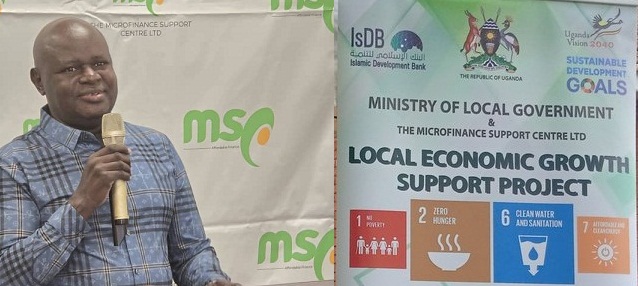
Executive Director John Peter Mujuni
KAMPALA — Trouble is deepening at the Microfinance Support Centre (MSC) after Parliament ordered the arrest of the institution’s top management for allegedly dodging a second summons to appear before lawmakers and answer questions over billions of shillings in losses, loan write-offs and other financial management failures.
The Committee on Commissions, Statutory Authorities and State Enterprises (COSASE) on Tuesday ordered the arrest of MSC Executive Director and Chief Executive Officer John Peter Mujuni and the institution’s directors after they failed to honour a second invitation to appear before the committee.
The dramatic order was issued by COSASE chairperson Muwada Nkunyingi, who accused the MSC bosses of deliberately refusing to face Parliament despite being summoned to explain queries raised in the Auditor General’s report.
The officials were expected to account for the institution’s financial management and performance, but their failure to appear has now turned a financial accountability investigation into a confrontation over parliamentary oversight.
Nkunyingi said the committee had invited the MSC management twice, but the top executives had failed to appear.
He warned that COSASE would use its powers to compel the officials to appear, including ordering their arrest.
The arrest order comes at a particularly difficult time for MSC, with the Auditor General’s report for the financial year 2024/2025 exposing a staggering Sh22.67 billion loss at the institution.
The audit also revealed that loans worth more than Sh63 billion had been written off, raising serious questions about the institution’s ability to protect public funds and recover money advanced to beneficiaries.
The Auditor General flagged a string of weaknesses in the management of the loan portfolio, including outdated collateral, weak loan recovery mechanisms, poor performance of restructured loans, inadequate monitoring and under-collection of outstanding loans.
Some of the loan securities, Parliament was told, had remained outdated for as long as nine years, exposing public funds to increased risk.
The figures have left lawmakers demanding answers over how an institution entrusted with supporting Ugandans through affordable financing could accumulate such huge losses and write off billions in loans.
The committee was also told about problems surrounding funds under the Emyooga programme.
According to the audit findings, Sh13.21 billion remained unutilised and was returned at the end of the financial year, prompting further questions about planning, absorption of funds and the institution’s management of government programmes.
The Auditor General also pointed to weaknesses in procurement, including failure to fully implement planned procurements, inadequate mechanisms for tracking performance and weaknesses in the management of the institution’s non-current assets.
The revelations have triggered growing concern among legislators, with some warning that MSC could be heading towards a crisis unless its management and financial controls are urgently overhauled.
Nakifuma County MP Robert Ssekitoleko said MSC management must be compelled to account for public funds.
Budadiri East MP Julius Nakiyi went further, warning that MSC could be heading towards collapse if urgent corrective measures were not taken.
Jinja South MP Timothy Batuwa also questioned the disbursement of loans to beneficiaries whose identities and eligibility he questioned, particularly in light of the more than Sh63 billion in loans written off.
Batuwa called for the Ministry of Finance to freeze further disbursements to MSC until the institution accounts for funds already committed. He also recommended the removal of the chief executive.
But the biggest immediate battle is now over the refusal of MSC’s top brass to appear before COSASE.
Nkunyingi said Parliament would not allow government agencies and state enterprises to selectively decide when to appear before parliamentary committees.
He accused MSC of previously seeking protection from the Speaker of Parliament following an earlier invitation, but said the current Parliament had made its position clear: accounting officers must personally appear and account for public resources.
“We shall not inherit any syndicate,” Nkunyingi said, insisting that every Auditor General’s report submitted to COSASE would be subjected to scrutiny.
Nkunyingi further rejected any suggestion that MSC’s corporate status could shield its officials from parliamentary accountability.
He said the Government of Uganda has an interest and shareholding in the institution, meaning its managers cannot use the company structure to escape scrutiny over public resources.
The committee, he said, would not only investigate the failure to attend the hearing but would also examine why MSC had repeatedly sought to avoid parliamentary scrutiny and whether individuals or institutions had attempted to shield the entity from accountability.
The confrontation comes as the new COSASE leadership appears determined to flex Parliament’s oversight muscle against government agencies, public corporations and state enterprises.
The committee’s action against MSC follows a warning by Speaker Jacob Marksons Oboth-Oboth, who last week cautioned accounting officers against dodging interfaces with parliamentary committees.
MSC is now the second government entity in two days to be forced to appear before COSASE.
On Monday, the committee summoned Uganda Airlines Chief Executive Officer Girma Wake and members of the airline’s top management after they failed to appear for a scheduled interface.
Unlike MSC, however, Uganda Airlines subsequently communicated with the committee and explained its absence.
Girma wrote to COSASE on Tuesday morning, indicating that the airline’s management team would be available to interface with the committee on Thursday as scheduled.
LEGS MONEY ALSO UNDER SPOTLIGHT
The MSC accountability storm is unfolding alongside questions over its involvement in the multibillion-shilling Local Economic Growth Support Project (LEGS), a major government programme designed to lift millions of Ugandans out of poverty.
The $150 million project, worth approximately Sh545 billion, is being implemented through the Ministry of Local Government with financing from the Government of Uganda, the Islamic Development Bank and the Lives and Livelihoods Fund.
The programme is intended to improve household incomes and reduce poverty in dry and remote rural areas by supporting agriculture, water access, agro-processing, local enterprises and financial inclusion.
But instead of a smooth rollout, the project has become entangled in land disputes, financial accountability questions and implementation problems.
One of the major concerns involves the ownership of land on which infrastructure financed under the project has been constructed.
The ownership of part of the land on which the Rwakibira Valley Dam in Gomba District was constructed is contested by a private individual.
In Nakaseke District, the problem is even more direct, with the land on which the Katalekamese market shade was constructed being privately owned.
The findings raise questions over how the land was identified, verified and secured before public money was committed to the projects.
And now MSC’s handling of LEGS financing has itself come under the microscope.
SH2.73BN LOANS TO PRIVATE COMPANIES
During the financial years ended June 30, 2024 and June 30, 2025, MSC disbursed loans amounting to Sh2.73 billion to private companies, according to the findings.
The disbursements were contrary to provisions contained in the financing agreement.
The revelation has placed project managers and responsible officials under pressure to explain how the money ended up with private companies despite the conditions governing the financing arrangement.
The concern is particularly significant because LEGS is supposed to support local economic growth, household incomes and rural enterprises.
SH216.53M UNACCOUNTED FOR
Another financial headache involves Kyenjojo District Local Government.
The project advanced Sh216.53 million to the district to facilitate dairy breed and nutritional improvement.
However, the money was not accounted for.
The missing accountability has raised questions about the controls used to track project funds transferred to local governments and whether those responsible for supervising implementation and financial reporting can account for how the money was utilised.
PROJECTS THAT ARE NOT WORKING AS EXPECTED
Physical inspection of projects funded under LEGS also uncovered a number of problems.
At Magoma Market shed in Nakaseke District, the facility was found to be under-utilised, raising questions about whether some of the infrastructure is adequately matched to the needs of the communities it was designed to serve.
At Kiwoko in Nakaseke, the maize processing plant was found to be small and lacking proper ventilation, with the inadequate ventilation identified as a health risk.
The findings have raised questions about the planning and design of the facility before construction and whether it meets the operational requirements of a maize processing plant.
The water component of the project has also run into trouble.
Part of the water supply system for Kinoni in Nakaseke District had not been constructed because there was no access road to the proposed site.
A project intended to improve access to water was therefore unable to complete part of its planned infrastructure because the proposed location could not be adequately accessed.
The finding underscores the importance of proper site assessment and coordination before public infrastructure projects are undertaken.
SH545BN PROJECT TARGETS 16M UGANDANS
The scale of the programme makes the accountability concerns even more significant.
LEGS was initially implemented in 17 districts, but its second phase has expanded to 55 districts and is expected to benefit nearly 16 million Ugandans.
The programme is designed to boost crop yields through better seeds, tractors and irrigation, improve access to safe water, construct storage facilities and processing plants, improve market roads and strengthen financial inclusion.
It also targets youth, women and disabled entrepreneurs through microfinance and other enterprise support.
The second phase is a five-year programme focusing on climate change, youth and women entrepreneurship, small-scale irrigation, agro-processing and improved post-harvest handling.
It is being implemented by the Ministry of Local Government with financing from the Lives and Livelihoods Fund, the Islamic Development Bank and the Government of Uganda.
The expansion to 55 districts means that weaknesses already exposed in project management could have implications far beyond the areas where the inspected projects were located.
For MSC, the parliamentary storm therefore comes at a time when the institution is already facing serious questions over its own financial performance, loan recovery and management of public resources.
With a Sh22.67 billion loss, more than Sh63 billion in written-off loans, Sh13.21 billion in unutilised Emyooga funds, and questions over billions disbursed under programmes such as LEGS, COSASE now wants the men and women at the top to come and explain.
Instead, the committee says, the MSC leadership has repeatedly stayed away.
That refusal has now triggered the arrest order.
The next showdown will determine whether the MSC bosses finally walk into Parliament to answer the questions—or are brought before the committee under the force of the law.
GOT A HOT STORY? LET US KNOW!
Got breaking news, explosive secrets, or hard evidence?
Email us: redpeppertips@gmail.com
We accept tips, documents, videos, photos, and recordings—the more evidence you have, the better.
CONFIDENTIALITY IS OUR TOP PRIORITY. SOURCES ARE ALWAYS PROTECTED!
About Post Author