ROTARY WARS EXPLODE! Kampala Ssese Islands Club Bosses Dragged To Court Over Illegal Purge, Abuse Of Power & Governance Chaos

Dr. Can.Kahigiriza
A bitter power struggle has exploded inside the Rotary Club of Kampala Ssese Islands after a group of newly recruited members threatened to drag the club leadership to court over what they describe as unlawful suspensions, illegal expulsions, abuse of office, manipulation of club structures and blatant violation of principles of natural justice.
The stunning fallout has now exposed deep divisions, bitter internal wrangles, allegations of intimidation, governance chaos and abuse of authority within one of the city’s known Rotary clubs, with senior club leaders now facing possible personal liability in court.
Red Pepper has exclusively landed on various leaked dossiers which established that the war erupted after some newly joined members within the club leadership hierarchy started questioning the conduct, governance systems and operations of some senior and long-serving members within the club.
Sources familiar with the explosive fallout say the new members attempted to raise concerns regarding accountability, procedural conduct, committee operations and governance standards inside the club, something that reportedly rattled sections of the old guard and past presidents who allegedly moved swiftly to silence them.
The aggrieved members are identified as Ronald Samuel Wanda, John Martin Sekwe, Robert Byamukama, Gladys Edwards Namala and Nelson Turyatemba.
The group, through Kiiza & Mugisha Advocates of Plot 88 Ben Kiwanuka Street, Master Plaza, First Floor Room F10, has already issued a powerful notice of intention to sue the club leadership and several individuals in their personal capacities over what they describe as unconstitutional, unfair and unlawful disciplinary actions.
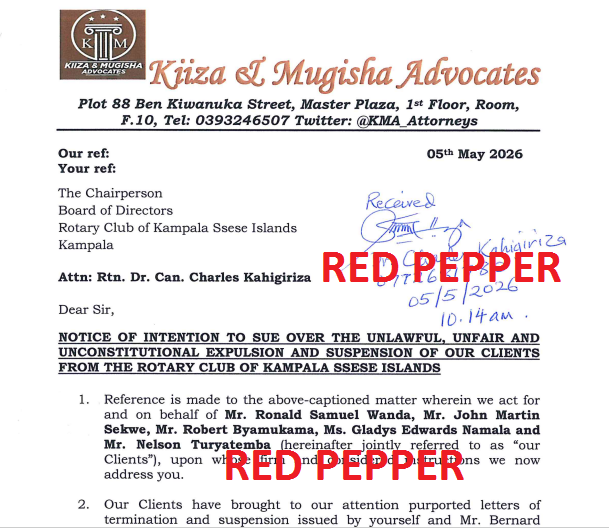
The explosive legal notice dated May 5, 2026 and addressed to the Chairperson Board of Directors of the Rotary Club of Kampala Ssese Islands-Dr. Can. Charles Kahigiriza, accuses the club leadership of trampling on the constitutional rights of members while disregarding the club’s own bylaws and governance procedures.
The notice, received by Kahigiriza who is also Ndejje University Secretary on May 5, 2026 at 10:14am, directly attacks purported suspension and termination letters allegedly issued by the leadership and signed by Charles Kahigiriza together with Bernard Ochan, a dean of students at Cavendish University.
According to the lawyers, the disciplinary actions violated Articles 17, 20, 28, 42, 43 and 44 of the Constitution of Uganda and offended the principles of fair hearing, administrative justice and natural justice.
The lawyers argue that the disciplinary process was fundamentally defective and violated the legal principles of “audi alteram partem”, meaning every side must be heard, and “nemo judex in causa sua”, meaning no person should sit as a judge in their own matter.
The legal notice further claims that the disciplinary process suffered from lack of quorum, lack of jurisdiction and procedural impropriety by individuals who allegedly exercised powers they did not legally possess.
The aggrieved members also accuse the leadership of imposing punitive measures that were oppressive, excessive and grossly disproportionate.
The crisis has since opened a floodgate of damaging allegations against top club officials.
Club President Deborah Itwau Ongwech has been accused of abuse of authority, disregarding club and Rotary district structures, encouraging procedural irregularities, failing to provide accountability to members, manipulating committee reports, undermining the management board and misguiding both club committees and the board of directors.
Sources say her leadership style has become a major source of friction within the club as divisions continue to widen between older members and newer entrants questioning governance practices.
The Chairperson of the Disciplinary Committee, Medard Muganzi, is also facing heavy accusations including abuse of authority, manipulation of reports, intimidation of committee members, disregard of club structures, bias and failure to account to the club.
Meanwhile, Board Chairperson Charles Kahigiriza is accused of abuse of authority, absenteeism from club activities, misguiding the board of directors, bias, accepting to be manipulated by the club president and undermining club bylaws and governance systems.
But perhaps the most explosive allegations are directed at Andrew Lugalambi, who insiders claim has allegedly been operating behind the scenes engineering chaos within the club.
Rumors within the club allege that Lugalambi has been manipulating the president, undermining established club structures, spreading rumors against members, disrespecting club leaders and ordinary members, misleading past presidents, interfering in management affairs, intimidating members and undermining club bylaws.
Sources say the internal tensions became more pronounced after younger and recently recruited leaders reportedly started demanding accountability and questioning certain practices by the old guard, something that allegedly triggered retaliation from senior members determined to protect their influence within the club.
The legal notice by Kiiza & Mugisha Advocates paints a picture of a deeply divided club where governance structures allegedly collapsed under power struggles and procedural irregularities.
The lawyers argue that under Article II Section 1 of the club bylaws, the Board of Directors is merely a non-executive oversight body and is not supposed to directly interfere in management operations or disciplinary execution.
The aggrieved members insist that the Board illegally overstepped its mandate by directly receiving and acting on disciplinary committee reports instead of allowing the Management Board to handle the process as required under the club bylaws.
The notice further argues that authority to implement disciplinary decisions belongs exclusively to the Management Board and Club Assembly under Article XI Sections 13(4)(iii) and (iv), 13(f)(iv) and 13(h) of the bylaws.
The lawyers accuse the club leaders of acting “ultra vires”, meaning beyond their legal powers, thereby rendering all disciplinary decisions null and void from the beginning.
The legal team further says the conduct of the leadership amounted to administrative caprice, illegality and unfairness that cannot go unchallenged.
In one of the strongest sections of the notice, the lawyers demanded that the club leadership immediately and unconditionally reverse, withdraw and expunge all suspension and termination decisions and related communications.
The lawyers also demanded several key governance documents including records of proceedings of the Disciplinary Committee and its report, minutes of the Board of Directors discussing the disciplinary report, minutes of the Management Board appointing Nelson Kabwama and Julianne Mweheire to the disciplinary committee and minutes of the Club Assembly approving their appointments.
The lawyers warned that failure to comply would trigger immediate court proceedings seeking declarations, injunctions, monetary compensation and legal costs.
The notice further warns that several club officials would personally be sued in their individual capacities for violating the rights and freedoms of the aggrieved members and would be held jointly and severally liable.
Those copied on the legal notice include Rtns’ Deborah Itwau Ongwech, Bernard Ochan, Julianne Mweheire, Medard Muganzi, Leonard Balwetera, Nelson Kabwama, Ivan Kasambeko, Laura Orobia and the Board of Directors of the Rotary Club of Kampala Ssese Islands.
GOVERNANCE QUESTIONS
The growing governance storm inside the Rotary Club of Kampala Ssese Islands has now sparked deeper reflection and scrutiny regarding whether the processes followed in suspending and terminating members were lawful, procedurally proper and consistent with both the Constitution and Bylaws governing the club.
One of the biggest questions now dominating discussions among members and governance observers is whether the correct procedure was actually followed before the drastic action of suspending and terminating members was taken.
The starting point for any discussion on the termination and suspension of members must be whether the process followed was procedurally sound and consistent with the club’s governing documents.
The Constitution and Bylaws provide a detailed, multi-step framework for handling member discipline.
The critical question being raised is whether each step was faithfully observed before the Board took the drastic action of terminating and suspending members.
Governance experts within the club argue that due process is not merely a legal formality.
They insist that due process is a safeguard of fairness, a protection of the club’s integrity and a cornerstone of the Rotary ideal of high ethical standards.
According to governance concerns circulating among members, any shortcut in the process, however well intentioned, can expose the club to legal challenges and reputational harm.
Another major issue now attracting heated debate is whether the Board of Directors acted within its lawful mandate.
Under the Bylaws, specifically Table B Article II Section 1, the Board of Directors is explicitly described as a non-executive body whose primary role is oversight and supervision of the Management Board.
Section 1(b) reportedly states that “The Board of Directors shall not ordinarily interfere with the operations of the Management Board save for any duties that may arise by virtue of their membership in the Club.”
The Board’s defined responsibilities reportedly center on long-term strategy, major corporate decisions, governance and compliance rather than day-to-day disciplinary matters.
This has now triggered serious questions within the club.
Members are asking whether the Board of Directors overstepped its mandate by directly receiving a Disciplinary Committee report and acting on it by terminating and suspending members without that report first passing through and being acted upon by the Management Board.
Some members now question whether the Board’s actions constituted interference with Management Board operations contrary to what the Bylaws expressly caution against.
Another contentious issue now dominating internal discussions is whether alternative dispute resolution mechanisms were genuinely exhausted before the conflict escalated into suspensions and expulsions.
The club’s governing documents reportedly contain layered conflict resolution mechanisms intended to resolve disputes before matters escalate into formal disciplinary action.
According to concerns raised within the club, the Bylaws under Article XII on Conflict Resolution establish a three-step procedure.
The first step reportedly requires a member to discuss a complaint with the Membership Committee Chairperson for mediation.
Secondly, if unresolved, the matter is supposed to move to the Disciplinary Committee Chairperson.
Thirdly, if still unresolved, the matter is then escalated to the President or the Board of Directors where the President is conflicted.
Similarly, the Constitution under Table A Article XI Sections 5, 6 and 7 reportedly provides for notices, hearings, rights of appeal, arbitration and mediation before membership termination for cause.
Article XVI reportedly further provides for arbitration as a dispute resolution mechanism.
This has now raised a critical governance question.
Were these mechanisms genuinely engaged and exhausted or was the Disciplinary Committee route pursued prematurely while bypassing opportunities for amicable resolution?
Governance analysts now argue that failure to exhaust these mechanisms may render the entire process procedurally defective.
The controversy has also triggered fierce debate regarding whether it was procedurally correct for the Disciplinary Committee report to bypass the Management Board.
According to governance concerns now circulating among members, the Bylaws and Article XI Section 13(d)(iv) explicitly state that the Disciplinary Committee shall make recommendations to the Management Board after the hearing and offer its verdict and recommendations.
Section 13(g) reportedly confirms that the Committee’s decision is forwarded to the Board, which governance analysts interpret to mean the Management Board that then assesses the verdict and advises the club on execution.
The chain of command according to critics is therefore supposed to be Disciplinary Committee to Management Board and then onward action.
The critical governance question now consuming the club is whether the Disciplinary Committee’s report was instead taken directly to the Board of Directors while bypassing the Management Board entirely.
Governance observers argue that if this happened, it would represent a clear deviation from the procedures prescribed in the Bylaws.
Critics further insist that no clause in the Bylaws appears to authorize the Disciplinary Committee to report directly to the Board of Directors while bypassing the Management Board.
Many members are now demanding clarification from the club leadership regarding this procedural gap.
Another governance question now arising directly from the same controversy is exactly to whom the Disciplinary Committee reports.
The Bylaws under Article XI Section 13(d)(iv) reportedly state that once the Committee has heard and disposed of a complaint, the same shall be forwarded to the Board which shall in turn assess the verdict and advise the club on execution of the verdict.
Section 13(h) reportedly further states that the Disciplinary Committee shall report to the Management Board of the club.
When read together, governance observers argue that the Bylaws indicate that the Disciplinary Committee’s primary reporting line is to the Management Board and not directly to the Board of Directors.
The Management Board would then process the recommendations and where appropriate involve or inform the Board of Directors.
The club is now being asked to clarify whether the Management Board was engaged at all in the matter under discussion.
Questions are also being raised about whether failure to involve the Management Board invalidated the disciplinary actions that were eventually taken.
The dispute has further reignited intense debate surrounding the principle of natural justice and conflict of interest.
Governance observers insist that the laws of natural justice rooted in the principles that no person should be a judge in their own cause and that every party must be heard are universally recognized and embedded within the club’s Bylaws.
Article XI Section 13(f)(i) reportedly guarantees the right to a fair hearing and requires that a member be given adequate time to respond to allegations.
Critics now argue that if the President or any member of the Disciplinary Committee had a personal interest in or conflict regarding the subject matter of the proceedings, natural justice demanded that they completely recuse themselves.
This has now triggered serious internal debate.
Members are asking whether any member of the Disciplinary Committee or Management Board was conflicted in the matter.
If so, did they recuse themselves?
Were replacement members appointed in accordance with the procedures outlined in the Bylaws?
Governance experts now warn that failure to ensure unconflicted decision-making taints the entire process and undermines the legitimacy of the outcome.
The question of confidentiality regarding the Disciplinary Committee report has also become another major point of contention.
According to Article XI Section 13(b), the Disciplinary Committee reportedly receives grievances of misconduct in writing.
The Bylaws reportedly further require that the Committee’s decisions and recommendations be forwarded to the Management Board which then advises the club on execution.
Governance observers now say the issue of confidentiality is therefore highly nuanced.
While details of disciplinary proceedings may carry some expectation of privacy intended to protect the dignity of parties involved, critics argue that the outcome especially where termination or suspension is involved must still be communicated to the Management Board and eventually to the membership through the appropriate process.
This has now sparked further questions.
Was the Disciplinary Committee report treated as entirely confidential in a way that prevented the Management Board from performing its oversight role?
Or was the report improperly shared and weaponized against accused members in ways that violated privacy and dignity?
Governance observers warn that both extremes carry serious risks for the club.
Perhaps the most urgent issue now facing the suspended and terminated members concerns the right of appeal.
The Constitution under Article XI Section 6 reportedly provides a framework for appeal or arbitration following termination.
According to governance discussions now circulating within the club, within seven days of the Board’s decision to terminate membership, the secretary is supposed to give written notice to the affected member.
Within fourteen days of receiving that notice, the member may reportedly notify the secretary in writing of the intention either to appeal to the club or to pursue arbitration as provided under Article XV.
If the member elects to appeal, the Board is reportedly required to set a hearing date within twenty one days at a regular club meeting with at least five days written notice to all members.
The appeal would then reportedly be heard by the membership and the decision of the Board can only be reversed by a two-thirds vote of members present at that meeting provided quorum exists.
Where arbitration is chosen, each party reportedly appoints a Rotarian arbitrator and those arbitrators then appoint a Rotarian umpire whose decision becomes final and binding.
However, the current dispute has exposed a dangerous governance complication.
Critics argue that the Constitution appears to anticipate that termination decisions originate from the Management Board through the Disciplinary Committee process.
Yet in this particular matter, the terminations and suspensions were allegedly effected by the Board of Directors.
This has now raised difficult structural questions.
Can the Board of Directors review and reverse its own decision?
Can the full club membership override the Board of Directors in the same way they can reportedly override the Management Board?
Governance observers now say the club’s legal advisors and leadership urgently need to address this gap to ensure that aggrieved members are not left without a meaningful remedy.
As the crisis deepens, many members now believe the leadership of the Rotary Club of Kampala Ssese Islands should treat the controversy not merely as a disciplinary matter but as an opportunity to strengthen governance culture, close procedural gaps and reaffirm principles of fairness, transparency and rule of law.
The ongoing storm has now transformed from a simple internal disagreement into a major governance battle threatening the image, unity and future stability of the club.
With court action looming, reputations on the line and allegations of abuse of office flying in all directions, the once prestigious club now finds itself battling a dangerous storm threatening to expose even deeper cracks within its leadership and governance systems.
The dispute has now exposed glaring gaps in the club’s governance systems especially concerning appeals and arbitration processes where members claim the bylaws do not clearly address situations where disciplinary decisions originate directly from the Board of Directors.
What started as internal questioning of governance practices inside the Rotary Club of Kampala Ssese Islands has now escalated into a full-blown legal and governance war threatening to tear apart the club’s leadership structures while exposing bitter factional battles between old power brokers and new entrants demanding accountability and procedural fairness.
Rotary Club of Kampala Ssese Islands has been contacted for a comment.
Watch this space. More details to follow!
GOT A HOT STORY? EMAIL: redpeppertips@gmail.
SOURCE PROTECTION/CONFIDENTIALITY IS OUR NO.1 PRIORITY.
About Post Author